
SGK Tiếng Anh 8 - Unit 16: Inventions
UNIT 16
INVENTIONS
GETTING STARTED.
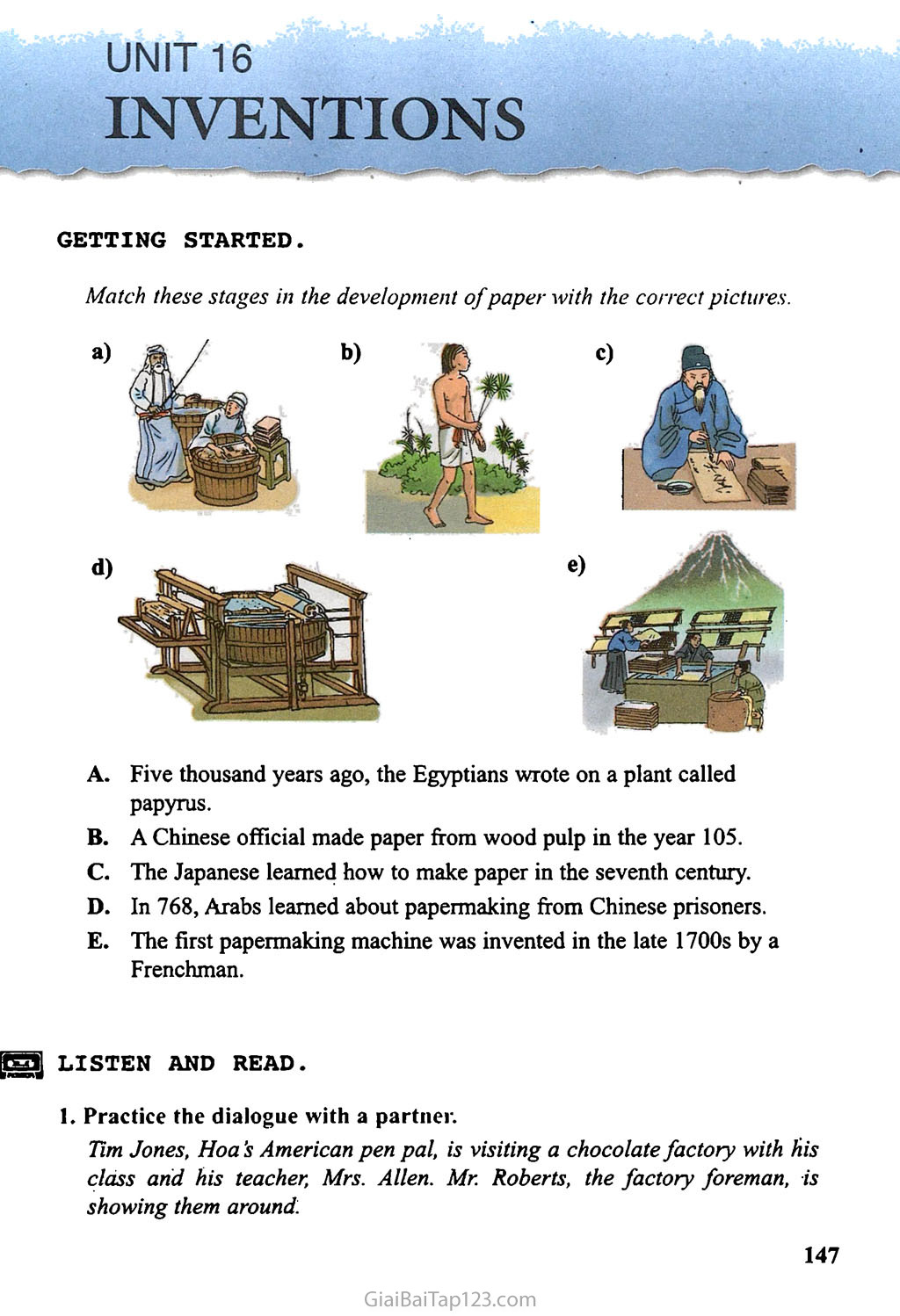
Match these stages in the development of paper with the correct pictures.
A. Five thousand years ago, the Egyptians wrote on a plant called
papyrus.
B. A Chinese official made paper from wood pulp in the year 105. c. The Japanese learned how to make paper in the seventh century.
In 768, Arabs learned about papermaking from Chinese prisoners.
The first papermaking machine was invented in the late 1700s by a Frenchman.
gsg LISTEN AND READ.
1. Practice the dialogue with a partner.
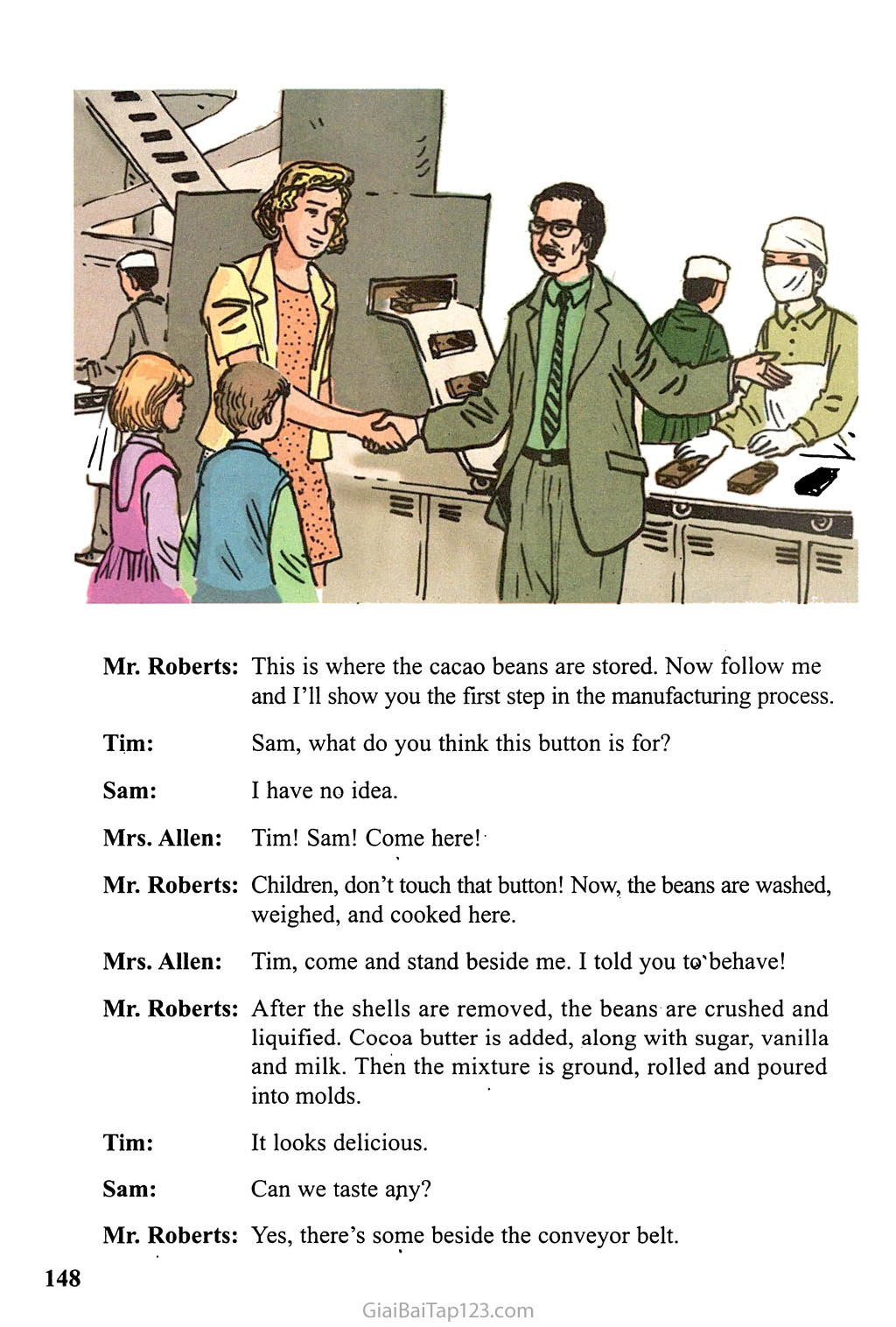
Tim Jones, Hoa s American pen pal, is visiting a chocolate factory with his class and his teacher, Mrs. Allen. Mr. Roberts, the factory foreman, is showing them around.
Mr. Roberts:
This is where the cacao beans are stored. Now follow me and I’ll show you the first step in the manufacturing process.
Tim:	Sam, what do you think this button is for?
Sam:	I have no idea.
Mrs. Allen: Tim! Sam! Come here!
Mr. Roberts: Children, don’t touch that button! Now, the beans are washed, weighed, and cooked here.
Mrs. Allen: Tim, come and stand beside me. I told you to'behave!
Mr. Roberts: After the shells are removed, the beans are crushed and liquified. Cocoa butter is added, along with sugar, vanilla and milk. Then the mixture is ground, rolled and poured into molds.
Tim:	It looks delicious.
Sam:	Can we taste apy?
Mr. Roberts: Yes, there’s some beside the conveyor belt.
Match the half-sentences. Then book.
The beans are cleaned
Mr. Roberts thought
After cooking,
Sugar is
write the full sentences in your exercise
the cacao beans smell like chocolate.
one'of the ingredients in chocolate.
c. Tim and Sam were going to touch the button.
D. before being cooked.
SPEAK.
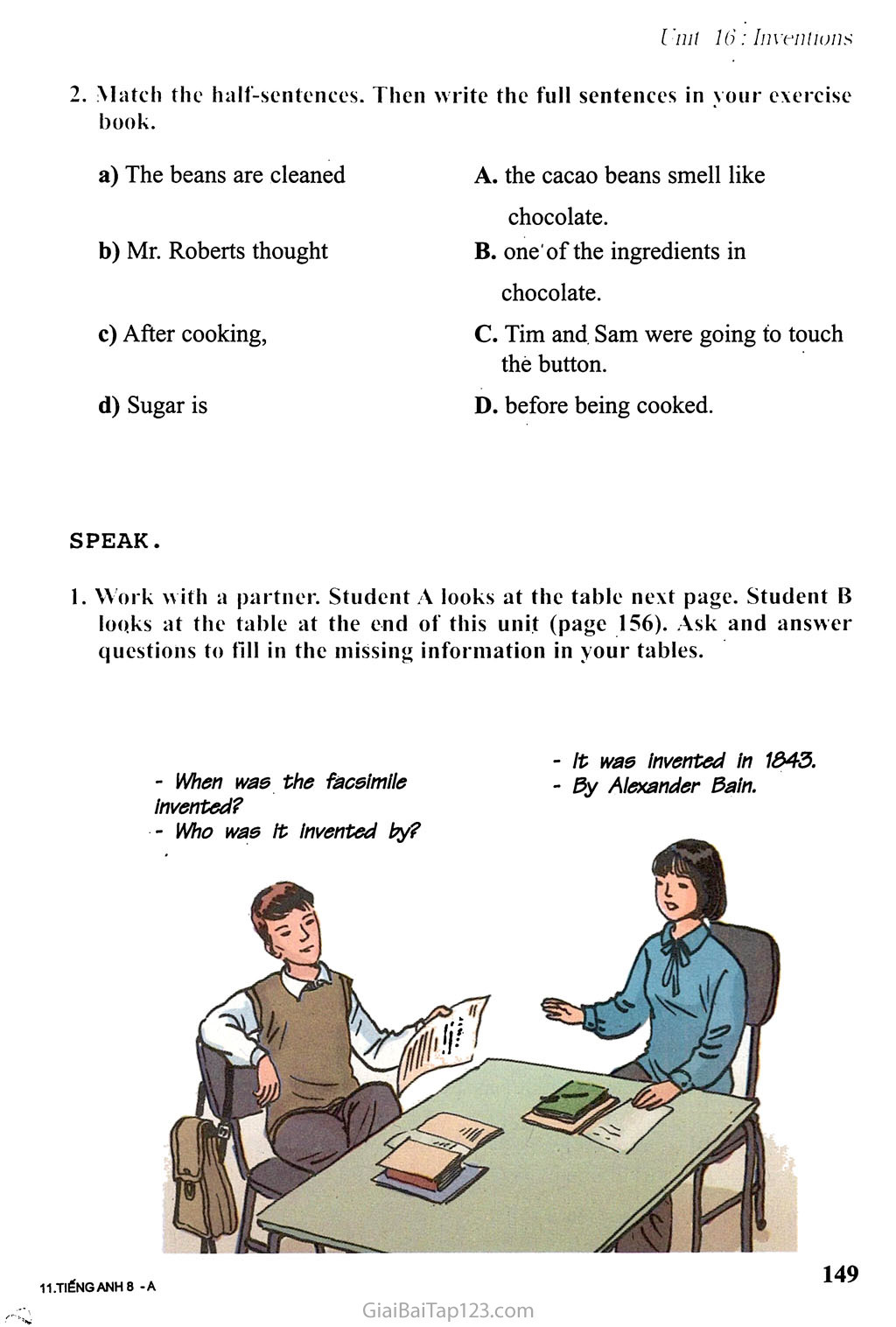
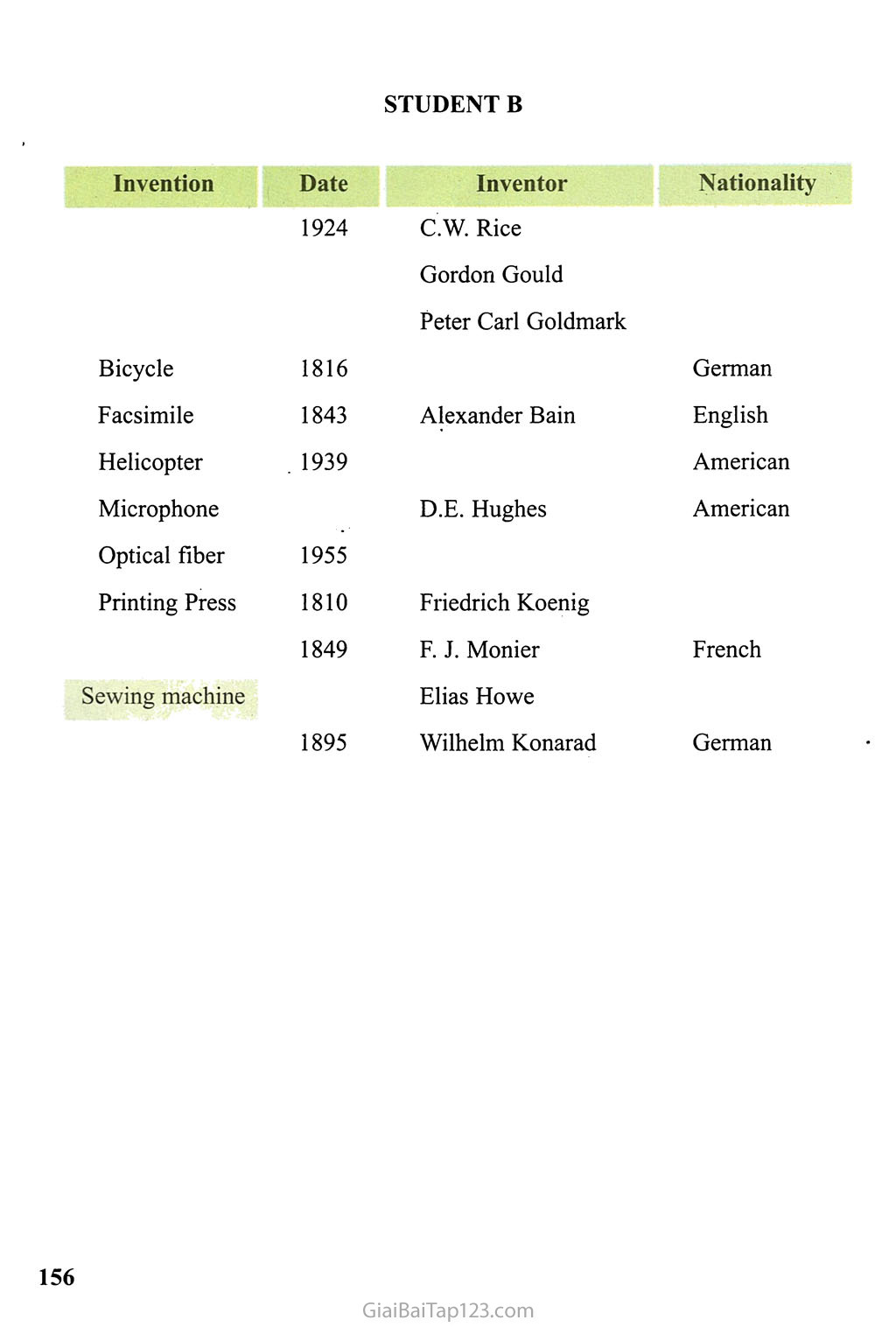
1. Work with a partner. Student A looks at the table next page. Student B looks at the table at the end of this unit (page 156). Ask and answer questions to fill in the missing information in your tables.
When was the facsimile invented?
Who was it invented by?
It was invented in 1343.
3y Alexander 3ain.
Invention
Date
Inventor
Nationality
Friedrich Koenig
German
1816
Karl D. Sauerbronn
Facsimile
1845
Elias Howe
American
Reinforced concrete
1849
Microphone
1878
X-ray
1895
Loudspeaker
1924
c.w. Rice
American
Helicopter
Igor Sikorsky
Color television
1950
Peter Carl Goldmark
American
1955
Narinder Kapany
German
Laser
1958
Gordon Gould
American
STUDENT A
2. Now report your findings to the teacher.
The facsimile was invented by Alexander Bain in 1843.
H LISTEN.
Listen and fill in the gaps in these sentences.
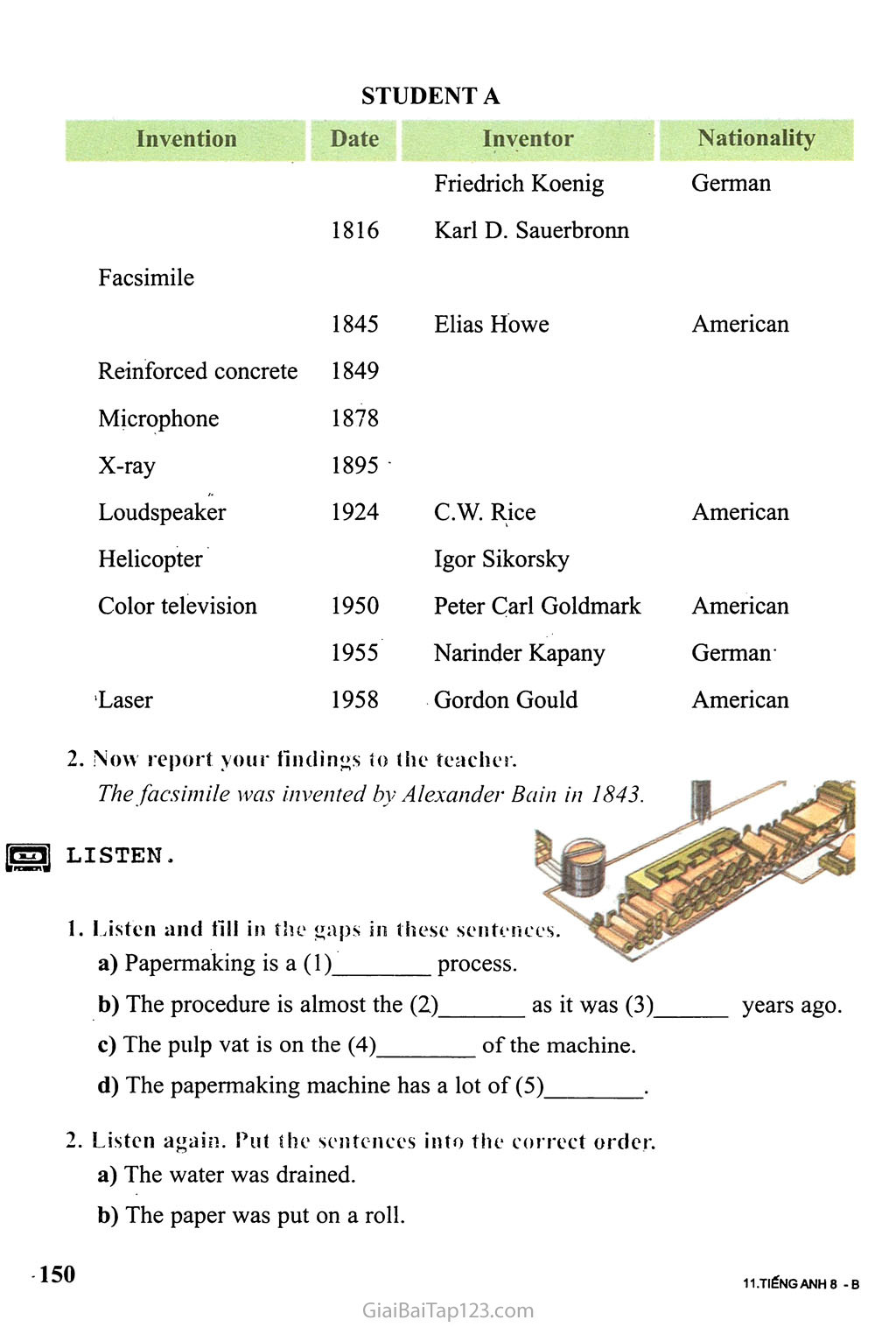
Papermaking is a (1)	process.
The procedure is almost the (2)	as it was (3)	 years ago.
The pulp vat is on the (4)	of the machine.
The papermaking machine has a lot of (5)	.
Listen again. Put the sentences into the correct order.
The water was drained.
The paper was put on a roll.
Paper pulp was placed in the vat.
Paper pulp was mixed with water.
The pulp fibers were poured out.
The fibers were smoothed and pressed dry.
The pulp was conveyed under the rollers.
Read the following poem about inventions.
READ.
V w 1
YS<
Vi
Up-to-Date
Look what I bought today in town The very latest thing A microwave that says be-doom! A toaster that goes ping!
The vacuum goes chugga-chug!
The hairdryer says vroom!
The dishwasher pulls out its plug And gives the loudest boom!
The telephone is new as well
The latest I have found
(adapted from a poem by Martin Lawrence)
It has a pretty colored bell
And doesn’t make a sound.
.1. Match the headings to the verses.
Verse 1
Verse 2
Verse 3
Instrument invented by Alexander Graham Bell
Appliances that cook food
Appliances that clean or dry things
Fill in each of the gaps in the sentences with one “invention” in the poem.
“Joan, where’s the (1)	? I want to clean the floor.”
Last night I was reading in the bedroom when the (2)	rang. It
was Ann, an old friend I didn’t see for more than twelve years.
A (3)	 is a kitchen appliance that automatically washes,
rinses, and dries dishes and utensils.
“Jane, why don’t you put the meat in the (4)	to defrost it?”
“Can I borrow your (5)	? I’ve just washed my hair.”
The Romans knew how to toast bread over an open fire two thousand
years ago. We now toast bread with a (6)	 on the table.
WRITE.
1. Fill in each gap with one of these sequence markers to describe the procedure of papermaking.
first then (2) next after this	finally
How Paper Is Made
(1)	, logs are cut into small chips. (2)	they are mixed with
water and acid. (3)	__ they are heated and crushed into a heavy pulp.
This wood pulp is also cleaned and chemically whitened. (4)	, it is
passed through rollers to be flattened. (5)	, sheets of wet paper are
produced. (6)	, the water is removed from the sheets which are
pressed, dried and refined until the finished paper is produced.
2. Look at the sequence of pictures that describe how cacao beans are processed. Put them in the correct order.
(1)	(2)	(3)
(4)	(5)	(6)
Now use the sequence markers in exercise ‘write 1.’ to link the sentences together in a paragraph.
The beans are dried in the sun.
They are shelled and ground to produce chocolate liquor.
The beans are roasted to bring out the chocolate flavor.
The fruit harvest is fermented for three to nine days to kill the beans and turn them brown.
The beans are cleared in special machines.
The liquor is made into chocolate candy or cocoa powder.
Language Focus
Passive forms
Sequence markers
Change the sentences from the active into the passive.
Example:
Miss Lien wrote the letter.
=> The letter was written by Miss Lien.
Mrs. Quyen typed the document.
Mr. Nhan repaired the computer.
Ba drew the picture.
Hoa turned off the lights.
Lan baked the cake.
Active or Passive? Use the correct form of the verbs in brackets to complete these sentences.
The grand prize 	to the Hoa Vinh Village team, (award)
Viet Nam	two gold medals on the first day of the Games, (win)
Last year Mrs. Jackson	a small business around the comer, (run)
The factory	by Quang Vinh Ltd. before it	to a
foreign firm.	(run / sell)
Thanh Ha School	for two days last week due to a flood, (close)
Put a question for each of the underlined phrases in the sentences below. Example:
The facsimile was invented by Alexander Bain in 1843.
When was the facsimile invented?
The zipper was invented by W.L. Judson in 1893.
Maize was brought into Viet Nam by Phung Khac Khoan in the 16th century.
The fountain pen was invented by Lewis Waterman in 1884.
The ballpoint pen was invented in Hungary by brothers Lazio and Georg Biro in 1935.
Xerography is widely used in commerce and industry in copying machines.
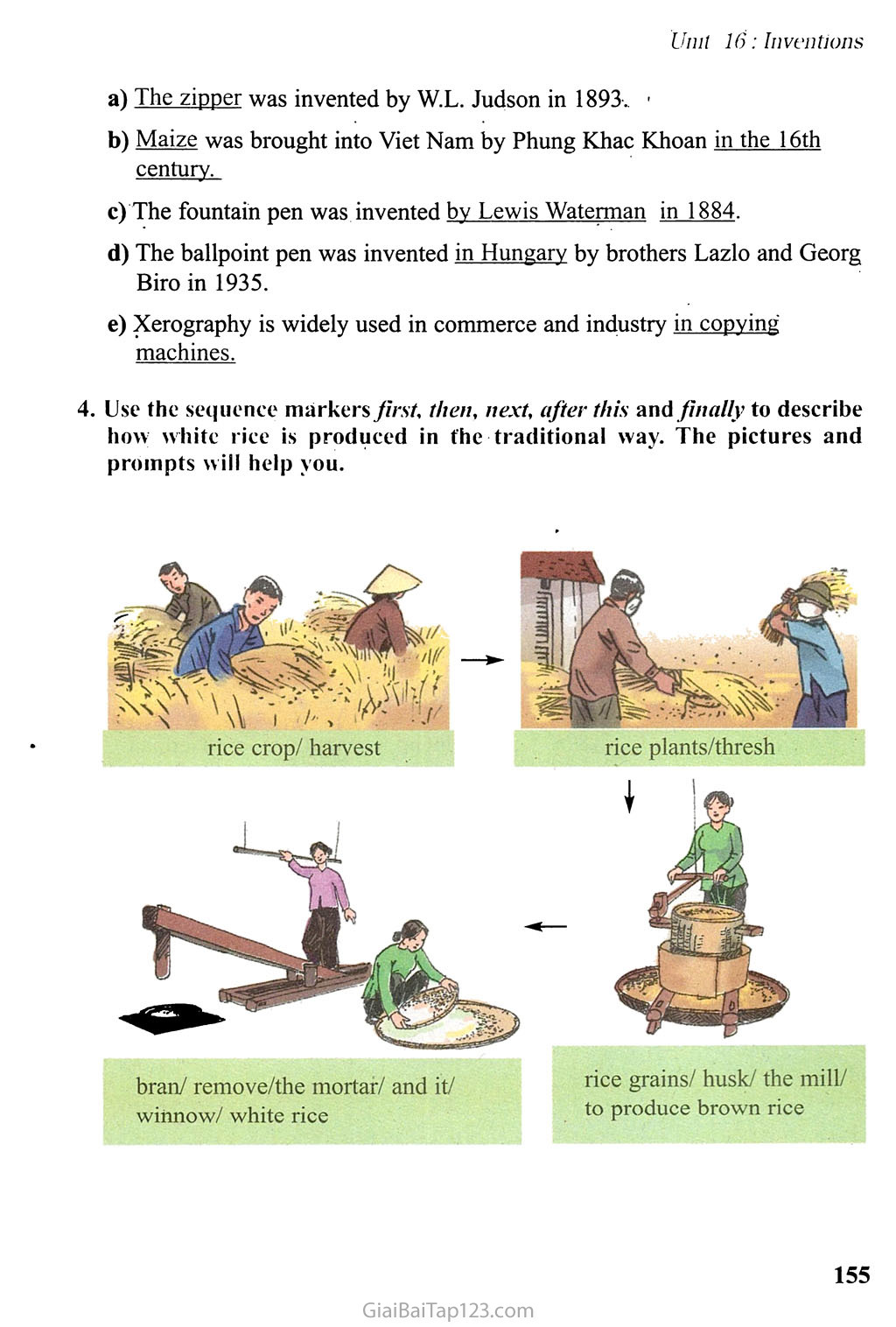
Use the sequence markers first, then, next, after this and finally to describe how white rice is produced in the traditional way. The pictures and prompts will help you.
rice crop/ harvest
rice plants/thresh
rice grains/ husk/ the mill/ to produce brown rice
bran/ remove/the mortar/ and it/ winnow/ white rice
Invention
Bicycle Facsimile Helicopter Microphone Optical fiber Printing Press
Sewing machine
Date
Inventor
Nationality
1924
c.w. Rice
Gordon Gould
Peter Carl Goldmark
1816
German
1843
Alexander Bain
English
1939
American
D.E. Hughes
American
1955
1810
Friedrich Koenig
1849
F. J. Monier
Elias Howe
French
1895
Wilhelm Konarad
German
STUDENT B