
SGK Tiếng Anh 8 - Unit 4: Our past
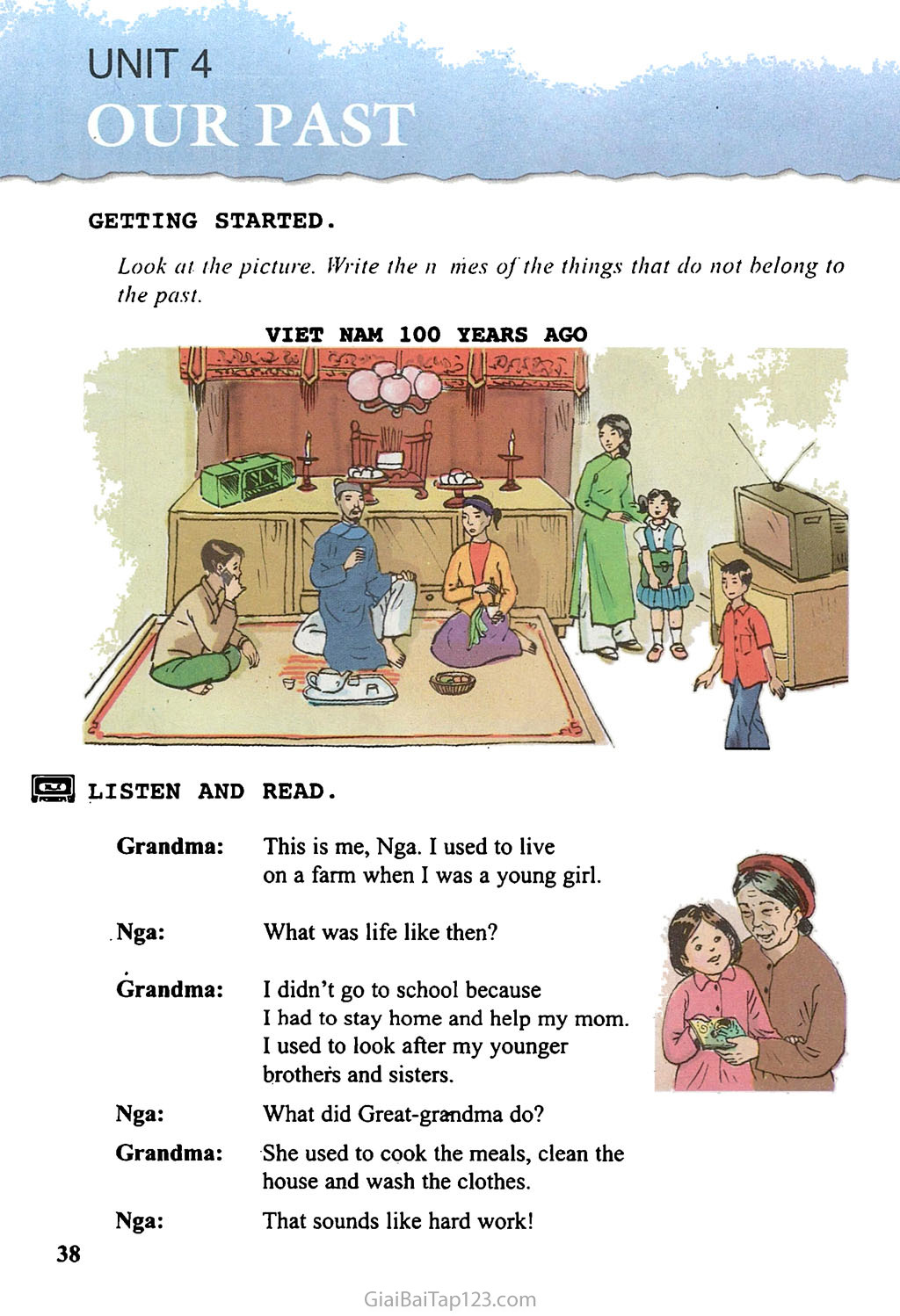
Look at- the picture. Write the names of the things that do not belong to the past.
LISTEN AND READ.
VIET NAM 100 YEARS AGO
GETTING STARTED.
Grandma:	This is me, Nga. I used to live
on a farm when I was a young girl.
Nga:	What was life like then?
Grandma:	1 didn’t go to school because
1 had to stay home and help my mom. I used to look after my younger brothers and sisters.
Nga:	What did Great-grandma do?
Grandma:	She used to cook the meals, clean the
house and wash the clothes.
Nga:	That sounds like hard work!
Grandma:
Nga:
Grandma:
Nga:
Grandma:
Nga:
Grandma:
It was. And there wasn’t any electricity.
Mom had to do everything without the help of modern equipment.
What did you do in the evenings?
After dinner, Mom lit the lamp and Dad used to tell us stories.
Do you remember any of them?
Oh, yes. The best one was The Lost Shoe.
It’s an old folktale.
Please tell me the tale, Grandma.
Traditional stories are great.
All right. Once a poor farmer . . .
Practice the dialogue with a partner.
Work with a partner. Ask and answer the questions.
Where did Nga’s grandmother use to live?
Why didn’t she go to school?
What did Nga’s great-grandmother use to do?
What did Nga’s great-grandmother and great-grandfather do after dinner?
What did Nga ask her grandmother to do at the end of the conversation?
Fact or opinion? Check (/) the boxes.
I used to live on a farm.
There wasn’t any electricity.
Mom had to do everything without the help of modem equipment.
My father used to tell US stories.
The best one was The Lost Shoe.
F
0
□
□
□
□
□
□
□
□
□
□
□
□
Í) Traditional stories are great.
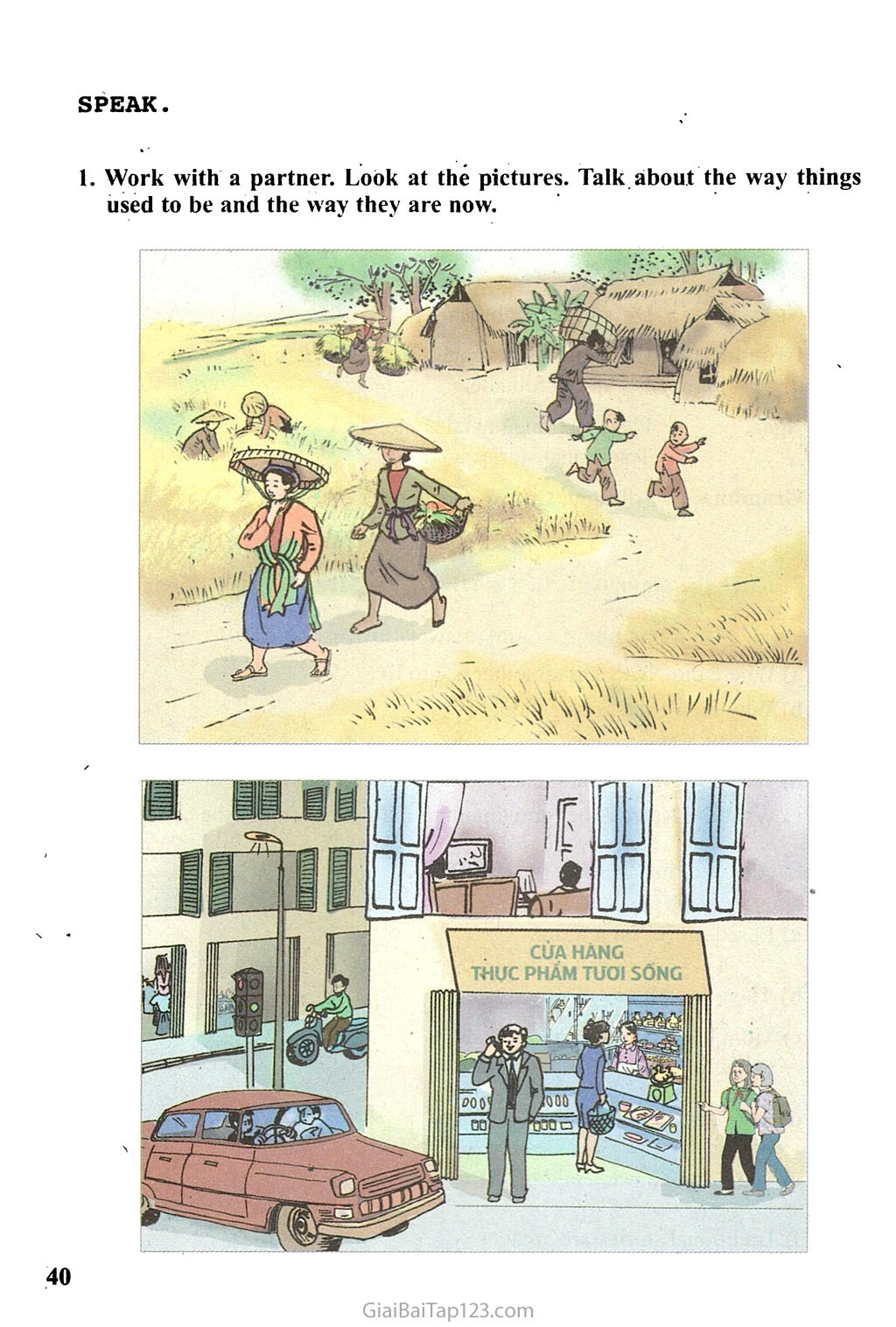
SPEAK
1/5
SJJ
H
4=
Now tell your partner about the things you used to do last year.
Last year I used to get up late. Now, I get up early and do morning exercises.
BI LISTEN.
Listen to the story. Write the letter of the most suitable moral lesson.
Don’t kill chickens.
Don’t be foolish and greedy.
Be happy with what you have.
It’s difficult to find gold.
READ.
Once a poor fanner had a daughter named Little Pea. After his wife died, the farmer married again. His new wife had a daughter, Stout Nut. Unfortunately, the new wife was very cruel to Little Pea. Little Pea had to do chores all day. This made Little Pea’s father very upset. He soon died of a broken heart.
Summer came and went. In the fall, the village held its harvest festival. That year, everyone was excited as the prince wanted to choose his wife from the village. Stout Nut’s mother made new clothes for her, but poor Little Pea had none.
However, before the festival started, a fairy appeared and magically changed Little Pea’s rags into beautiful clothes.
As Little Pea ran to the festival, she dropped one of her shoes and lost it. When the prince found the shoe, he decided to marry the girl who owned it. Of course the shoe fitted Little Pea, and the prince immediately fell in love with her.
Unit 4: Our'past
Complete the sentences with words from the story.
Little Pea’s father was a	.
Little Pea’s mother	when she was young.
Little Pea	to do the housework all day after her father
got married	.
The prince wanted to	a girl from Little Pea’s village.
Stout Nut’s mother did not make	 	for Little Pea.
The prince found Little Pea’s	shoe.
Answer the questions. Write the answers in your exercise book.
Who was Little Pea?
What did Stout Nut’s mother make Little Pea do all day?
How did Little Pea get her new clothes?
Who did the prince decide to many?
Is this a true stoiy? How do you know?
WRITE.
1. Complete the story. Use the verbs in the box. •
burned
escaped
went
was
appeared
left
lit
tied
was grazing
said
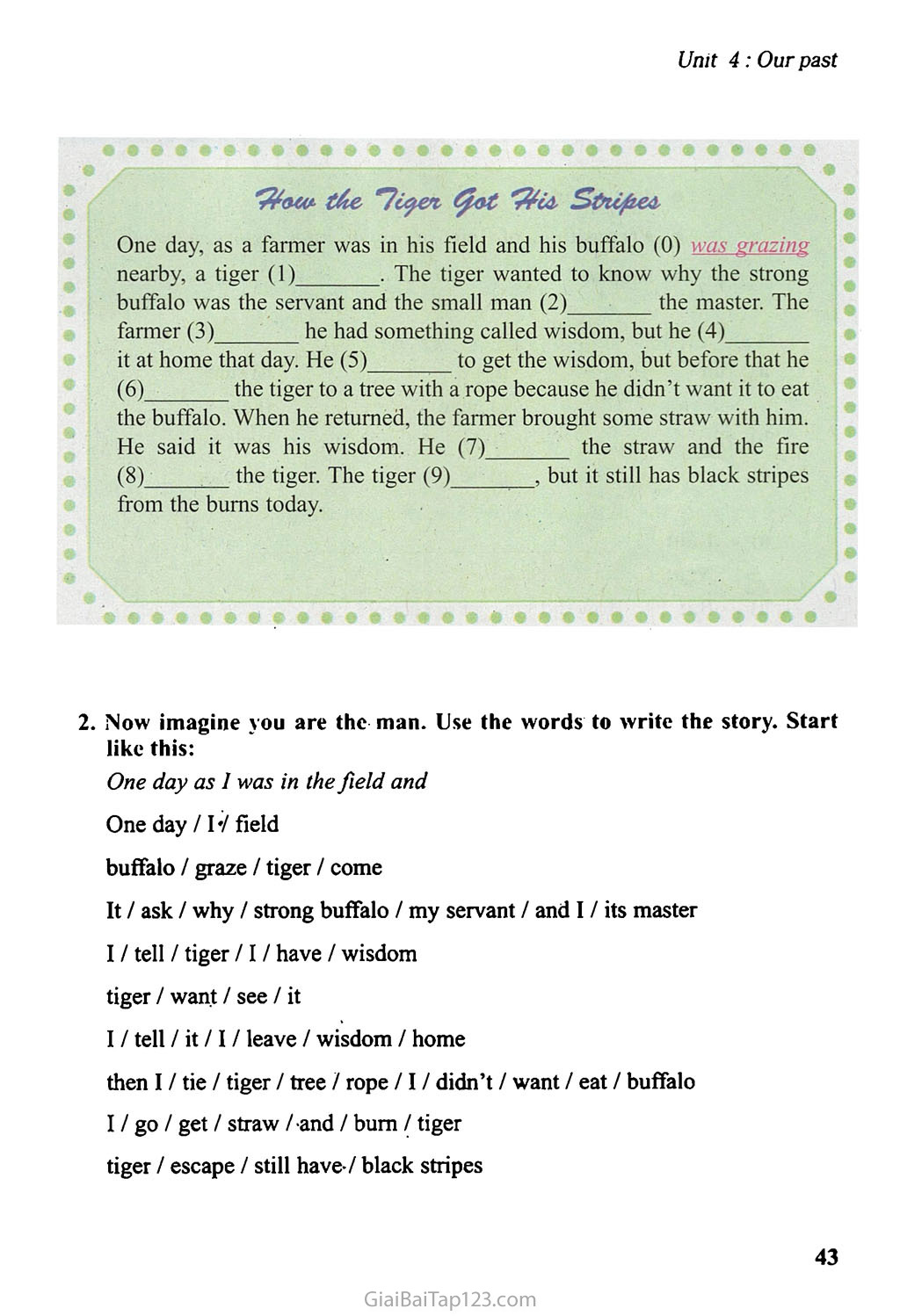
'Zfcwt tfic	tyữt 7?^ Sùùfre&
One day, as a farmer was in his field and his buffalo (0) was grazing
nearby, a tiger (1)	. The tiger wanted to know why the strong
buffalo was the servant and the small man (2)	the master. The
farmer (3)	he had something called wisdom, but he (4)
it at home that day. He (5)	to get the wisdom, but before that he
(6)	the tiger to a tree with a rope because he didn’t want it to eat
the buffalo. When he returned, the farmer brought some straw with him.
He said it was his wisdom. He (7)_	 the straw and the fire
(8)	the tiger. The tiger (9)	 , but it still has black stripes
from the bums today.
Now imagine you are the man. Use the words to write the story. Start like this:
One day as I was in the field and ....
One day /1'/ field buffalo / graze / tiger / come
It / ask / why / strong buffalo / my servant / and I / its master I / tell / tiger /1 / have / wisdom tiger / want / see / it I / tell / it /1 / leave / wisdom / home
then I / tie / tiger / tree / rope /1 / didn’t / want / eat / buffalo I / go / get / straw / and / burn / tiger tiger / escape / still have / black stripes
Language Focus	'	-
Past simple
Prepositions of time: in, on, at, after, before, between
used to
1. Write the past simple form of each verb.
a) run
d) go
h) ride
=> ran
e) have
i) eat
b) fly
f) do
j) sit
c) take
g) be
k) come
2. Complete the dialogue below. Use the past simple.
a)
Lan:
9
Nga:
No. I ate noodles.
b)
Ba:
How did you get to school?
Nam:
c)
Minh:
9
Hoa:
I was at home.
d)
Chi:
Which subject did you have yesterday?
Ba:
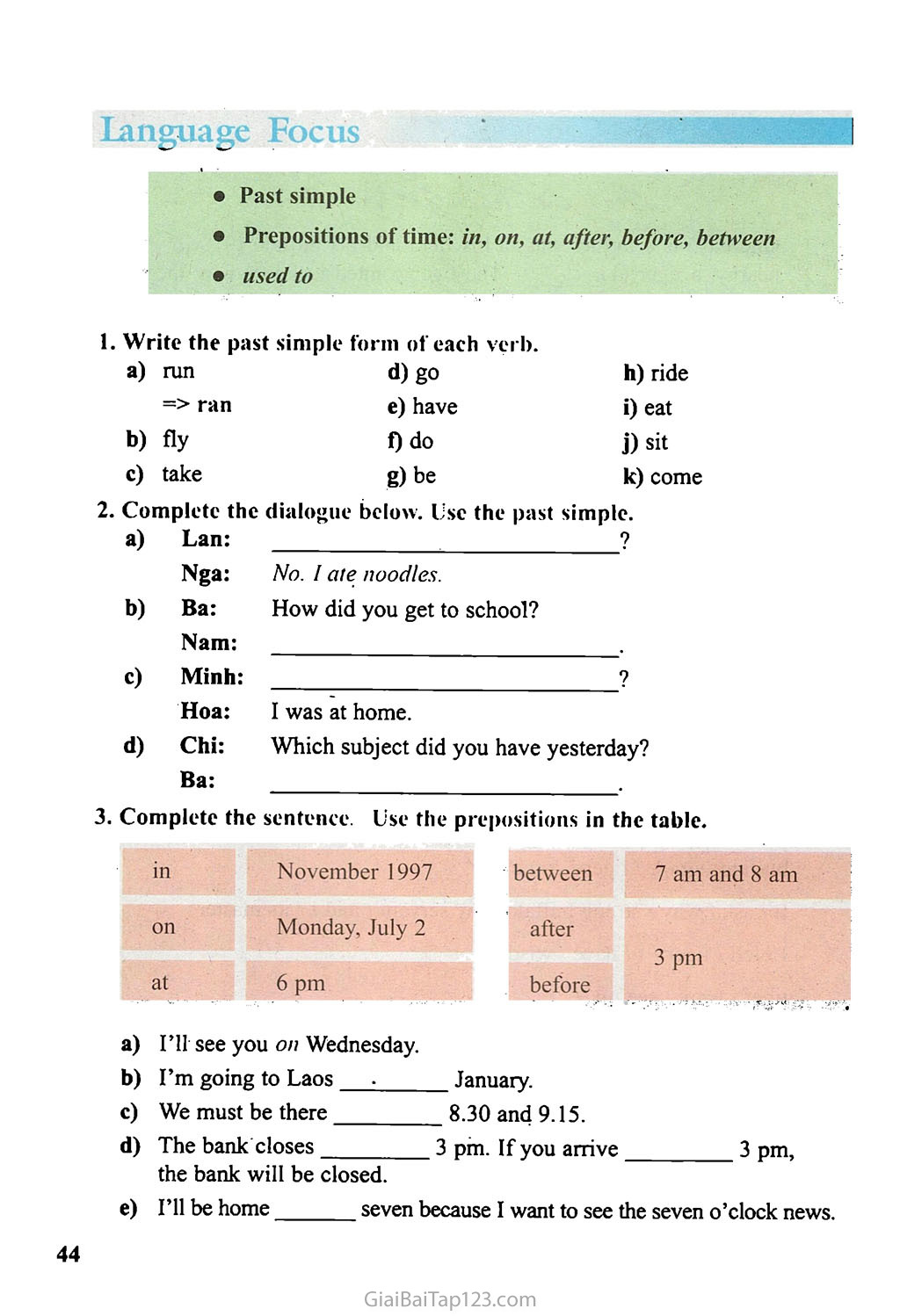
3. Complete the sentences. Use the prepositions in the table.
in
November 1997
between
7 am and 8 am
on
Monday, July 2
after
3 pm
at
6 pm
before
I’ll see you on Wednesday.
I’m going to Laos ■	January.
We must be there	8.30 and 9.15.
The bank closes 	3 pm. If you arrive	3 pm,
the bank will be closed.
I’ll be home	seven because I want to see the seven o’clock news.
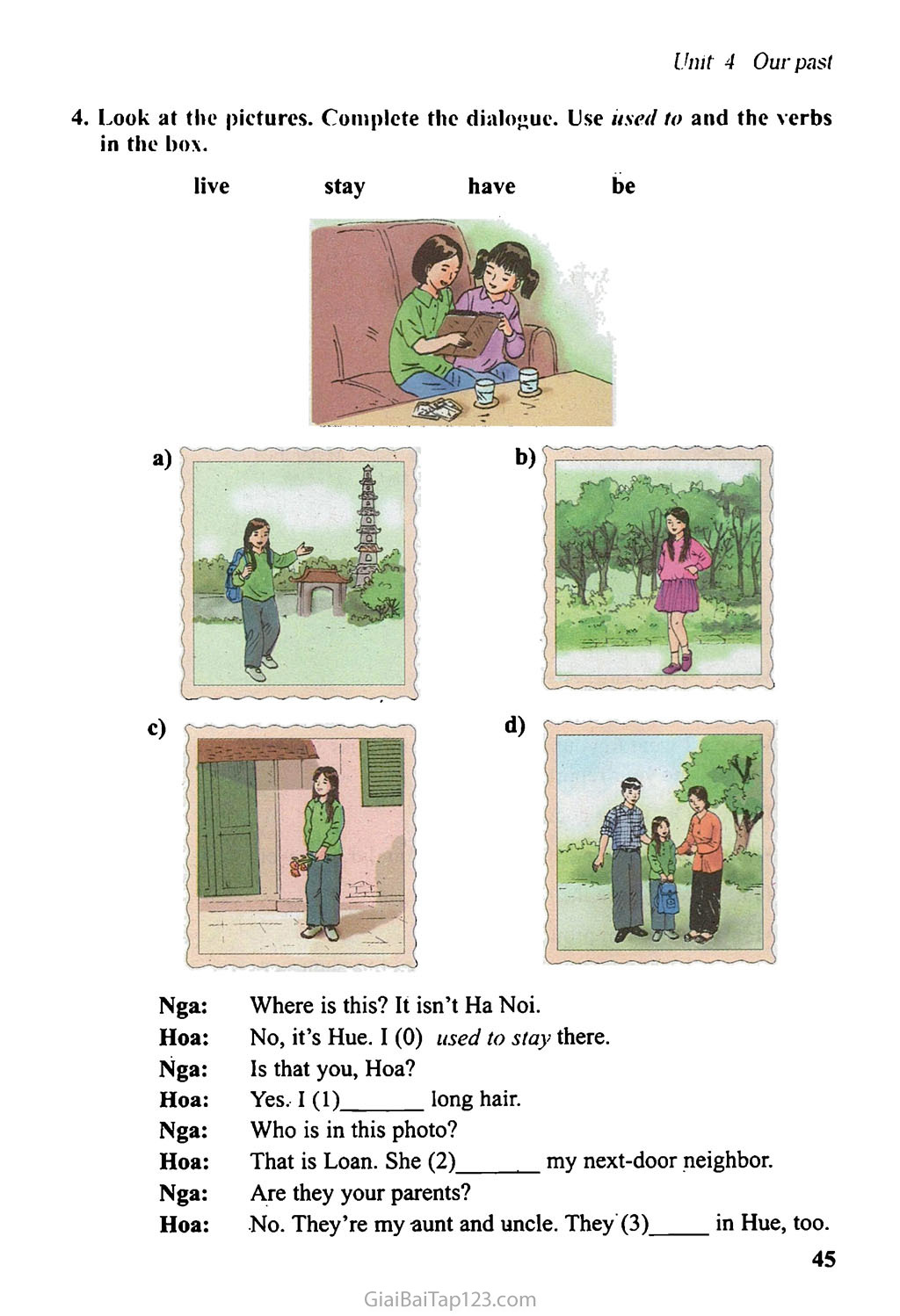
Look at the pictures. Complete the dialogue. Use used to and the verbs in the box.
live	stay	have	be
d)
Nga:	Where is this? It isn’t Ha Noi.
Hoa:	No, it’s Hue. I (0) used to stay there.
Nga:	Is that you, Hoa?
Hoa:	Yes, I (1)	long hair.
Nga:	Who is in this photo?
Hoa:	That is Loan. She (2)	my next-door neighbor.
Nga:	Are they your parents?
Hoa:	No. They’re my aunt and uncle. They (3)	in Hue, too.