
Giải tiếng Anh lớp 9 Unit 9: Natural Disasters
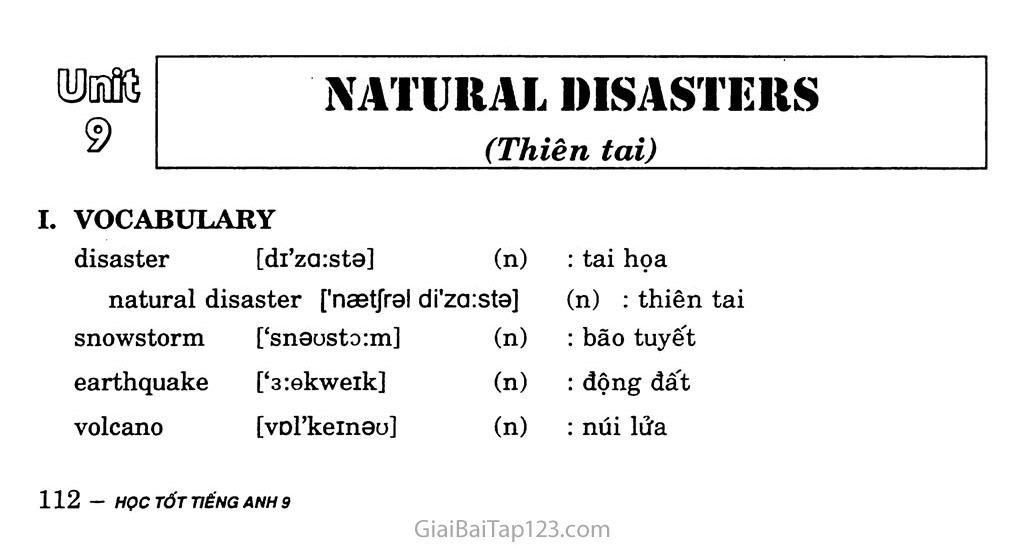
NATURAL DISASTERS
(Thiên tai)
VOCABULARY
disaster
[di’za:st8]
(n)
: tai họa
natural disaster ['naetfrel di'za:ste]
(n) : thiên tai
snowstorm
[‘sn9usto:m]
(n)
: bão tuyết
earthquake
[‘3:ekweik]
(n)
: động đất
volcano
[vDl’keinsu]
(n)
: núi lửa
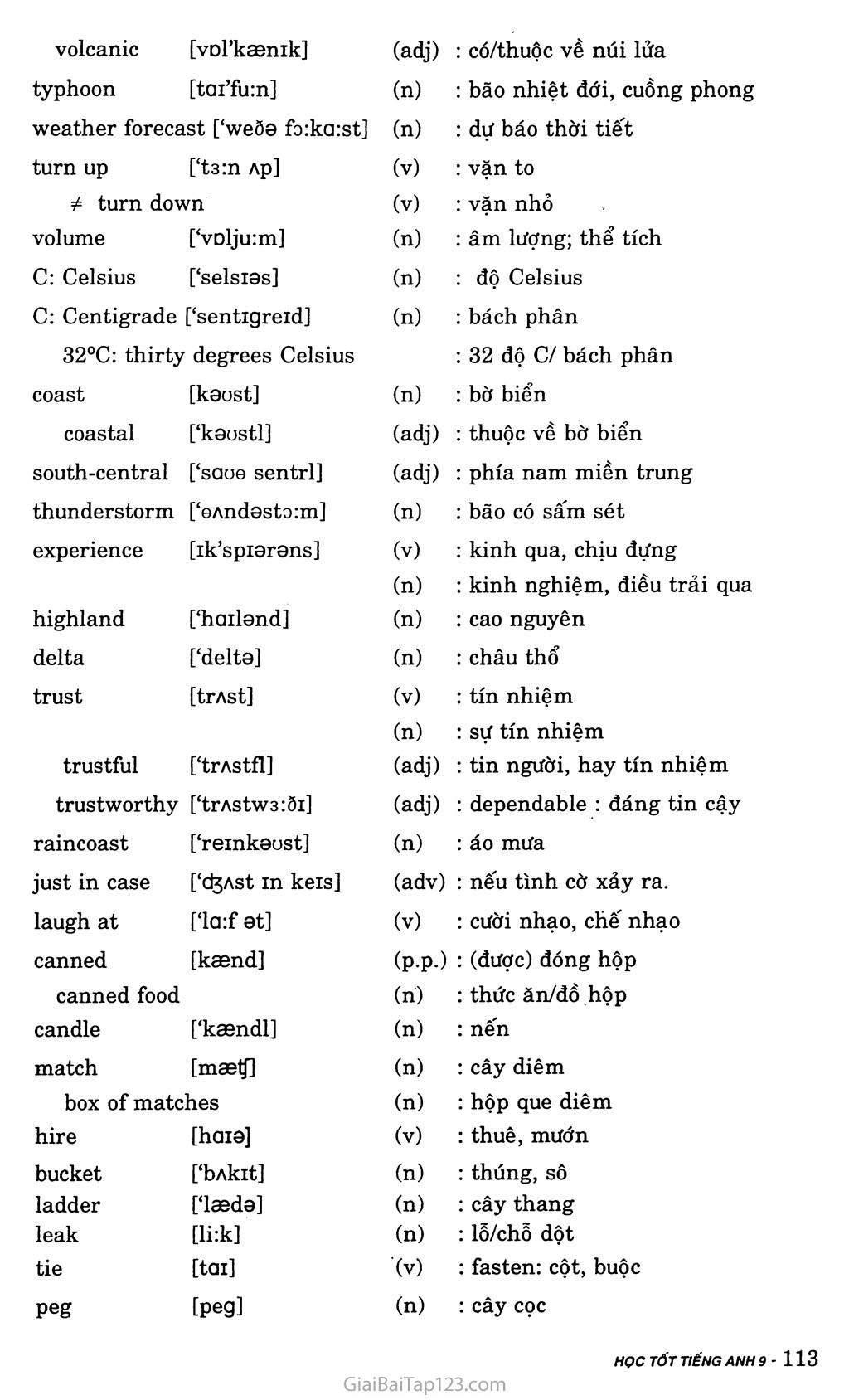
volcanic
[vDl’keenik]
(adj)
có/thuộc về núi lửa
typhoon
[tai’fum]
(n)
bão nhiệt đới, cuồng phong
weather forecast [‘weSa fo:ka:st]
(n)
dự báo thời tiết
turn up
[‘t3:n Ap] -
(v)
vặn to
turn down
(v)
vặn nhỏ
volume
[‘vDlju:m]
(n)
âm lượng; thể tích
C: Celsius
[‘selsias]
(n)
độ Celsius
C: Centigrade [‘sentigreid]
(n)
bách phân
32°C: thirty degrees Celsius
32 độ c/ bách phân
coast
[kaost]
(n)
bờ biển
coastal
[‘kaostl]
(adj)
thuộc về bờ biển
south-central
[‘saue sentrl]
(adj)
phía nam miền trung
thunderstorm
[‘eAndasto:m]
(n)
bão có sấm sét
experience
[ik’spiarans]
(v)
(n)
kinh qua, chịu đựng kinh nghiệm, điều trải qua
highland
[‘hailand]
(n)
cao nguyên
delta
[‘delta]
(n)
châu thổ
trust
[trAst]
(v)
(n)
tín nhiệm sự tín nhiệm
trustful
[‘trAstfl]
(adj)
tin người, hay tín nhiệm
trustworthy
[‘trAstw3:0i]
(adj)
dependable : đáng tin cậy
raincoast
[‘reinkaust]
(n)
áo mưa
just in case
[‘d^Ast in keis]
(adv)
nếu tình cờ xảy ra.
laugh at
[‘la:f at]
(v)
cười nhạo, chế nhạo
canned
[kaend]
(p.p.)
(được) đóng hộp
canned food
(n)
thức ăn/đồ hộp
candle
[‘kaendl]
(n)
nến
match
[maetf]
(n)
cây diêm
box of matches
(n)
hộp que diêm
hire
[haia]
(v)
thuê, mướn
bucket
[‘bAkit]
(n)
thúng, sô
ladder
riaeda]
(n)
cây thang
leak
[li:k]
(n)
lỗ/chỗ dột
tie
[tai]
(v)
fasten: cột, buộc
peg
[peg]
(n)
cây cọc
rope
[raup]
(n)
dây thừng
latch
[laefl
(n)
chốt/then cửa
available
[a’veilabl]
(adj)
có sẵn
damage
[‘dasmid3l
(v)
(n)
làm hu/hại sự thiệt hại/hư hại
supply
[sa’plax]
(v)
(n)
provide: cung cấp sự cung cấp
expert
[‘eksp3:t]
(n)
chuyên viên
fixture
[‘fiktfa]
(n)
đồ đạc cố định
block
[blDk]
(v)
chặn đứng, ngăn chặn
(n)
building: cao ốc
roller
[‘raula]
(n)
trục lăn, xe lăn đường
drill
[drill
(n)
sự luyện tập
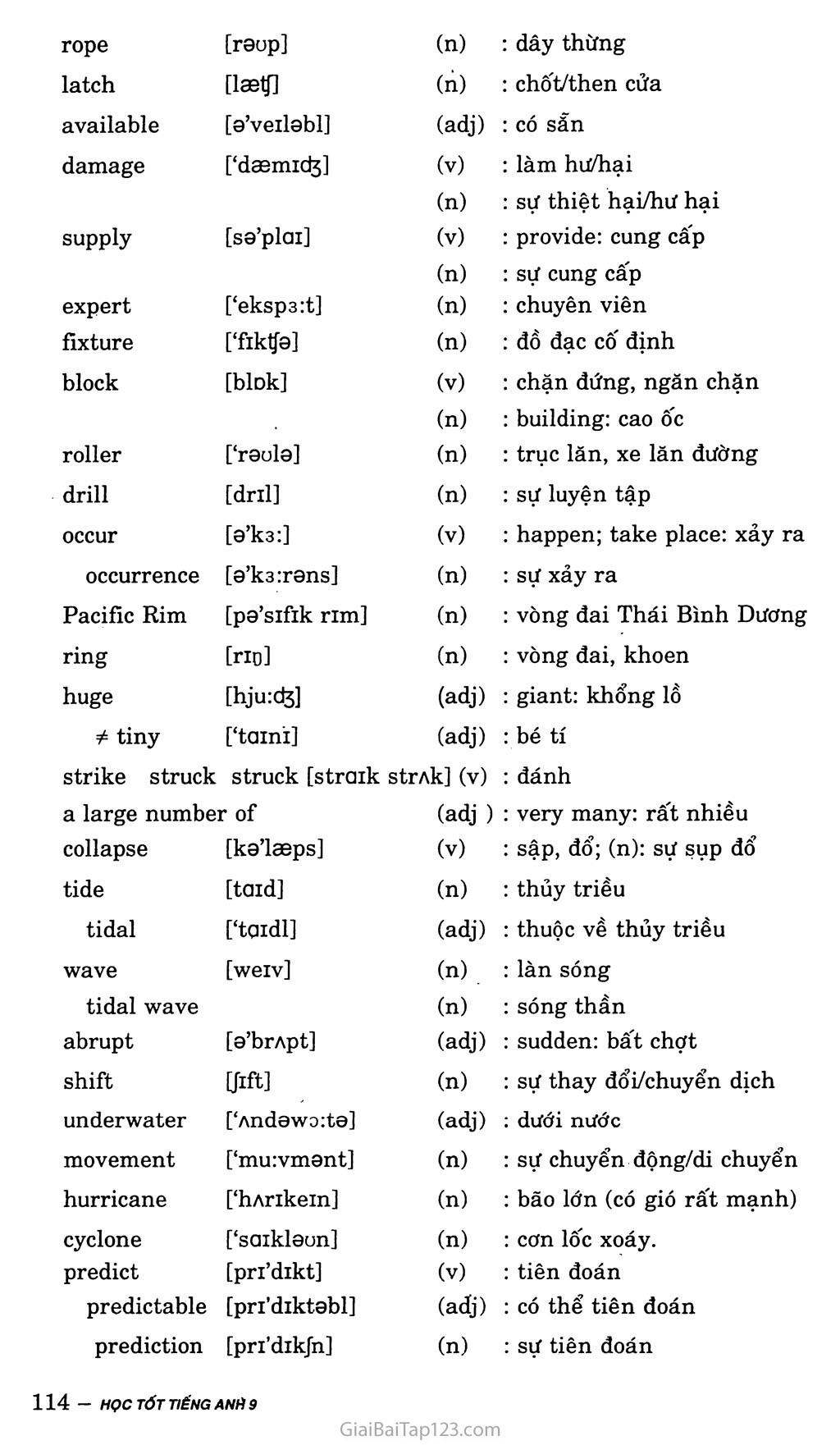
occur
[a’ks:]
(v)
happen;take place: xảy ra
occurrence
[a’k3:rans]
(n)
sự xảy ra
Pacific Rim
[pa’sifik rim]
(n)
vòng đai Thái Bình Dương
ring
[rip]
(n)
vòng đai, khoen
huge
[hju:d3]
(adj)
giant: khổng lồ
/ tiny
[‘tdini]
(adj)
bé tí
strike struck
struck [straik strAk] (v)
đánh
a large number of
(adj )
very many: rất nhiều
collapse
[ka’leeps]
(v)
sập, đổ; (n): sự sụp đổ
tide
[told]
(n)
thủy triều
tidal
rtqidl]
(adj)
thuộc về thủy triều
wave
[weiv]
(n)
làn sóng
tidal wave
(n)
sóng thần
abrupt
[a’brApt]
(adj)
sudden: bát chợt
shift
[fift]
(n)
sự thay đổi/chuyển dịch
underwater
[‘Andawo:ta]
(adj)
dưới nước
movement
[‘mmvmant]
(n)
sự chuyển động/di chuyển
hurricane
[‘hArikein]
(n)
bão lớn (có gió rất mạnh)
cyclone
[‘saiklaon]
(n)
cơn lô'c xoáy.
predict
[pri’dikt]
(v)
tiên đoán
predictable
[pri’diktabl]
(adj)
có thể tiên đoán
prediction
[pri’dikjn]
(n)
sự tiên đoán
erupt
[I’rApt]
(v)
phun
eruption
[I’rApJh]
(n)
vụ phun
warn
[worn]
(v)
cảnh báo
warning
t‘wo:nio]
(n)
lời cảnh báo
tornado
[tofneidao]
(n)
bão xoáy
funnel
[‘fAnl]
(n)
cái phễu
shape
Qeip]
(n)
hình dáng
overland
[‘auvalsend]
[auva’leend]
(adj)
(adv)
qua đất liền bằng đường bộ
suck up
[sAk Ap]
(v)
hút
path
[pa:e]
(n)
đường đi
carriage
[‘kasricỊị]
(n)
xe ngựa
baby carriage [‘beibi kasridsl
(n)
xe nôi
majority
[ma’djDrati]
(n)
đa số
* miniority [mai’norati]
(n)
thiểu số
all of a sudden [o:l av sAdan]
(adv)
suddenly: cách thình lình
behave
[bi’heiv]
(v)
cư xử, xử sự
behaviour
[bi’heivia]
(n)
hành vi
shelter
[‘Jelta]
(n)
nơi trú ẩn
circle
[‘S3:kl]
(n)
vòng tròn
scared (of)
(skead
(adj)
sợ
e.g.: She’s very much scared of dogs. (Chị ấy rất sợ chó.)
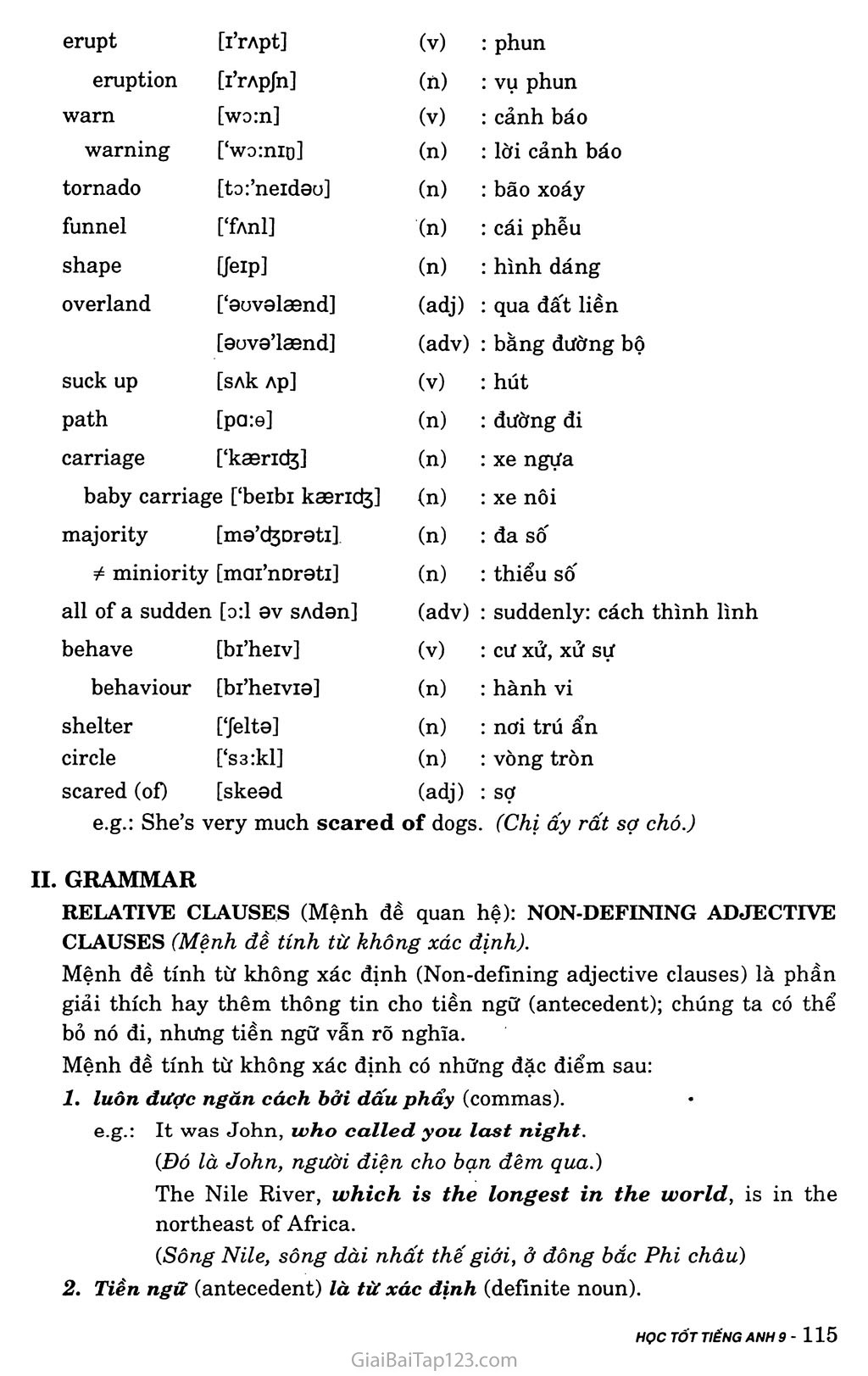
II. GRAMMAR
RELATIVE CLAUSES (Mệnh đề quan hệ): NON-DEFINING ADJECTIVE CLAUSES (Mệnh đề tính từ không xác định).
Mệnh đề tính từ không xác định (Non-defining adjective clauses) là phần giải thích hay thêm thông tin cho tiền ngữ (antecedent); chúng ta có thể bỏ nó đi, nhưng tiền ngữ vẫn rõ nghĩa.
Mệnh đề tính từ không xác định có những đặc điểm sau:
luôn được ngăn cách bởi dấu phẩy (commas), e.g.: It was John, who called you last night.
(Đó là John, người điện cho bạn đêm qua.)
The Nile River, which is the longest in the world, is in the northeast of Africa.
(Sông Nile, sông dài nhất thế giới, ở đông bắc Phi châu)
Tiền ngữ (antecedent) là từ xác định (definite noun).
danh từ riềng (proper nouns).
g.: Nguyen Du, who wrote the work “Kim Van Kieu”, is a great Vietnamese poet.
{Nguyễn Du, người viết tác phẩm “Kim Vân Kiều”, là một thi hào Việt Nam.)
Mount Ba Đen, which is the highest in the south, is in Tay Ninh province.
{Núi Bà Đen, là ngọn cao nhất miền nam, ở tỉnh Tây Ninh.)
từ được bổ nghĩa bởi sở hữu tính từ (possessive adjectives: my, your, her, his,...) hay chỉ thị tính từ (demonstrative adjectives: this/these, that/those).
g.: That building, where they worked two years ago, is used as •a guest house.
{Cao ốc kia, nơi họ làm việc cách đây hai năm, giờ được dùng làm nhà khách.).
This book, which you gave me last summer, is very interesting. {Cuốn sách mà bạn cho tôi mùa hè qua rất hay.)
từ được bổ nghĩa bởi một cụm tính từ (an adjective phrase).
g.: The man in black, who’s speaking to the principal, is an environmental activist.
{Người đàn ông mặc đồ đen, người đang nói chuyện với hiệu trưởng, là nhà hoạt động môi trường.)
Đại từ quan hệ làm túc từ (objective relative pronouns) không được bỏ
(như ở mệnh đề tính từ xác định).
e.g.: That boy, whom you saw in the library last week, is the best in my class.
{Cậu bé kia, người bạn thấy ở thư viện tuần qua, là học sinh giỏi nhất lớp tôi.)
The books on top of the shelf, which you recommended me, are Dickens’s novels.
{Những cuốn sách trên kệ, (mà) bạn giới thiệu cho tôi, là tiểu ,	thuyết của Dickens.)
Từ “THAT”không bao giở dược dùng.
III. SOLUTIONS AND TRANSLATIONS. {Lời giải và Bài dịch)
GETTING STARTED. (Bắt đẩu)
Match the pictures with the correct words. Then compare your answer with a partner’s. {Ghép hình với từ đúng. Sau đó so sánh câu trả lời của em với câu trả lời của một bạn cùng học.)
Picture 1: snowstorm	Picture 2: earthquake
Picture 3: volcano	Picture 4: typhoon
LISTEN AND READ. (Nghe và đọc)
Thuy đang nói chuyện với bà của cô.
Thuy : Bà ạ, đó là dự báo thời tiết trên tivi.
Bà : Thuy, cháu vui lòng vặn âm thanh to lên.
Thuy : Thưa bà, vâng.
Người dự báo thời tiết: Đây là dự báo thời tiết ngày mai. Hà Nội và khu vực phía bắc sẽ có nắng. Hà Nội sẽ có nhiệt độ khoảng 23 và 27 độ c. Trời sẽ mưa dọc theo bờ biển Thanh Hóa. Bờ biển ở nam Trung bộ sẽ có bão vớì sấm sét. Huế sẽ chịu đựng nhiệt độ khoảng 25 và 30 độ c. Cũng sẽ có bão với sấm sét khắp vùng cao nguyên miền Trung. Các khu vực vùng châu thổ sông Cửu Long có thể có nhiều mây vào ban ngày. Nhiệt độ ở thành phố Hồ Chí Minh sẽ khoảng giữa 27 và 35 độ c.
Thuy : Bà ơi, hết rồi.
Bà : Cám ơn cháu. Cháu đang làm gì đấy?
Thuy :Chậu đang chuẩn bị cho cuộc dã ngoại với vài bạn của cháu. Chúng cháu không gặp nhau từ khi rời trường. Chúng cháu sẽ đến công viên ở bờ sông bên kia
Bà : Các cháu đừng quên mang theo áo mưa nhé?
Thuy : Nhưng, Bà ơi, dự báo thời tiết nói trời sẽ nắng.
Bà : Bà không bao giờ tín nhiệm dự báo thời tiết.
Thuy : Bà không bỏ qua tin dự báo thời tiết nào, phải không?
Bà : Nhưng bà thích theo dõi chúng, cháu à.
Thuy : Thưa Bà, vâng. Cháu sẽ mang theo áo mưa dự phòng. Cháu hi vọng các bạn sẽ không cười nhạo cháu.
Practice the dialogue with a partner. {Thực hành bài đôi thoại với một bạn cùng học.)
Fill in each blank with one word or phrase from the dialogue. {Điền mỗi chỗ trống với một từ hay cụm từ từ bài đối thoại.)
Thuy’s grandmother wants her to turn up the volume on TV because she wants to listen to the weather forecast.
It will be rainy along the coast of Thanh Hoa
The south-central coast will experience thunderstorms.
Ho Chi Minh will experience temperatures between 27°C and 35 °C.
Although Thuy’s grandmother doesn’t trust weather forecasts, she likes watching them.
SPEAK. {Nói)
Check (what preparations you think should be made for a typhoon. (Ghi dấu (o những chuẩn bị gi em nghĩ nên làm trước trận cuồng phong.)
_ . . s. . Buying some canned food
	Painting the house.
	Buying a dog.
. . < -Buying candies.
. . < . Buying matches.
—	Hiring some video movies.
- . .s. Filling all buckets with water.
. .	Buying a ladder.
	Washing your blankets.
. . s. Fixing the leak in the roof
.. >z. Tying the roof to the ground with pegs and ropes.
. ..	. Inviting some friends over for a dinner.
. . Checking all the windows and door latches.
6. Now work with a partner. Talk about what you think you want to buy and do for a typhoon: explain why. The ideas in the box may help you. (Bâỵ giờ thực hành với một bạn cùng học. Nói về những gì em nghĩ em muốn mua và làm để chuẩn bị cho trận cuồng phong: giải thích tại sao. Những ý tưởng trong khung có thể giúp em.)
A: I think we should buy some canned food before a typhoon B: Yes, I think so, too. The markets will be closed and no food will
be available.
A: I think we should buy a ladder.
B: Why?
A: Just in case we have to fix the roof, because there will be hard rain. And we should tie up the roof to the ground since there must be strong wind.
B: I agree with you. Why don’t we buy some matches and candles for there may be a power cut?
A: That’s my idea, too. And we should fill all buckets with water.
B: That’s right, because the water pipes may be damaged.
A: Finally, I think we should check all the window and door
latches for the wind may be very strong.
4. LISTEN. (Nghe)
An expert is giving a talk on how to live with earthquakes. Listen to the talk, then complete the table. (Một chuyên viên đang nói chuyện về làm thế nào sống chung với động đất-. Nghe cuộc nói chuyện và điển vào bảng này)
	Living with earthquakes
Heavy fixtures, furniture, and aplliances:
— Place heavy books on the (1) bottom shelf of your bookshelves.
Block the rollers on your (2) fridge and (3) washing machines.
Flying glass:
— Check the (4) mirrors.
- Don’t put your bed near (5) a window.
Earthquakes drill:
— Stay(6) inside.
— Sit (7) under a strong table or (8) doorway.
— Stand in the (9) corner of a room.
READ. (Đọc)
Động đất : 90% cuộc động đất xảy ra quanh vòng đai Thái Bình Dương được biết như là “Vòng đai lửa”. Năm 1995, vụ động đất dữ dội làm sập thành phố Kobe ở Nhật. Rất nhiều người chết khi nhà cửa, cao ốc văn phòng và xa lộ sụp đổ.
Sóng thần : Sóng thần là hậu quả của sự chuyển dịch thình lình của sự chuyển động dưới nước của trái đất. Vào thập niên 1960, một ngọn sóng thần khổng lồ đập vào Anchorage, ở Alaska. Cơn sóng thần di chuyển từ Alaska đến California!
Cuồng phong : Khi bão nhiệt đới đạt đến 120 cây số một giờ, nó được gọi là bão (câ'p 8) ở Bắc và Nam Mĩ, cơn lốc xoáy ở úc và cuồng phong ở Á châu. Từ “typhoon” phát xuất từ tiếng Trung quốc: “tai” nghĩa là “to, lớn”, và “feng” có nghĩa “gió”, do đó từ “typhoon” có nghĩa “ gió lớn”.
Núi lửa : Chúng ta thường thường có thể tiên đoán khi nào núi lửa phun. Ngọn Pinatubo, ngọn núi lửa ở Phi-líp-pin, phun năm 1991. Đó là vụ phun núi lửa lớn nhất thế giới trong vòng hơn 50 năm. Hàng trăm người chết, nhưng hàng ngàn người được cứu vì các nhà bác học đã cảnh giác họ về vụ phun.
Bão xoáy : Bão xoáy là những cơn bão có hình phễu đi qua đâ't liền dưới dạng cơn bão có sấm sét. Chúng hút bất kì vật gì trên đường đi. Năm 1981 ở Ý, một cơn bão xoáy bốc một em bé đang ngủ trong xe nôi lên không và bỏ xuống an toàn cách xa 100 cây sô'.
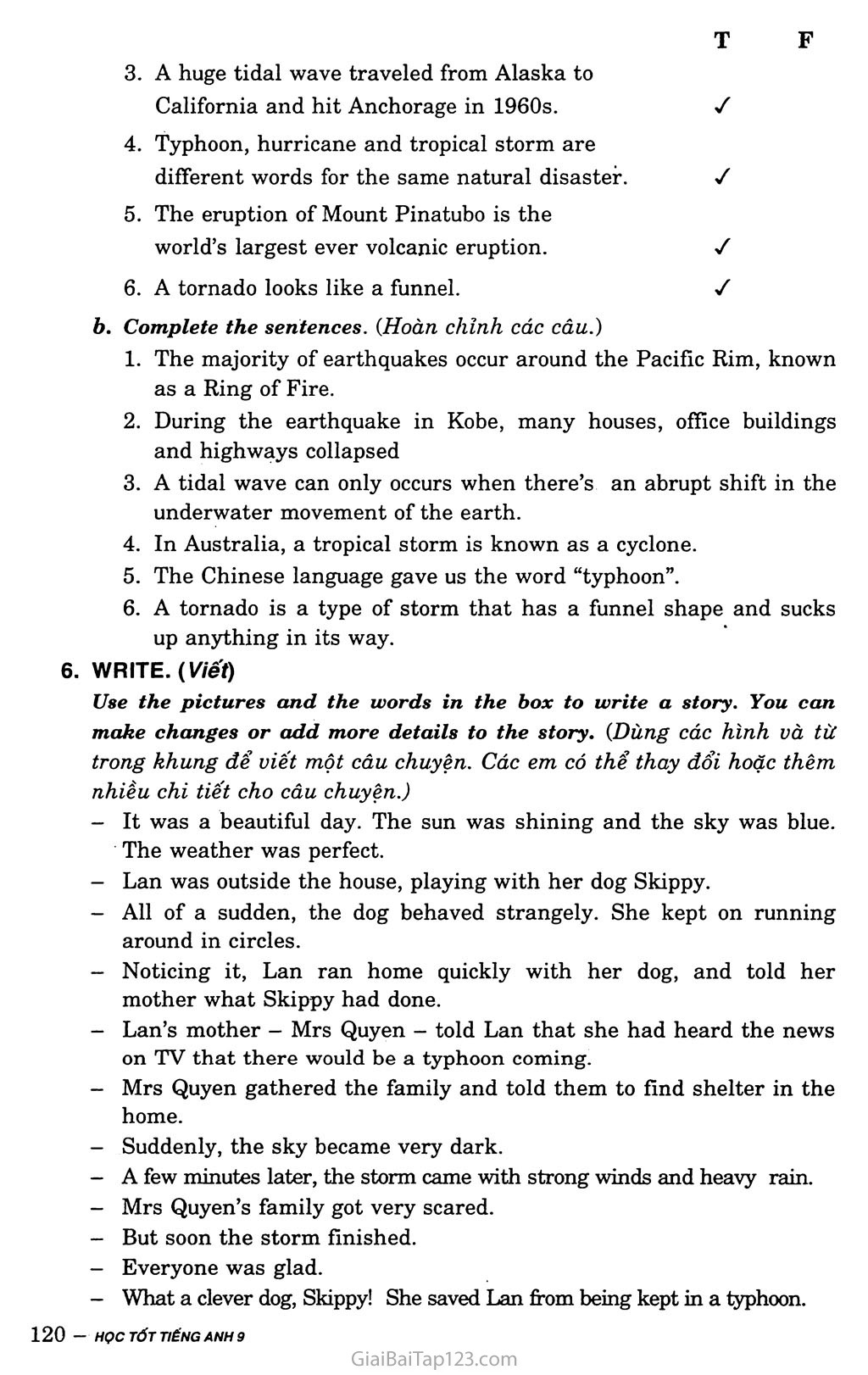
True or False? Check (S) the boxes. {Đúng hay Sai? Đánh dâu (■/) vào các ô.)
T F
Most of the earthquakes in the world occur
in the Ring of Fire.	■/
The earthquake in Kobe in 1995 caused
severe damage.	/
A huge tidal wave traveled from Alaska to
6. Complete the sentences. {Hoàn chỉnh các câu.)
The majority of earthquakes occur around the Pacific Rim, known as a Ring of Fire.
During the earthquake in Kobe, many houses, office buildings and highways collapsed
A tidal wave can only occurs when there’s an abrupt shift in the underwater movement of the earth.
In Australia, a tropical storm is known as a cyclone.
The Chinese language gave us the word “typhoon”.
A tornado is a type of storm that has a funnel shape and sucks up anything in its way.
WRITE. {Viết)
Use the pictures and the words in the box to write a story. You can make changes or add more details to the story. {Dùng các hình và từ trong khung để viết một câu chuyện. Các em có thể thay đổi hoặc thêm nhiều chi tiết cho câu chuyện.)
It was a beautiful day. The sun was shining and the sky was blue. The weather was perfect.
Lan was outside the house, playing with her dog Skippy.
All of a sudden, the dog behaved strangely. She kept on running around in circles.
Noticing it, Lan ran home quickly with her dog, and told her mother what Skippy had done.
Lan’s mother - Mrs Quyen - told Lan that she had heard the news on TV that there would be a typhoon coming.
Mrs Quyen gathered the family and told them to find shelter in the home.
Suddenly, the sky became very dark.
A few minutes later, the storm came with strong winds and heavy rain.
Mrs Quyen’s family got very scared.
But soon the storm finished.
Everyone was glad.
What a clever dog, Skippy! She saved Lan from being kept in a typhoon. 120 — HỌC TOT TIẾNG ANH 9
LANGUAGE FOCUS
Relative pronouns: who, that, which
Relative clauses (continued)
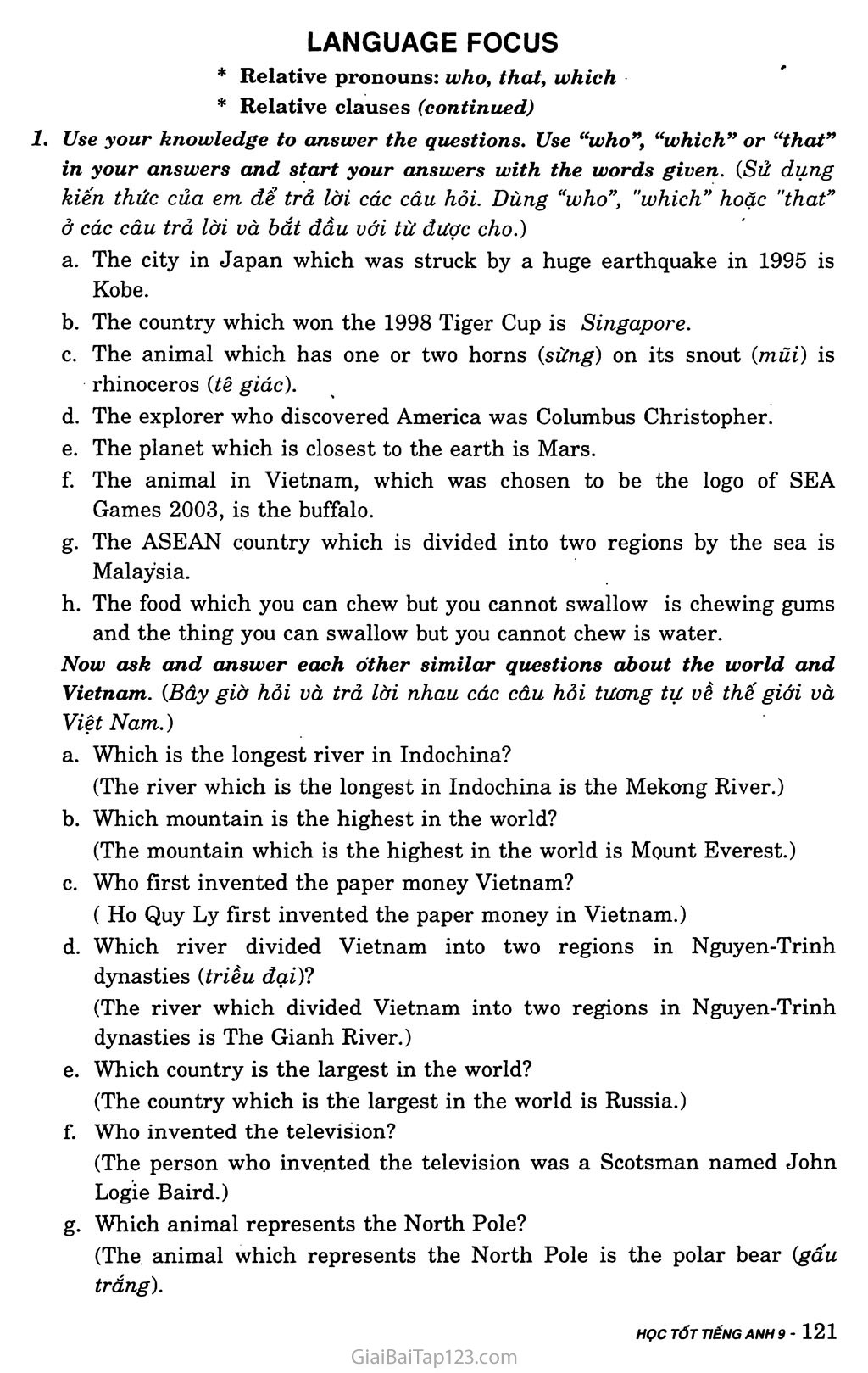
1. Use your knowledge to answer the questions. Use “who”, “which” or “that” in your answers and start your answers with the words given. (Sử dụng kiến thức của em để trả lời các câu hỏi. Dùng “who”, "which” hoặc "that” ở các câu trả lời và bắt đầu với từ được cho.}
The city in Japan which was struck by a huge earthquake in 1995 is Kobe.
The country which won the 1998 Tiger Cup is Singapore.
The animal which has one or two horns (sừng} on its snout (mủi} is rhinoceros (tê giác).
The explorer who discovered America was Columbus Christopher.
The planet which is closest to the earth is Mars.
The animal in Vietnam, which was chosen to be the logo of SEA Games 2003, is the buffalo.
The ASEAN country which is divided into two regions by the sea is Malaysia.
The food which you can chew but you cannot swallow is chewing gums and the thing you can swallow but you cannot chew is water.
Now ask and answer each other similar questions about the world and Vietnam. (Bây giờ hỏi và trả lời nhau các câu hỏi tương tự về thê' giới và Việt Nam.)
Which is the longest river in Indochina?
(The river which is the longest in Indochina is the Mekong River.)
Which mountain is the highest in the world?
(The mountain which is the highest in the world is Mount Everest.)
Who first invented the paper money Vietnam?
( Ho Quy Ly first invented the paper money in Vietnam.)
Which river divided Vietnam into two regions in Nguyen-Trinh dynasties (triều đạiỴỈ
(The river which divided Vietnam into two regions in Nguyen-Trinh dynasties is The Gianh River.)
Which country is the largest in the world?
(The country which is the largest in the world is Russia.)
Who invented the television?
(The person who invented the television was a Scotsman named John Logie Baird.)
Which animal represents the North Pole?
(The animal which represents the North Pole is the polar bear (gấu trắng).
Who invented the system of reading and writing for the blind?
■ ' (The person who invented the system of reading and writing for the
blind was Louis Braille.)
Match each of the sentences in Column A with a related sentence in Column B. Then use a suitable relative pronoun to join the two sentences.
(Ghép mỗi câu ở cột A với câu liền hệ ở cột B. Sau đó dùng đại từ quan hệ thích hợp nối hai câu.)
Andrew is flying to Sacramento, which is the capital of California.
In the winter of 2002, it snowed in Lang Son, which is on the Ky Cung River.
Pompeii, which was completely destroyed in 79 AD by an eruption of Mount Vesuvius, is an ancient city of Italy.
Hurricane Andrew, which swept through southern Florida in August 1992, killed 41 people and made more than 200,000 homeless.
The cyclone of November 1970 in Bangladesh, which is bordered by the Bay of Bengal on the south, was one of the worst natural disasters of the 20th century.
The most disastrous earthquake in Japanese history, which occurred in 1923, damaged Tokyo and Yokohama and killed about 150,000 people.
The October 1989 Lorna Prieta earthquake, which caused extensive damage to older buildings in San Franscisco Bay Area, measured 7.1 on the Richter scale.
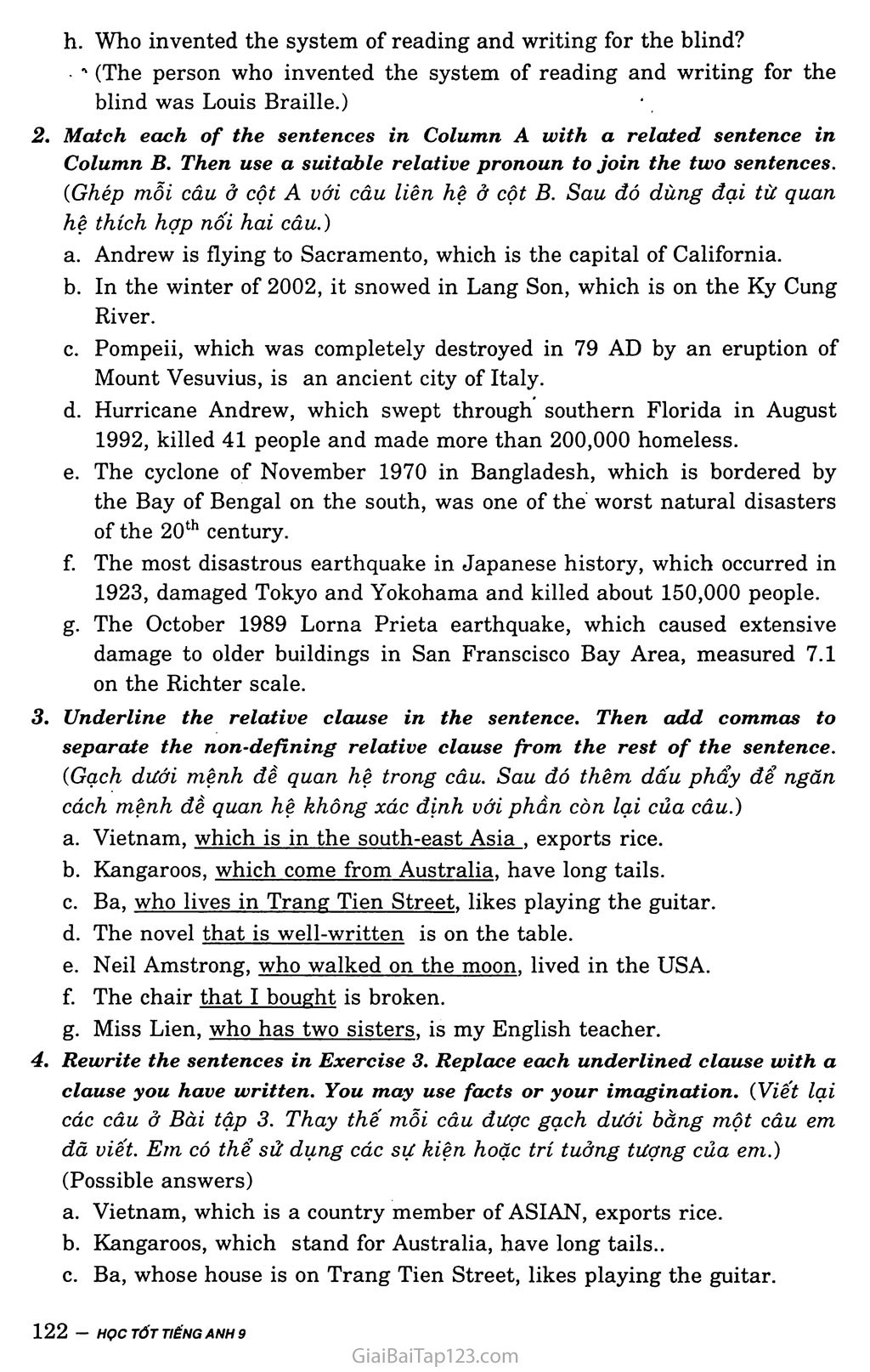
Underline the relative clause in the sentence. Then add commas to separate the non-defining relative clause from the rest of the sentence. (Gạch dưới mệnh đề quan hệ trong câu. Sau đó thêm dấu phẩy để ngăn cách mệnh để quan hệ không xác định với phần còn lại của câu.)
Vietnam, which is in the south-east Asia . exports rice.
Kangaroos, which come from Australia, have long tails.
Ba, who lives in Trang Tien Street, likes playing the guitar.
The novel that is well-written is on the table.
Neil Amstrong, who walked on the moon, lived in the USA.
The chair that I bought is broken.
Miss Lien, who has two sisters, is my English teacher.
Rewrite the sentences in Exercise 3. Replace each underlined clause with a clause you have written. You may use facts or your imagination. (Viết lại các câu ở Bài tập 3. Thay thế mồi câu dược gạch dưới bằng một câu em đã viết. Em có thể sử dụng các sự kiện hoặc trí tuởng tượng của em.) (Possible answers)
Vietnam, which is a country member of ASIAN, exports rice.
Kangaroos, which stand for Australia, have long tails..
Ba, whose house is on Trang Tien Street, likes playing the guitar.
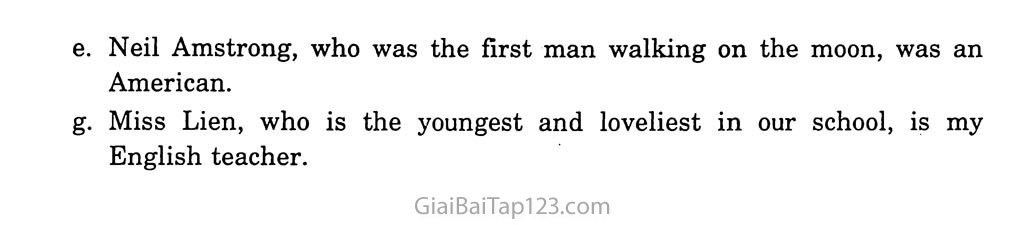
e. Neil Amstrong, who was the first man walking on the moon, was an American.
Miss Lien, who is the youngest and loveliest in our school, is my English teacher.