
Giải tiếng Anh lớp 8 Unit 16: Inventions
Unit
16
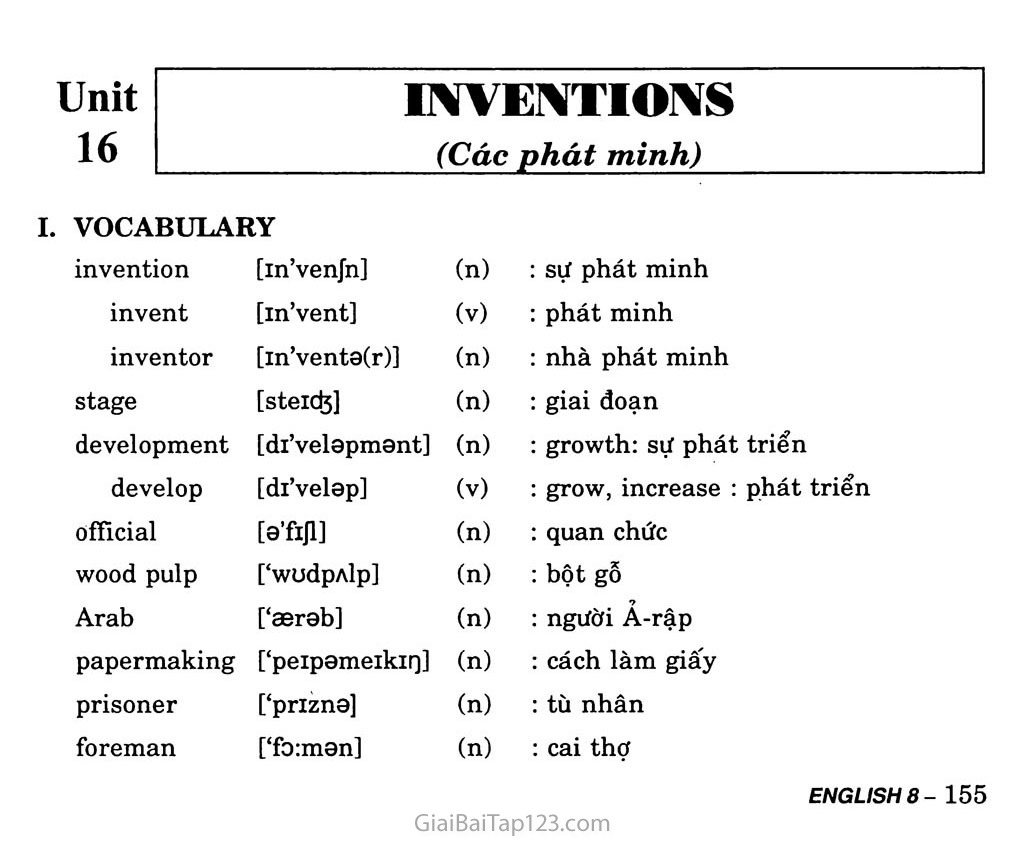
INVENTIONS
(Các phát minh)
I. VOCABULARY
invention
[in’venfn]
(n)
: sự phát minh
invent
[in’vent]
(v)
: phát minh
inventor
[in’venta(r)]
(n)
: nhà phát minh
stage
[steicfe]
(n)
: giai đoạn
development
[di’velapmant]
(n)
: growth: sự phát triển
develop
[di’velap]
(v)
: grow, increase : phát triển
official
[9’fijl]
(n)
: quan chức
wood pulp
[‘wudpAlp]
(n)
: bột gỗ
Arab
[‘cerab]
(n)
: người A-rập
papermaking
[‘peipameikiq]
(n)
: cách làm giấy
prisoner
[‘prizna]
(n)
: tù nhân
foreman
[‘fa:man]
(n)
: cai thợ
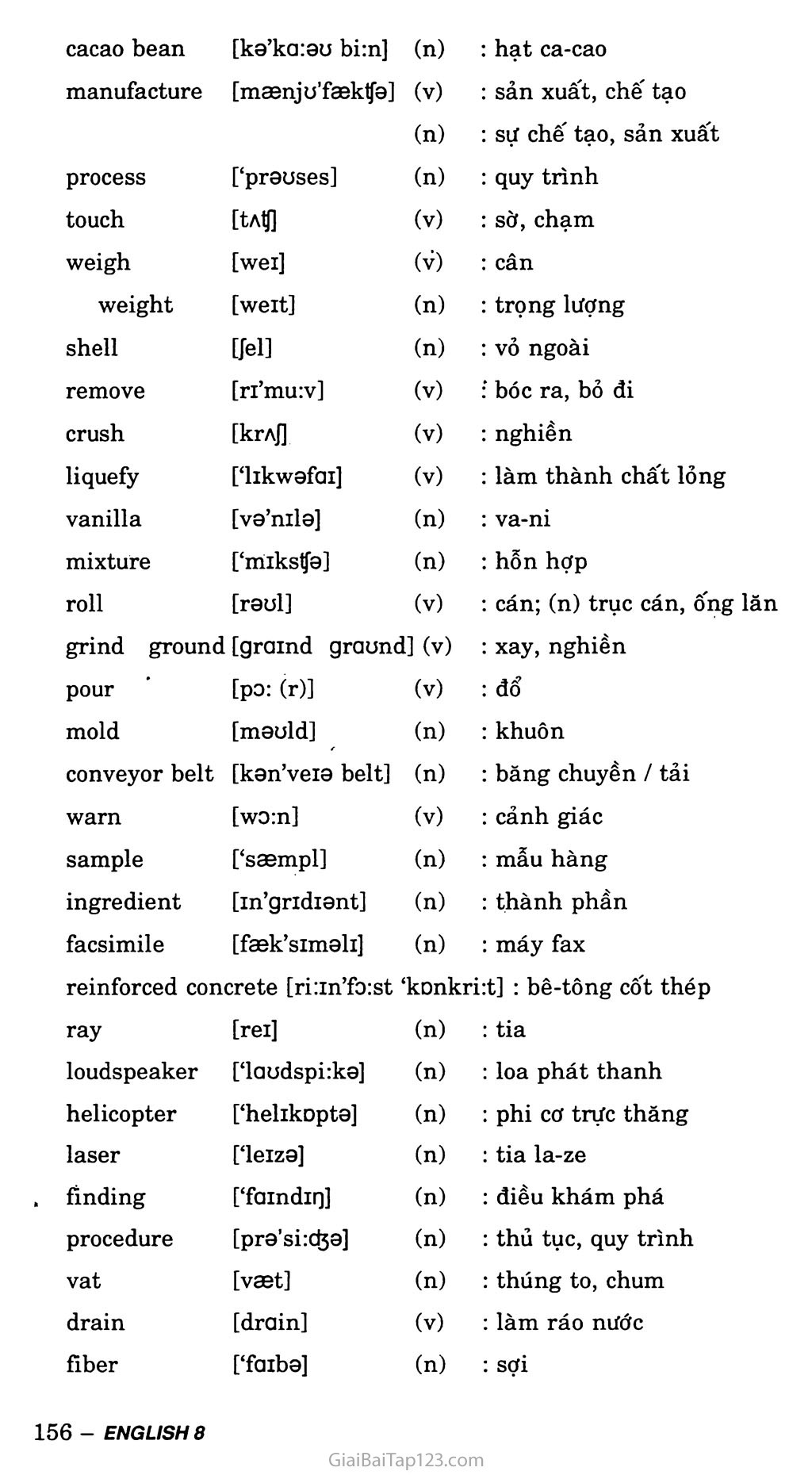
cacao bean
[ka’ka:au bi:n]
(n)
: hạt ca-cao
manufacture
[msenju’fgek^a]
(v)
(n)
: sản xuất, chế tạo : sự chế tạo, sản xuất
process
[‘prauses]
(n)
: quy trình
touch
[tAfl]
(v)
: sờ, chạm
weigh
[wex]
(v)
: cân
weight
[welt]
(n)
: trọng lượng
shell
[Jell
(n)
: vỏ ngoài
remove
[ri’mu:v]
(v)
: bóc ra, bỏ đi
crush
[krAj]
(v)
: nghiền
liquefy
[‘likwafai]
(v)
: làm thành chất lỏng
vanilla
[va’nila]
(n)
: va-ni
mixture
[‘mikstfa]
(n)
: hỗn hợp
roll
[raul]
(v)
: cán; (n) trục cán, ông
grind ground [graind ground] (v)
: xay, nghiền
pour
[po: (r)]
(v)
: đổ
mold
[mauld]
(n)
: khuôn
conveyor belt
[kan’veia belt]
(n)
: băng chuyền / tải
warn
[worn]
(v)
: cảnh giác
sample
[‘saempl]
(n)
: mẫu hàng
ingredient
[in’gridiant]
(n)
: thành phần
facsimile
[faek’simali]
(n)
: máy fax
reinforced concrete [ri:in’fo:st ‘kDnkri:t] : bê-tông cốt thép
ray
[rei]
(n)
: tia
loudspeaker
[llaudspi:ka]
(n)
: loa phát thanh
helicopter
[‘helikDpta]
(n)
: phi cơ trực thăng
laser
[‘leiza]
(n)
: tia la-ze
finding
[‘faindiq]
(n)
: điều khám phá
procedure
[pra’sirdja]
(n)
: thủ tục, quy trình
vat
[vaet]
(n)
: thúng to, chum
drain
[drain]
(v)
: làm ráo nước
fiber
[‘faiba]
(n)
: sợi
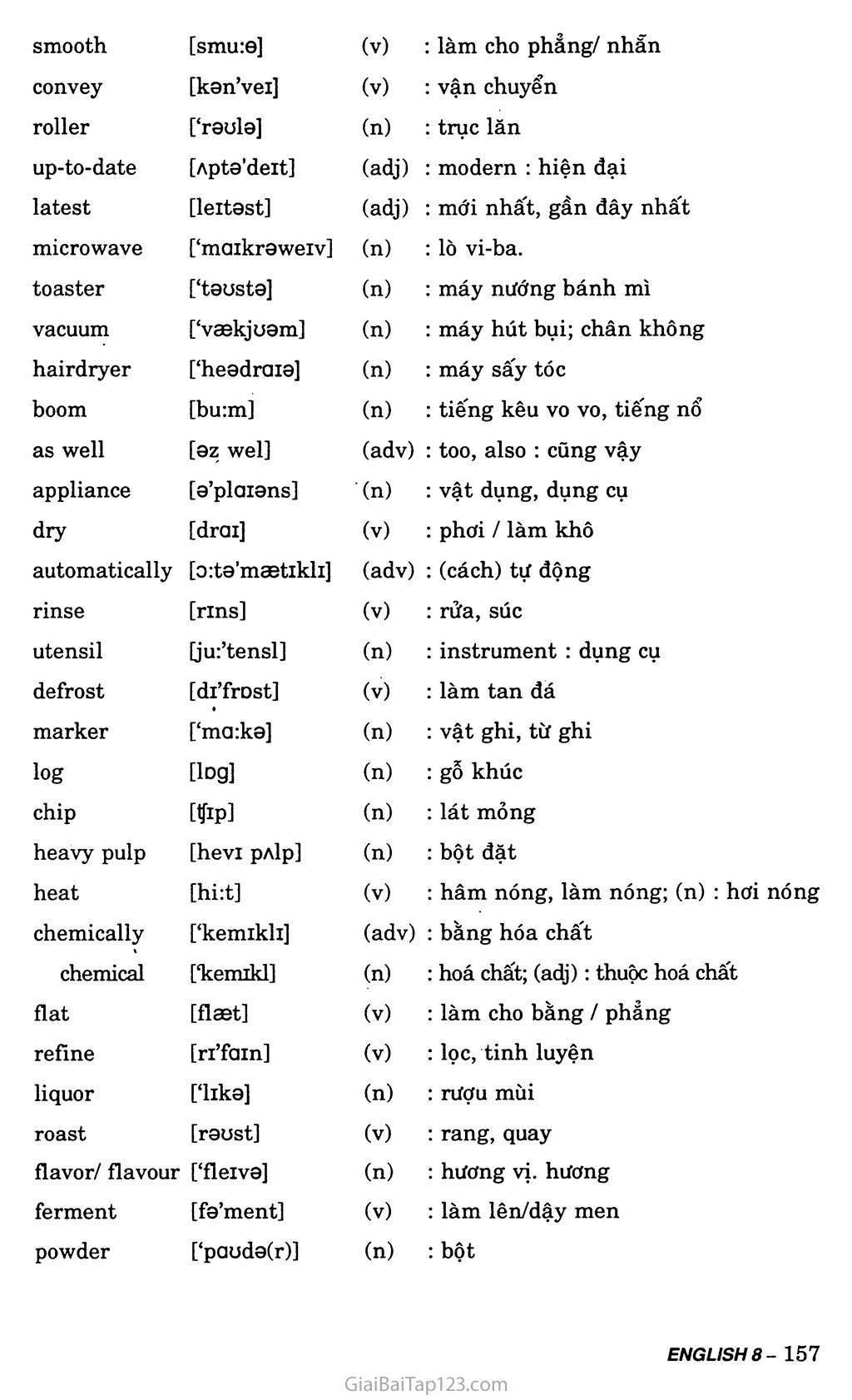
smooth
[smu:e]
(V)
convey
[kan’vei]
(v)
roller
[‘raula]
(n)
up-to-date
[Apta’deit]
(adj)
latest
[leitast]
(adj)
microwave
[‘maikraweiv]
(n)
toaster
[‘tausta]
(n)
vacuum
[‘vaekjuam]
(n)
hairdryer
[‘headraia]
(n)
boom
[bu:m]
(n)
as well
[az wel]
(adv)
appliance
[a’plaians]
(n)
dry
[drai]
(v)
automatically
[o:ta’msetikli]
(adv)
rinse
[rins]
(v)
utensil
[ju:’tensl]
(n)
defrost
[di’frDst]
(v)
marker
[‘ma:ka]
(n)
log
[log]
(n)
chip
[ftp]
(n)
heavy pulp
[hevi pAlp]
(n)
heat
[hi:t]
(v)
chemically
[‘kemikli]
(adv)
chemical
[‘kemikl]
(n)
flat
[fleet]
(v)
refine
[ri’fain]
(v)
liquor
[‘Ilka]
(n)
roast
[raust]
(V)
flavor/ flavour
[‘fleiva]
(n)
ferment
[fa’ment]
(v)
powder
[‘pauda(r)]
(n)

làm cho phẳng/ nhẵn
vận chuyển
trục lăn
modern : hiện đại
mới nhất, gần đây nhất
lò vi-ba.
máy nướng bánh mì
máy hút bụi; chân không
máy sấy tóc
tiếng kêu vo vo, tiếng nổ
too, also : cũng vậy
vật dụng, dụng cụ
phơi / làm khô
(cách) tự động
rửa, súc
instrument : dụng cụ
làm tan đá
vật ghi, từ ghi
gỗ khúc
lát mỏng
bột đặt
hâm nóng, làm nóng; (n) : hơi nóng
bằng hóa chất
hoá chất; (adj): thuộc hoá chất
làm cho bằng / phẳng
lọc, tinh luyện
rượu mùi
rang, quay
hương vị. hương
làm lên/dậy men
bột
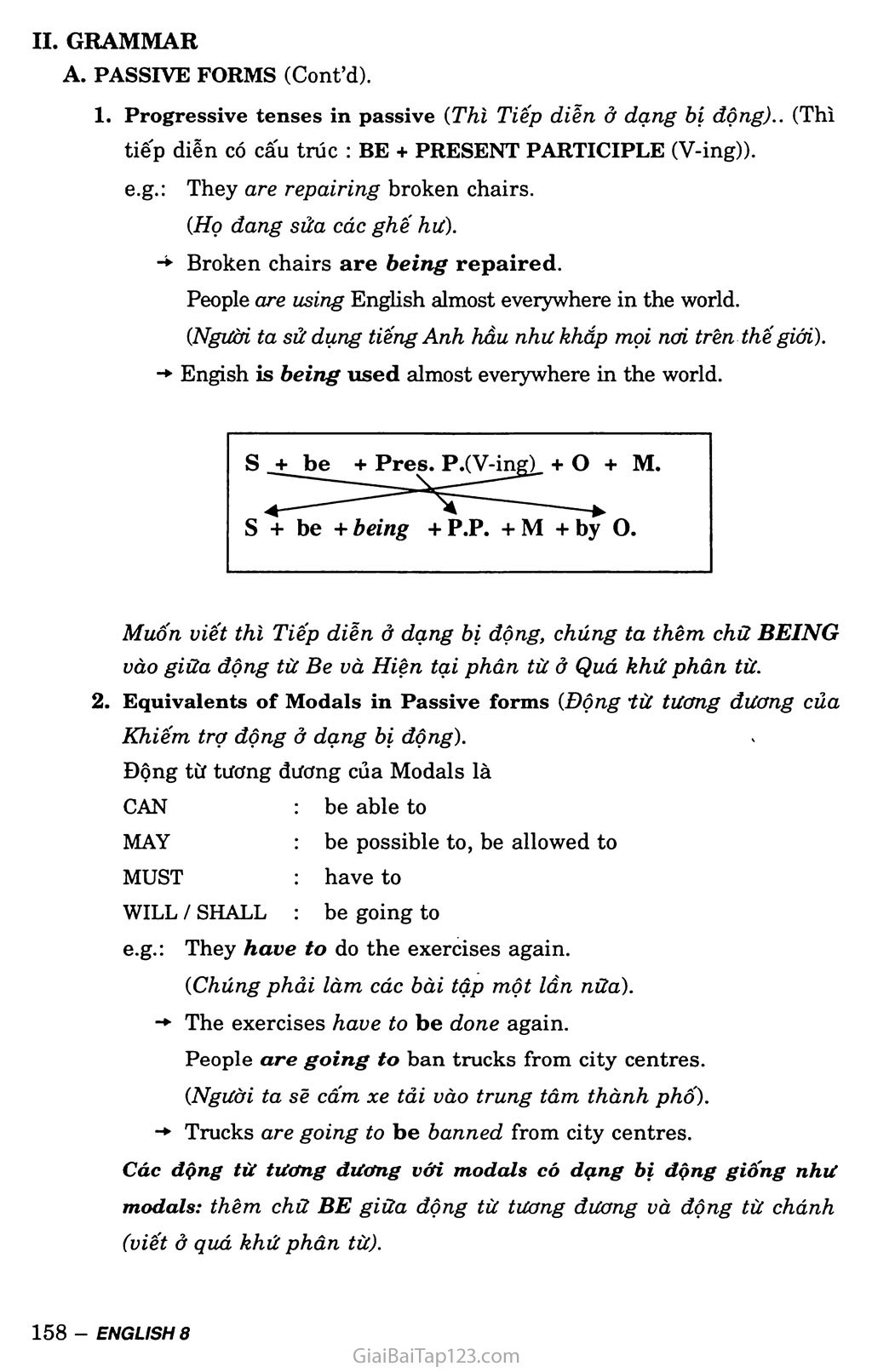
GRAMMAR
A. PASSIVE FORMS (Cont’d).
1. Progressive tenses in passive (Thì Tiếp diễn ở dạng bị động).. (Thì tiếp diễn có cấu trúc : BE + PRESENT PARTICIPLE (V-ing)). e.g.: They are repairing broken chairs.
(Họ đang sửa các ghế hư).
-*• Broken chairs are being repaired.
People are using English almost everywhere in the world.
(Người ta sử dụng tiếng Anh hầu như khắp mọi nơi trên thế giới).
-* Engish is being used almost everywhere in the world.
Muốn viết thì Tiếp diễn ở dạng bị dộng, chúng ta thềm chữ BEING vào giữa động từ Be và Hiện tại phân từ ở Quá khứ phân từ.
2. Equivalents of Modals in Passive forms (Động 'từ tương đương của Khiếm trợ động ở dạng bị động).
Động từ tương đương của Modals là
CAN	:	be able to
MAY	:	be possible to, be allowed to
MUST	:	have to
WILL / SHALL :	be going to
e.g.: They have to do the exercises again.
(Chúng phải làm các bài tập một lần nữa).
-*■ The exercises have to be done again.
People are going to ban trucks from city centres.
(Người ta sẽ cấm xe tải vào trung tâm thành phố).
-* Trucks are going to be banned from city centres.
Các dộng từ tương dương với modals có dạng bị dộng giống như modals: thêm chữ BE giữa động từ tương đương và động từ chánh (viết ở quá khứ phân từ).
SOLUTIONS AND TRANSLATIONS.(Lời giải và Bài dịch).
GETTING STARTED
Match these stages in the development of paper with the correct pictures. {.Ghép các thời kì phát triển, này của giấy với hình đúng).
A - b; B - c; c - e; D - a; E - d
LISTEN AND READ. {Nghe và Đọc).
Practice the dialogue with a partner. {Thực hành bài dối thoại với một bạn cùng học).
Tim Jones, một bạn tâm thư người Mĩ của Hoa, đang thăm một nhà máy sô-cô-la với lớp và giáo viên của anh, bà Allen. Ong Roberts, cai thợ, đang dẫn họ xem quanh nhà máy).
Ong Roberts : Đây là nơi hạt ca-cao được dự trữ. Bây giờ hãy theo tôi và tôi sẽ cho các cháu xem giai đoạn đầu tiên trong quy trình chế biến.
Tim	: Sam, bạn nghĩ cái nút này để làm gì?
Sam	: Tôi không biết.
Bà Allen : Tim! Sam! Hãy đến đây!
Ong Roberts : Các cháu, đừng sờ vào nút đó. Bây giờ các hạt ca-cao được rửa, cân và được nâ'u ở đây.
Bà Allen : Tim, đến đứng bên cạnh cô. Cô đã bảo cháu cách xử sự rồi mà!
Ông Roberts : Sau khi vỏ được bóc đi, hạt được nghiền và làm thành chất lỏng. Bơ ca-cao được thêm vào cùng với đường, va-ni và sữa. Kế hỗn hợp này được nghiền, cán và đổ vào khuôn.
Tim	: Nó trông ngon quá.
Sam	: Các cháu có thể thử chút ít chứ?
Ong Roberts : Vâng, có một ít bên cạnh băng chuyền tải.
Match the half-sentences. Then write the full sentences in your exercise book. {Ghép các phân nửa câu. Sau đó viết câu dầy đủ vào tập bài tập của em).
a +	E	:	The beans are cleaned before being cooked.
b +	D	:	Mr Roberts thought Tim and Sam were going	to	touch
the button.
c +	c	:	After cooking , the cacao beans smell like chocolate.
d +	F	:	Sugar is one of the ingredients in chocolate.
SPEAK. {Nói)
Work with a partner. Students A looks at the table next page. Student B looks at the table at the end of this unit. Ask and answer questions to fill in the missing information in your tables. {Thực hành với một bạn cùng học. Học sinh A nhìn vào bản ở trang kế. Học sinh B nhìn vào bản ở cuối bài này. Hỏi và trả lời để điển
thông tin thiếu vào các bản).
a. Student A : When was the facsimile invented?
Student B :
s. A	:
s. B	:
s . A	:
s. B	:
Student B :
Student A :
s. B.	:
s. A.
s. A	:
s. B.	:
s. A	:
s. B.	:
It was invented in 1843.
Who was it invented by?
By Alexander Bain.
What was his nationality?
He was English.
What was invented by c.w. Rice?
It was loudspeaker.
What was his nationality?
He was American
Who was microphone invented by?
It was invented by D.E. Hughes.
What was his nationality?
He was American. Do you know when was
s. A	:
s. B	:
s . A	:
s. B	:
s. A	:
s. B	:
s .A	:
s. A.	:
s . B	:
s. A.	:
s. B.	:
microphone invented?
It was invented in 1878.
What was invented by Gordon Gould?
It was laser.
When was it invented ?
It was invented in 1958.
What was the inventor's nationality?
He was American.
What was invented by Friedrich Koenig?
It was printing press.
When was it invented?
It was invented in 1810. What was the inventor’s
s. A.	:
f. s. A	:
s. B	:
s. A.	:
nationality?
He was German.
When was helicopter invented?
It was invented in 1939. Who was it invented by? It was invented by Igor Sikorsky. What was his
s. B.	:
g. S.A .	:
s . B	:
s. A	:
s. B	:
s . A	:
nationality?
He was American.
What was invented by Elias Howe?
It was sewing machine. When was it invented?
It was invented in 1845.
What was the inventor’s nationality?
He was American.
Now report your findings to the teacher. (Bây giờ tường thuật những khám phá của em cho giáo viên).
The facsimile was invented Alexander Bain in 1843.
The printing press was invented by a German inventor named Friedrich Koenig in 1810.
The sewing machine was invented by Elias Howe in 1845.
The microphone was invented by an American inventor named D.E. Hughes in 1878.
The loudspeaker was invented by c.w. Rice in 1924.
The helicopter was invented by an American inventor named Igor Sikorsky in 1939.
The laser was invented by Gordon Gould in 1958.
LISTEN. (Nghe).
Listen and fill in the gaps in these sentences. (Nghe và điền chỗ trống ở các câu này).
Papermaking is a (1) simple process.
The procedure is almost the (2) same as it was (3) 200 years ago.
The pulp vat is on the (4) left of the machine.
The papermaking machine has a lot of (5) rollers.
Listen again. Put the sentences in the correct order. (Nghe lại và đặt các câu đúng thứ tự).
D, A, E, G, F, B
READ. (.Đọc).
Read the following poem. (Đọc bài thơ sau đây).
Hiện Đại
Hãy nhìn những gì tôi mua ở thành phô' hôm nay Vật mới đây nhất
Một lò vi-ba nó kêu bi-đom!
Một máy bánh mì nó kêu ping!
Máy hút bụi nó kêu Chuga - chug!
Máy sấy tóc kêu vrom!
Máy rửa đĩa sút cái ghim điện ra Và phát tiếng nổ to nhất!
Chiếc điện thoại cũng mới Cái mới nhất tôi tìm thấy
Nó có cái chuông màu xinh xinh Và không gây tiếng động nào.
1. Match the headings to the verses. (Ghép các tiểu tựa với các đoạn tha).
Verse 1 : b : Appliances that cook food.
Verse 2 : c : Appliances that clean or dry things.
Verse 3 : a : Instrument invented by Alexander Graham Bell.
2. Fill in each of the gaps in the sentences with one “invention” in the poem. (Điền mỗi chỗ trống ở các câu với một phát minh ở bài thơ).
“Joan, Where’s the (1) vacuum ? I want to clean the floor.”
Last night I was reading in the bedroom when the (2) telephone rang. It was Ann, an old friend I didn’t see for more than twelve years.
A (3) dishwasher is a kitchen appliance that automatically washes, rinses and dries dishes and utensils.
“Jane, why don’t you put the meat in the (4) microwave to defrost it?”
“Can I borrow your (5) hairdryer? I’ve just washed my hair.”
The Romans knew how to toast bread over an open fire two thousand years ago. We now toast bread with a (6) toaster on the table.
• WRITE. (Viết).
Fill in each gap with one of these sequence markers to describe the procedure of papermaking. (Điền mỗi chỗ trống với một từ chỉ sự kế tiếp này để mô tả quy trình làm giấy).
first	then (2)	next	after this	finally
(1) First, logs are cut into small chips. (2) Next they are mixed with water and acid. (3) Then they are heated and crushed into a heavy pulp. This wood pulp is also cleaned and chemically whitened. (4) After this, it is passed through rollers to be flattened. (5) Then, sheets of wet paper are produced. (6) Finally, the water is removed from the sheets which are pressed, dried and refined until the finished paper is produced.
Look at the sequence of pictures that describe how cacao beans are processed. Put them in the correct order. (Nhìn sự tuần tự của các hình mô tả cách hột ca-cao được chế biến. Hãy đặt chúng đúng thứ tự).
1-d;	2 - a; 3-e; 4-c; 5-b;	6-f
Now use the sequence markers in exercise “Write 1” to link the sentences together in a paragraph. (Bây giờ dùng các từ chỉ sự kế tiếp ở bàị ‘Viết 1” để liên kết các câu với nhau thành một đoạn văn).
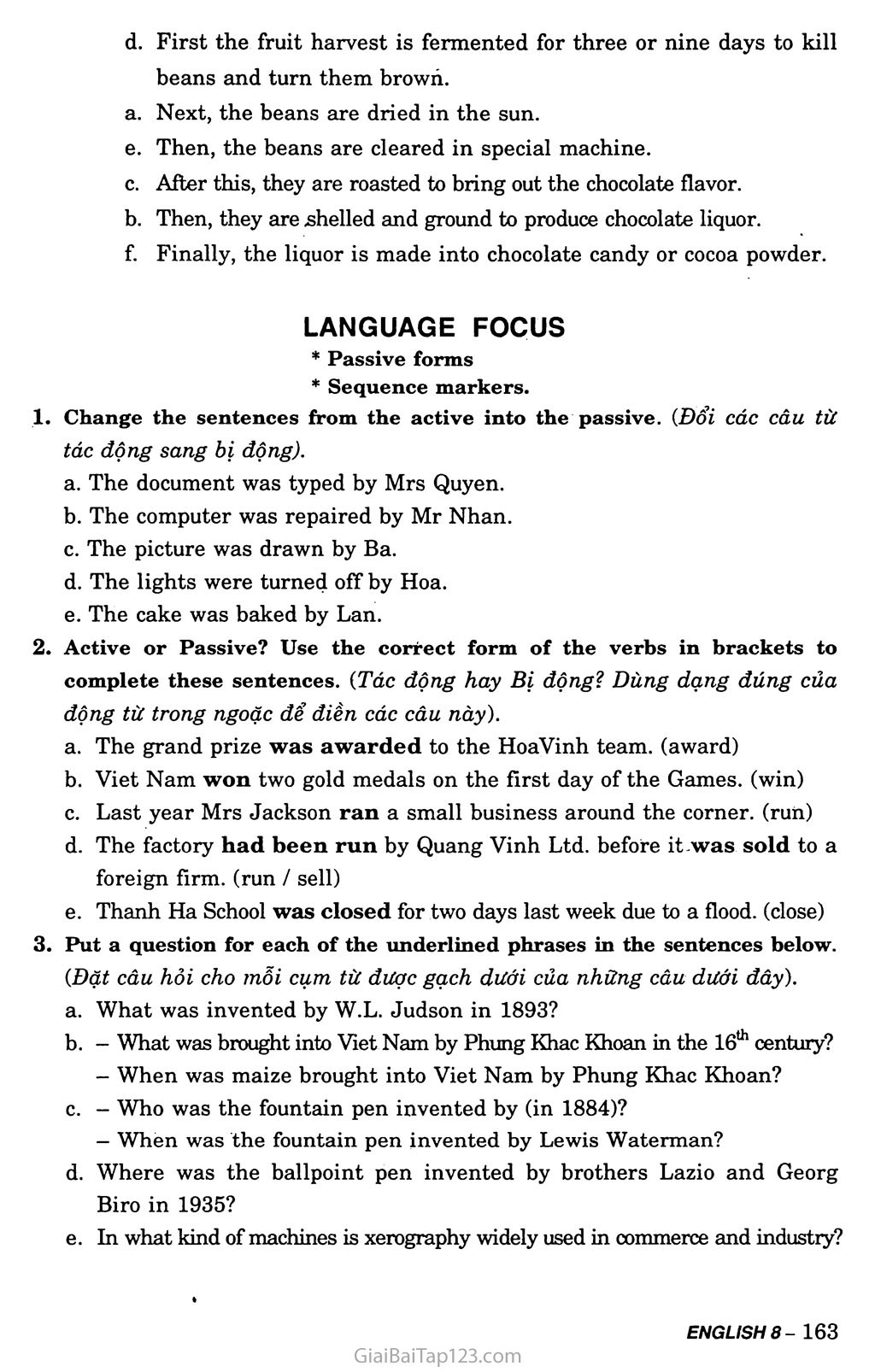
First the fruit harvest is fermented for three or nine days to kill beans and turn them brown.
Next, the beans are dried in the sun.
Then, the beans are cleared in special machine.
After this, they are roasted to bring out the chocolate flavor.
Then, they are shelled and ground to produce chocolate liquor.
Finally, the liquor is made into chocolate candy or cocoa powder.
LANGUAGE FOCUS
Passive forms
Sequence markers.
Change the sentences from the active into the passive. {Đổi các câu từ tác động sang bị động).
The document was typed by Mrs Quyen.
The computer was repaired by Mr Nhan.
The picture was drawn by Ba.
The lights were turned off by Hoa.
The cake was baked by Lan.
Active or Passive? Use the correct form of the verbs in brackets to complete these sentences. {Tác động hay Bị động? Dùng dạng đúng của động từ trong ngoặc để điền các câu này').
The grand prize was awarded to the HoaVinh team, (award)
Viet Nam won two gold medals on the first day of the Games, (win)
Last year Mrs Jackson ran a small business around the corner, (run)
The factory had been run by Quang Vinh Ltd. before it .was sold to a foreign firm, (run / sell)
Thanh Ha School was closed for two days last week due to a flood, (close)
Put a question for each of the underlined phrases in the sentences below. {Đặt câu hỏi cho mỗi cụm từ được gạch dưới của những câu dưới đây).
What was invented by W.L. Judson in 1893?
- What was brought into Viet Nam by Phung Khac Khoan in the 16th century? — When was maize brought into Viet Nam by Phung Khac Khoan?
- Who was the fountain pen invented by (in 1884)?
— When was the fountain pen invented by Lewis Waterman?
Where was the ballpoint pen invented by brothers Lazio and Georg Biro in 1935?
In what kind of machines is xerography widely used in commerce and industiy?
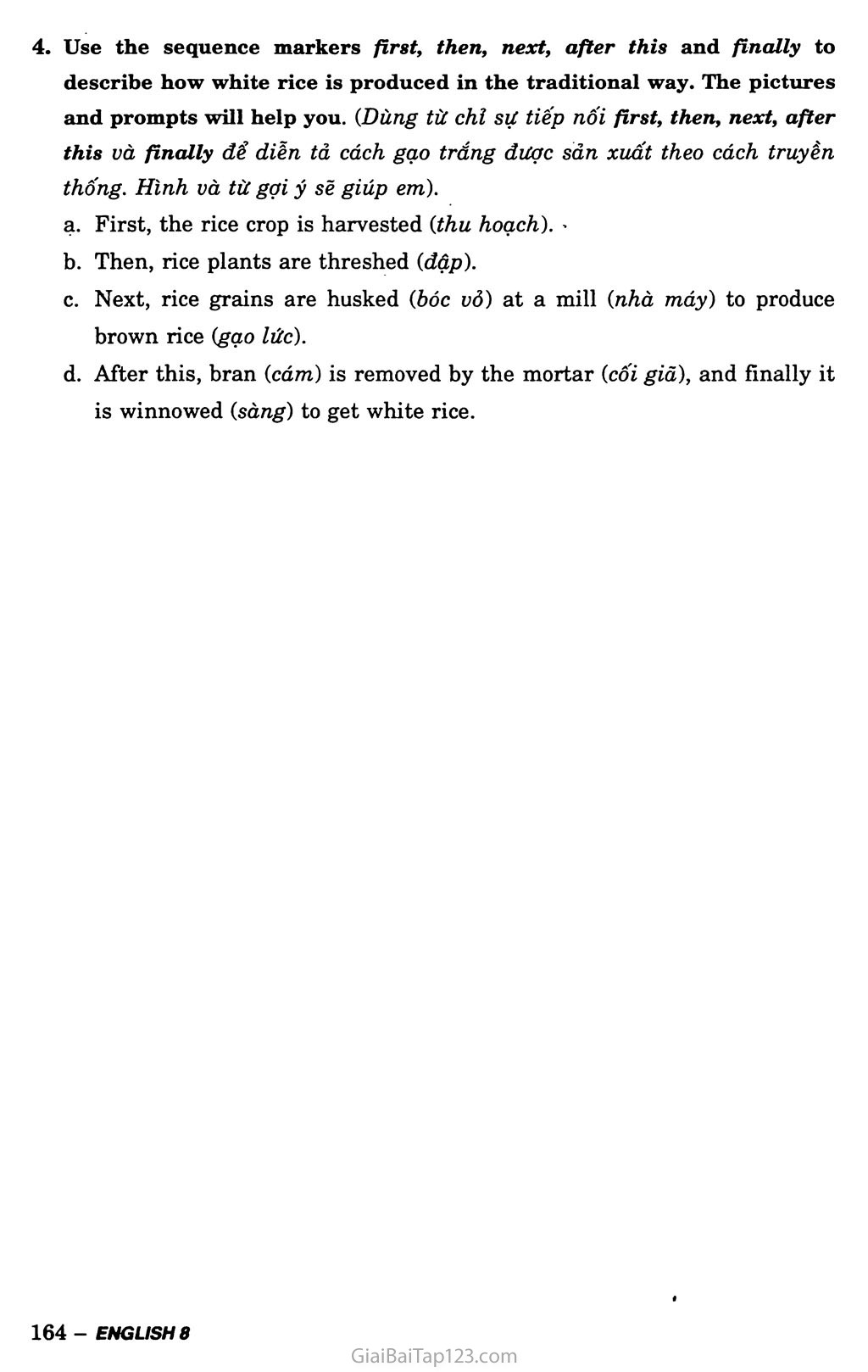
4. Use the sequence markers first, then, next, after this and finally to describe how white rice is produced in the traditional way. The pictures and prompts will help you. {Dùng từ chỉ sự tiếp nối first, then, next, after this và finally để diễn tả cách gạo tráng được sản xuất theo cách truyền thống. Hình và từ gợi ỷ sẽ giúp em').
ạ. First, the rice crop is harvested {thu hoạch). '
Then, rice plants are threshed {đập).
Next, rice grains are husked {bóc vỏ) at a mill {nhà máy) to produce brown rice (gạo lức).
After this, bran (cám) is removed by the mortar (cối giã), and finally it is winnowed (sàng) to get white rice.
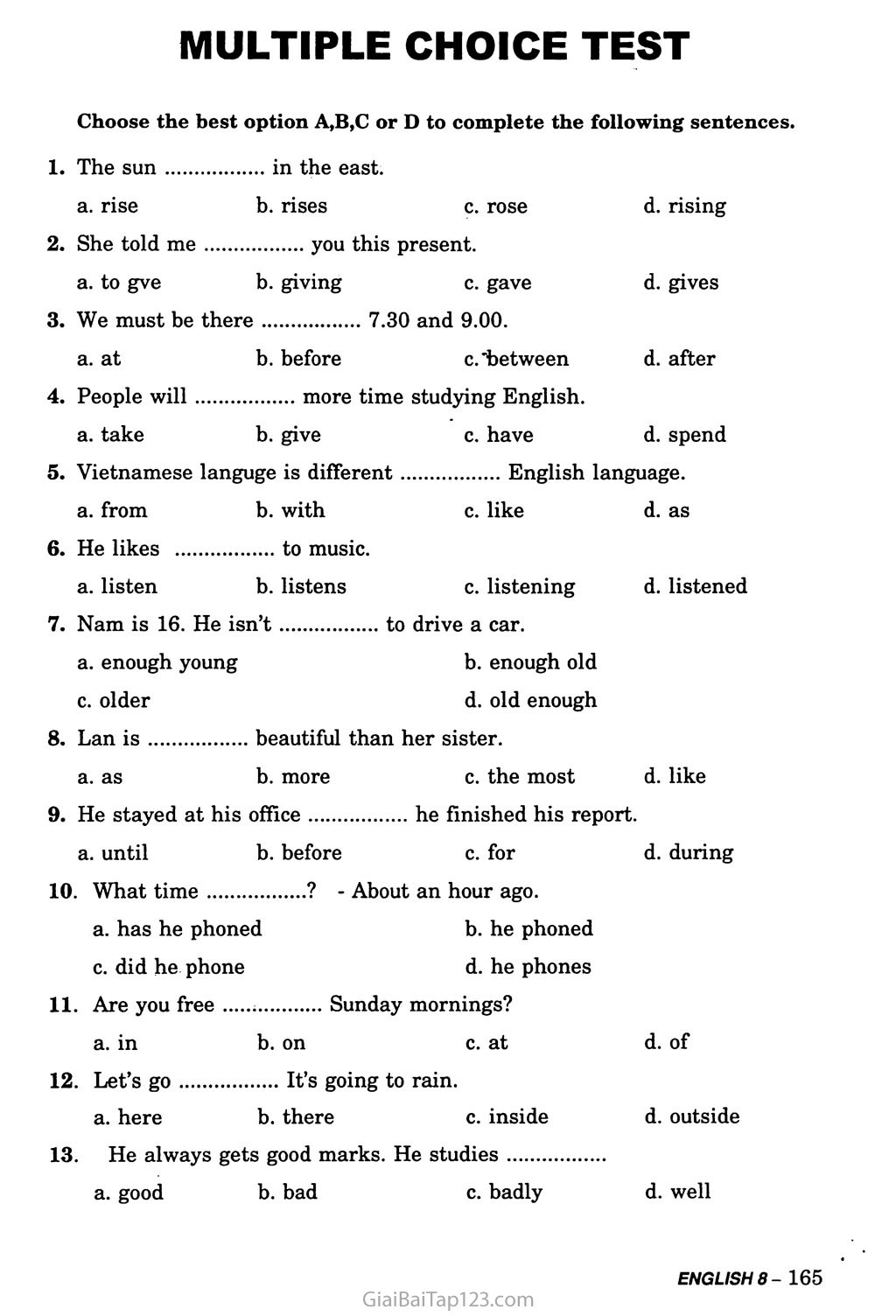
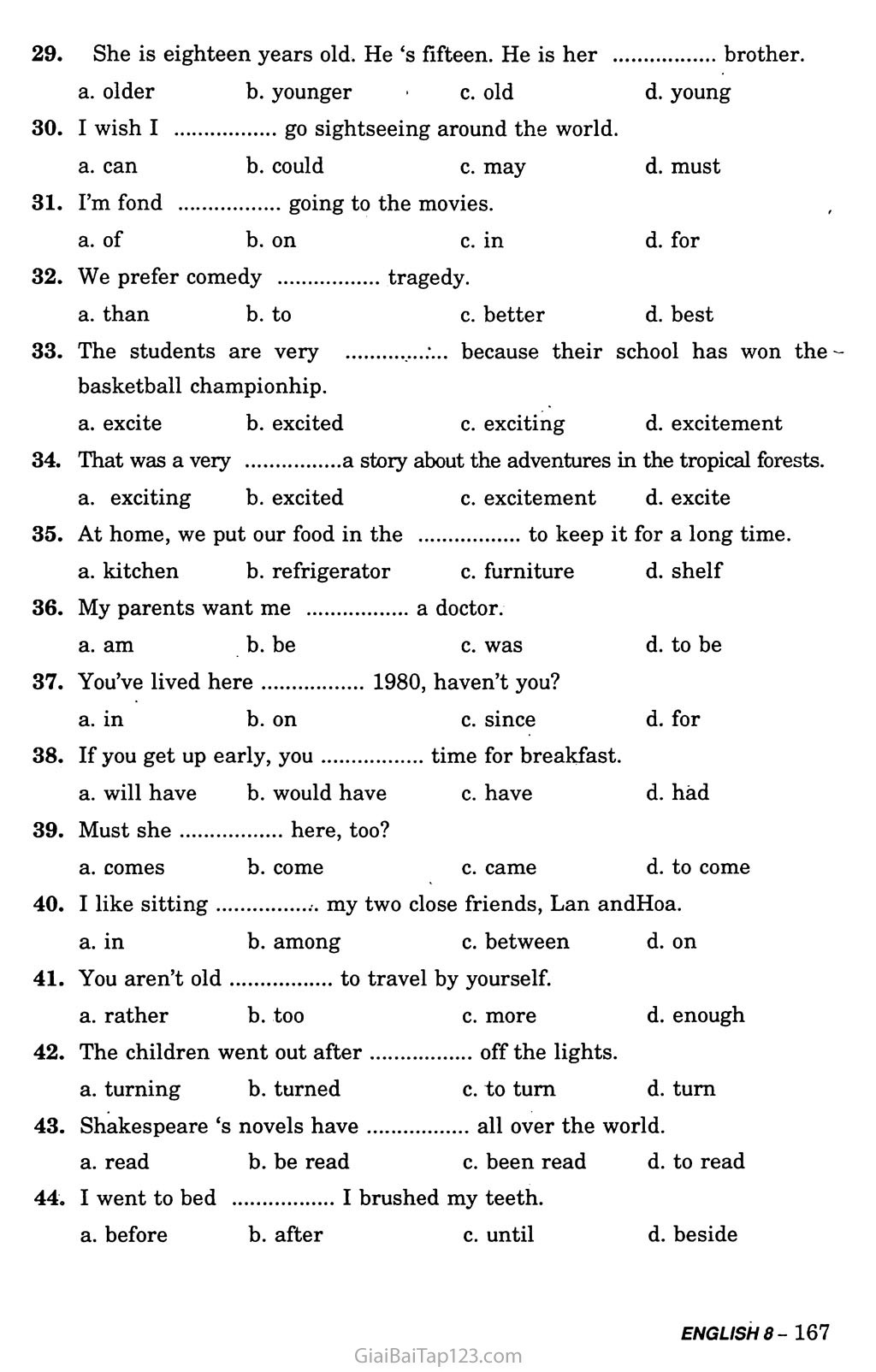
MULTIPLE CHOICE TEST
Choose the best option A,B,C or D to complete the following sentences.
1. The sun	in the east.
a. rise
b. rises	c. rose
d. rising
2. She told me
	you this present.
a. to gve
b. giving	c. gave
d. gives
3. We must be there
:	7.30 and 9.00.
a. at
b. before	c.'between
d. after
4. People will
	more time studying English.
a. take
b. give	c. have
d. spend
5. Vietnamese languge is different	English language.
a. from
b. with
c. like
d. as
6. He likes
.... to music.
a. listen
b. listens
c. listening
d. listened
7. Nam is 16. He isn’t
to drive a car.
a. enough young
b. enough old
c. older
d. old enough
8. Lan is
beautiful than her sister.
a. as
b. more
c. the most
d. like
9. He stayed at his office
.... he finished his report.
a. until
b. before
c. for
d. during
10. What time
	? - About an hour ago.
a. has he phoned
b. he phoned
c. did he phone
d. he phones
11. Are you free
	Sunday mornings?
a. in
b. on
c. at
d. of
12. Let’s go
	It’s going to rain.
a. here
b. there
c. inside
d. outside
13. He always gets good marks,
. He studies
a. good
b. bad
c. badly
d. well
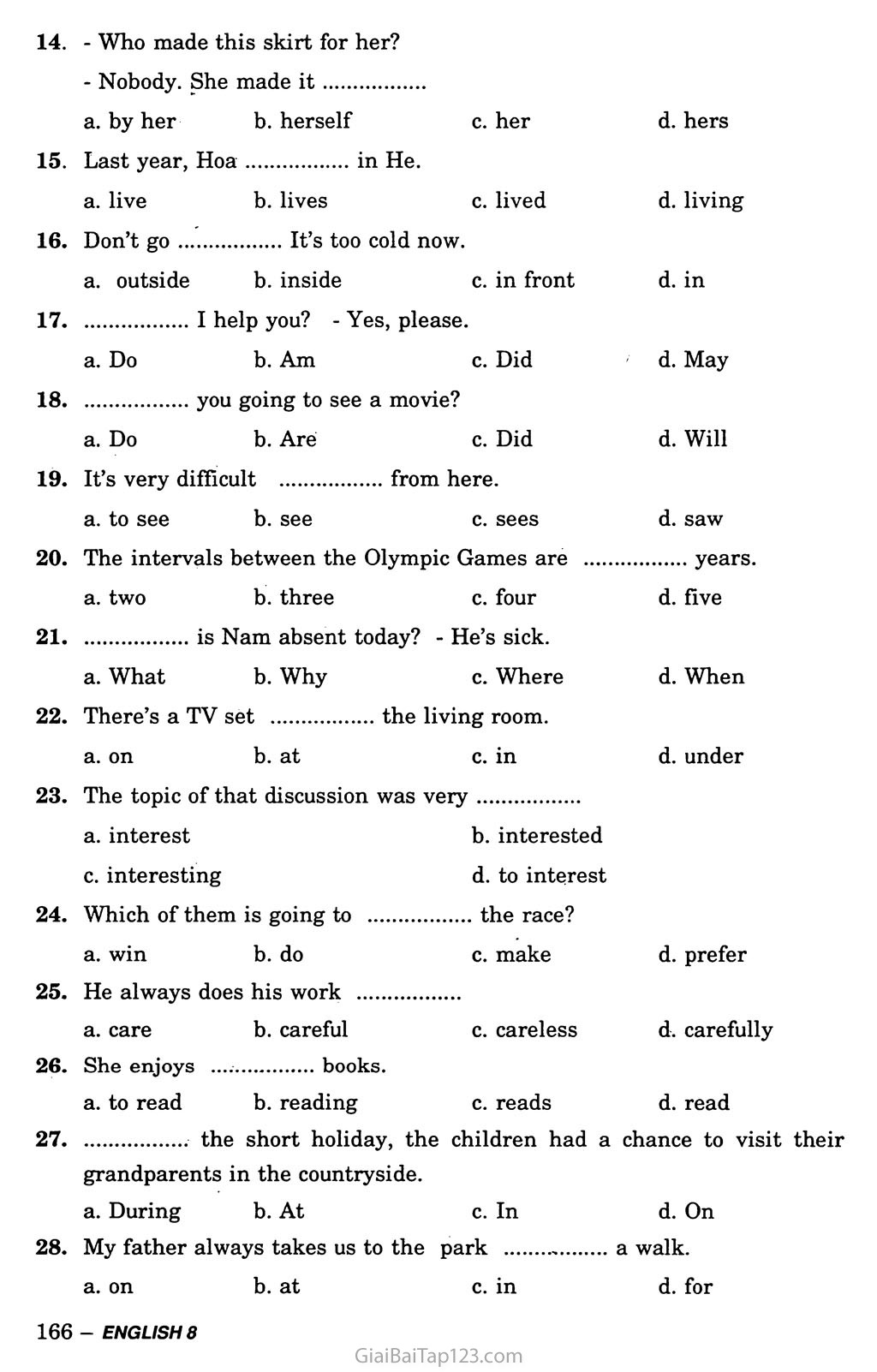
14.
15.
16.
17.
18.
19.
20.
21.
22.
23.
24.
25.
26.
27.
28.
166
Who made this skirt for her?
Nobody. She made it
a. by her
b. herself	c. her
d. hers
Last year, Hoa
	in He.
a. live
b. lives	c. lived
d. living
Don’t go
	It’s too cold now.
a. outside
b. inside	c. in front
d. in
	I help you? - Yes, please.
a. Do	b. Am
c. Did
d. May
	you going to see a movie?
a. Do	b. Are
c. Did
d. Will
It’s very difficult
	from here.
a. to see	b. see
c. sees
d. saw
The intervals between the Olympic Games are 	years.
a. two
b. three
c. four
d. five
. is Nam absent today? - He’s sick.
a. What
b. Why
c. Where
d. When
There’s a TV set
... the living room.
a. on
b. at
c. in
d. under
The topic of that discussion was very
a. interest
b. interested
c. interesting
d. to interest
Which of them is going to
	 the race?
a. win	b. do
c. make	d. prefer
He always does his work
a. care	b. careful
c. careless	d. carefully
She enjoys 	 books.
a. to read	b. reading
c. reads	d. read
	 the short holiday, the
children had a chance to visit
grandparents in the countryside.
a. During	b. At
c. In	d. On
My father always takes US to the
park 	a walk.
a. on	b. at
c. in	d. for
29.
She is eighteen years old. He ‘s fifteen. He is her ...
	brother.
d. young
a. older
b. younger
c. old
30.
I wish I
	go sightseeing around the world.
a. can
b. could
c. may
d. must
31.
I’m fond
	going to the movies.
a. of
b. on
c. in
d. for
32.
We prefer comedy
.. tragedy.
a. than
b. to
c. better
d. best
33.
The students
are very
	.... because their school has won the
basketball championhip.
a. excite
b. excited
c. exciting
d. excitement
34. That was a very
a. exciting
b. excited
c. excitement
d. excite
35. At home, we put our food in the
	to keep it for a long time.
a. kitchen
b. refrigerator
c. furniture
d. shelf
36. My parents want me
a doctor.
a. am
b. be
c. was
d. to be
37. You’ve lived here	 1980, haven’t you?
a. in
b. on
c. since
d. for
38. If you get up early, you
... time for breakfast.
a. will have
b. would have
c. have
d. had
39. Must she
	here, too?
a. comes
b. come
c. came
d. to come
40. I like sitting ...
	 my two close friends, Lan andHoa.
a. in
b. among
c. between
d. on
41. You aren’t old .
	to travel by yourself.
a. rather
b. too
c. more
d. enough
42. The children went out after
	off the lights.
a. turning
b.turned
c. to turn
d. turn
43. Shakespeare ‘s
novels have
	all over the world.
a. read
b. be read
c. been read
d. to read
44. I went to bed .
	I brushed my teeth.
a. before
b. after
c. until
d. beside
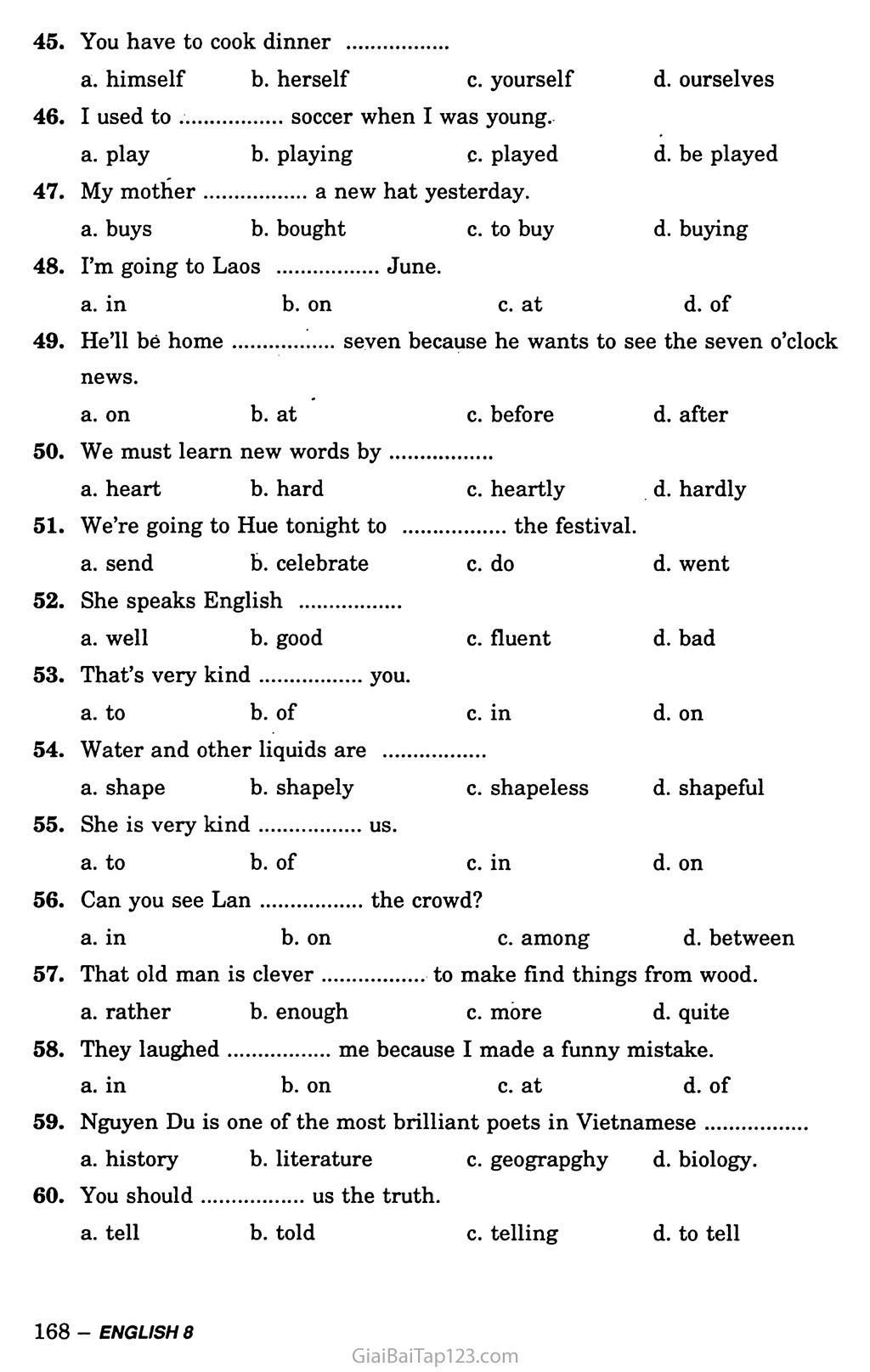
45.
46.
47.
48.
49.
50.
51.
52.
53.
54.
55.
56.
57.
58.
59.
60.
168
You have to cook dinner
a. himself b. herself	c. yourself	d. ourselves
I used to 	soccer when I was young.
a. play	b. playing	c. played	d. be played
My mother	a new hat yesterday.
a. buys	b. bought	c. to buy	d. buying
I’m going to Laos 	June.
a. in	b. on	c. at	d. of
He’ll be home	 seven because he wants to see the seven o’clock
news.
a. on	b. at	c. before	d. after
We must learn new words by
a. heart	b. hard	c. heartly	d. hardly
We’re going to Hue tonight to 	the festival.
a. send	b. celebrate	c. do	d. went
She speaks English
a. well	b.	good	c.	fluent	d.	bad
That’s very kind	you.
Can you see Lan	the crowd?
a. in	b. on	c. among	d. between
That old man is clever	to make find things from wood.
a. rather	b. enough	c. more	d. quite
They laughed	me because I made a funny mistake.
a. in	b. on	c. at	d. of
Nguyen Du is one of the most brilliant poets in Vietnamese
a. history	b. literature	c. geograpghy	d. biology.
You should	us the truth.
a. tell	b. told	c. telling	d. to tell
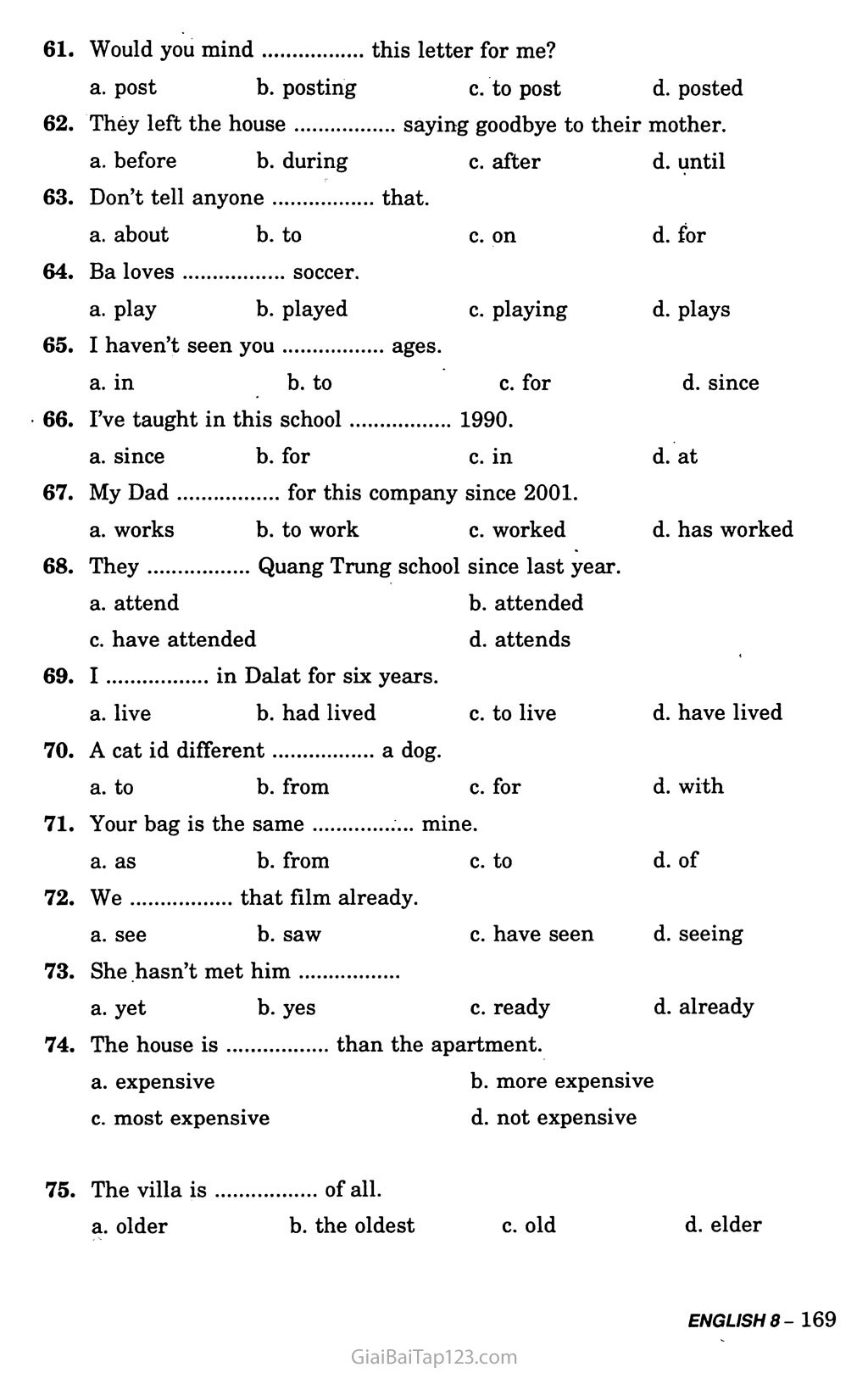
61.
Would you mind
a. post	b. posting
this letter for me?
c. to post
d. posted
62.
They left the house
	saying goodbye to their mother.
a. before	b. during
c. after
d. until
63.
Don’t tell anyone
.. that.
a. about	b. to
c. on
d. for
64.
Ba loves	soccer.
a. play	b. played
c. playing
d. plays
65.
Ĩ haven’t seen you
affes.
a. in	b. to
c. for
d. since
66.
I’ve taught in this school ...
	 1990.
a. since	b. for
c. in
d. at
67.
My Dad	for this
company since 2001.
a. works	b. to work
c. worked
d. has worked
68.
They	Quang Trung school since last year.
a. attend
b. attended
c. have attended
d. attends
69.
I	in Dalat for six years.
a. live	b. had lived	c. to live
d. have lived
70.
A cat id different
.. a dog.
a. to	b. from
c. for
d. with
71.
Your bag is the same
	 mine.
a. as	b. from
c. to
d. of
72.
We	that film already.
a. see	b. saw
c. have seen
d. seeing
73.
She hasn’t met him
a. yet	b. yes
c. ready
d. already
74.
The house is	than the apartment.
a. expensive
b. more expensive
c. most expensive
d. not expensive
75.
The villa is	of all.
a. older	b. the oldest	c. old
d. elder
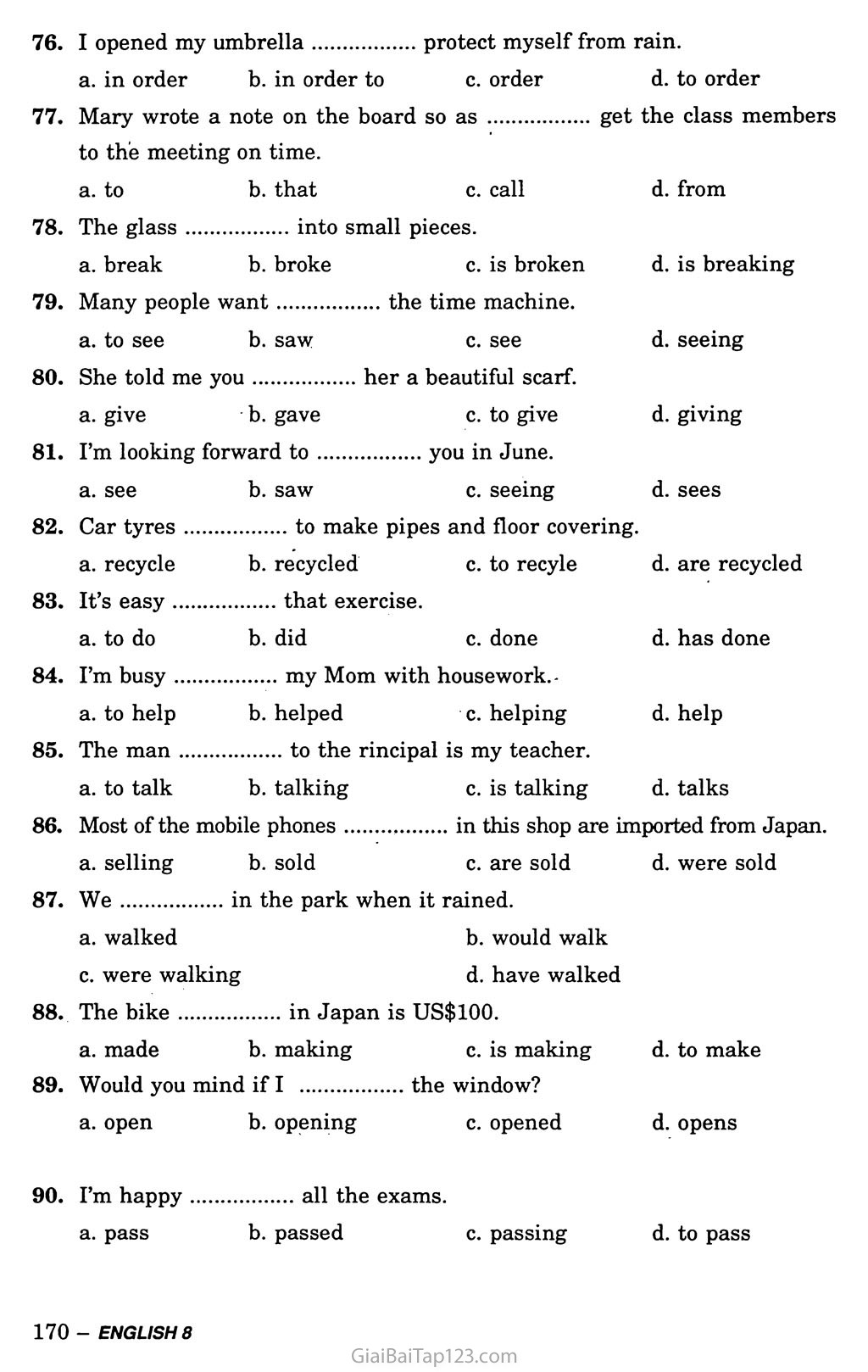
I opened my umbrella	protect myself from rain.
a. in order b. in order to	c. order	d. to order
Mary wrote a note on the board so as 	 get the class members
to the meeting on time.
a. to
b. that
c. call
d. from
78.
The glass ...
	into small pieces.
a. break
b. broke
c. is broken
d. is breaking
79.
Many people want
.. the time machine.
a. to see
b. saw
c. see
d. seeing
80.
She told me
you	her a beautiful scarf.
a. give
b. gave
c. to give
d. giving
81.
I’m looking forward to
	you in June.
a. see
b. saw
c. seeing
d. sees
82.
Car tyres ....
	to make pipes and floor covering.
a. recycle
b. recycled
c. to recyle
d. are recycled
83.
It’s easy
	that exercise.
a. to do
b. did
c. done
d. has done
84.
I’m busy
a. to help
b. helped
c. helping
d. help
85.
The man
	to the rincipal is my teacher.
a. to talk
b. talking
c. is talking
d. talks
86.
Most of the mobile phones
a. selling
b. sold
c. are sold
d. were sold
87.
We
... in the park when it rained.
a. walked
b. would walk
c. were walking
d. have walked
88.
The bike
	in Japan is US$100.
a. made
b. making
c. is making
d. to make
89.
Would you mind if I
	the window?
a. open
b. opening
c. opened
d. opens
90.
I’m happy ...
	all the
exams.
a. pass
b. passed
c. passing
d. to pass
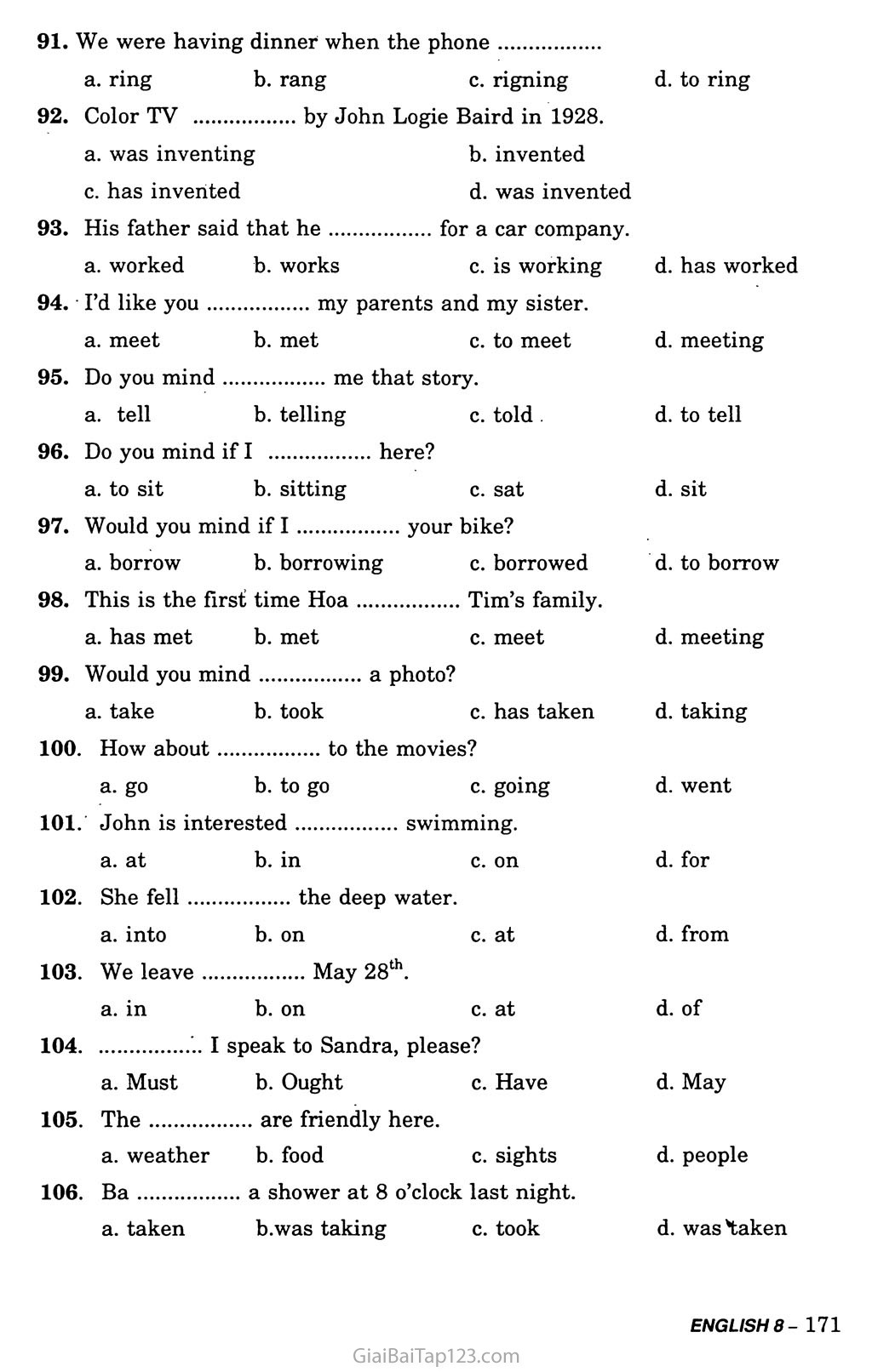
91. We were having dinner when the phone
a. ring	b. rang
c. rigning
d. to ring
92. Color TV 	by John Logie Baird in 1928.
a. was inventing
b. invented
c. has invented
d. was invented
93. His father said that he
	for a car company.
a. worked	b. works
c. is working
d. has worked
94. I’d like you	my parents and my sister.
a. meet
b. met
c. to meet
d. meeting
95. Do you mind ..
	me
that story.
a. tell
b. telling
c. told .
d. to tell
96. Do you mind if I 	here?
a. to sit
b. sitting
c. sat
d. sit
97. Would you
mind if I
. your bike?
a. borrow
b. borrowing
c. borrowed
d. to borrow
98. This is the first time Hoa
	Tim’s family.
a. has met
b. met
c. meet
d. meeting
99. Would you mind	a photo?
a. take
b. took	c. has taken
d. taking
100. How about
	to the movies?
a. go
b. to go	c. going
d. went
101. John is interested	swimming.
a. at
b. in	c. on
d. for
102. She fell ....
	the deep water.
a. into
b. on	c. at
d. from
103. We leave ..
	May 28th.
a. in
b. on	c. at
d. of
104
1 speak to Sandra, please?
a. Must
b. Ought	c. Have
d. May
105. The
	are friendly here.
a. weather
b. food	c. sights
d. people
106. Ba
	a shower at 8 o’clock last night.
a. taken
b.was taking	c. took
d. was'ta
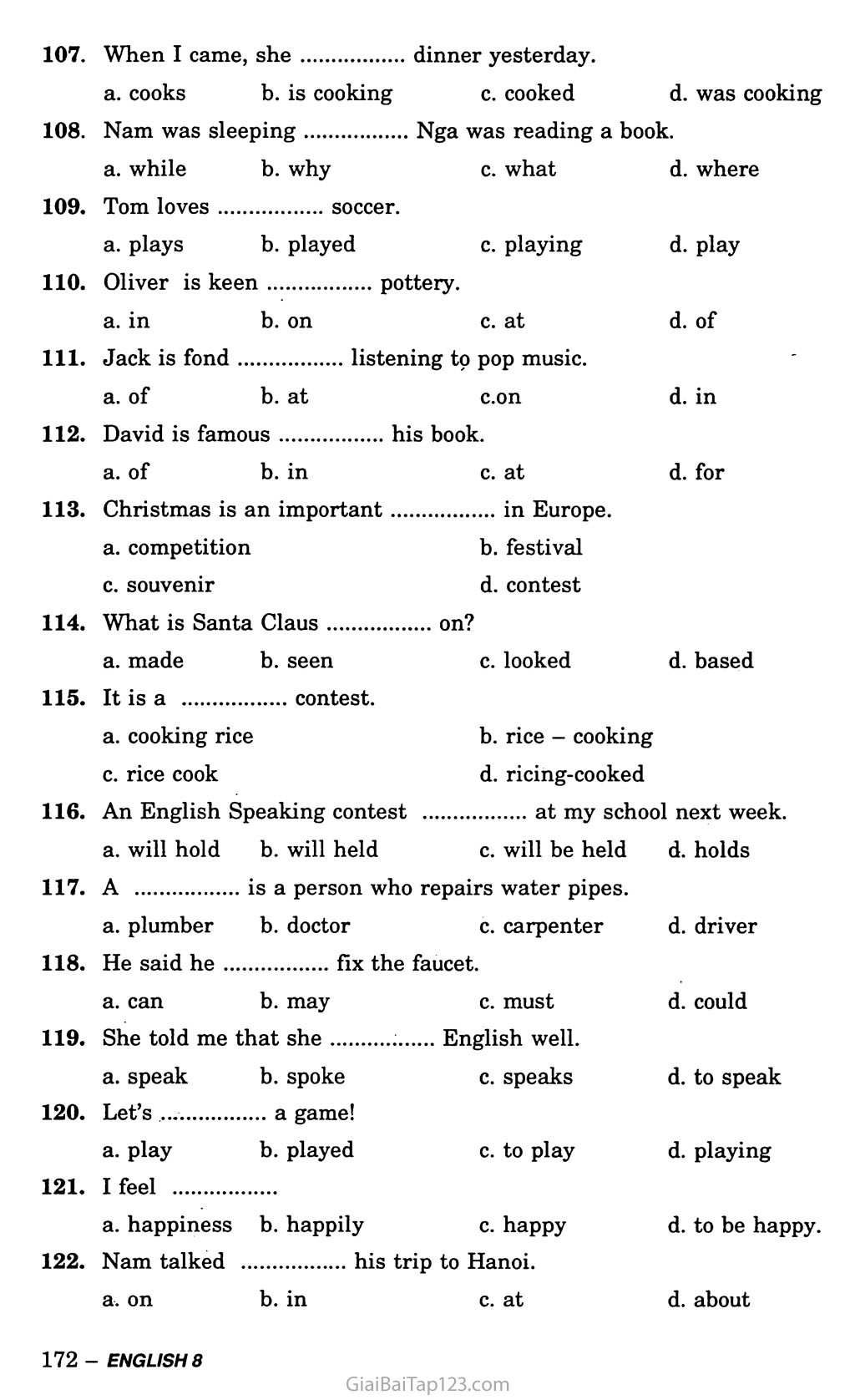
107.
When I came, she
dinner yesterday.
a. cooks
b. is cooking
c. cooked
d. was cooking
108.
Nam was sleeping
Nga was reading a book.
a. while
b. why
c. what
d. where
109.
Tom loves
	soccer.
a. plays
b. played
c. playing
d. play
110.
Oliver is keen	pottery.
a. in
b. on
c. at
d. of
111.
Jack is fond ...
	listening to pop music.
-
a. of
b. at
c.on
d. in
112.
David is famous	his book.
a. of
b. in
c. at
d. for
113.
Christmas is an important ...
	in Europe.
a. competition
b. festival
c. souvenir
d. contest
114.
What is Santa Claus
.... on?
a. made
b. seen
c. looked
d. based
115.
It is a
	contest.
a. cooking rice
b. rice - cooking
c. rice cook
d. ricing-cooked
116.
An English Speaking contest
	at my school next week.
a. will hold
b. will held
c. will be held
d. holds
117.
A 	is a person who repairs water pipes.
a. plumber
b. doctor
c. carpenter
d. driver
118.
He said he
	fix the faucet.
a. can
b. may
c. must
d. could
119.
She told me that she
.... English well.
a.speak
b. spoke
c. speaks
d. to speak
120.
Let’s
.. a game!
a. play
b. played
c. to play
d. playing
121.
I feel
a. happiness
b. happily
c. happy
d. to be happy.
122.
Nam talked ..
	his trip to Hanoi.
a. on
b. in
c. at
d. about
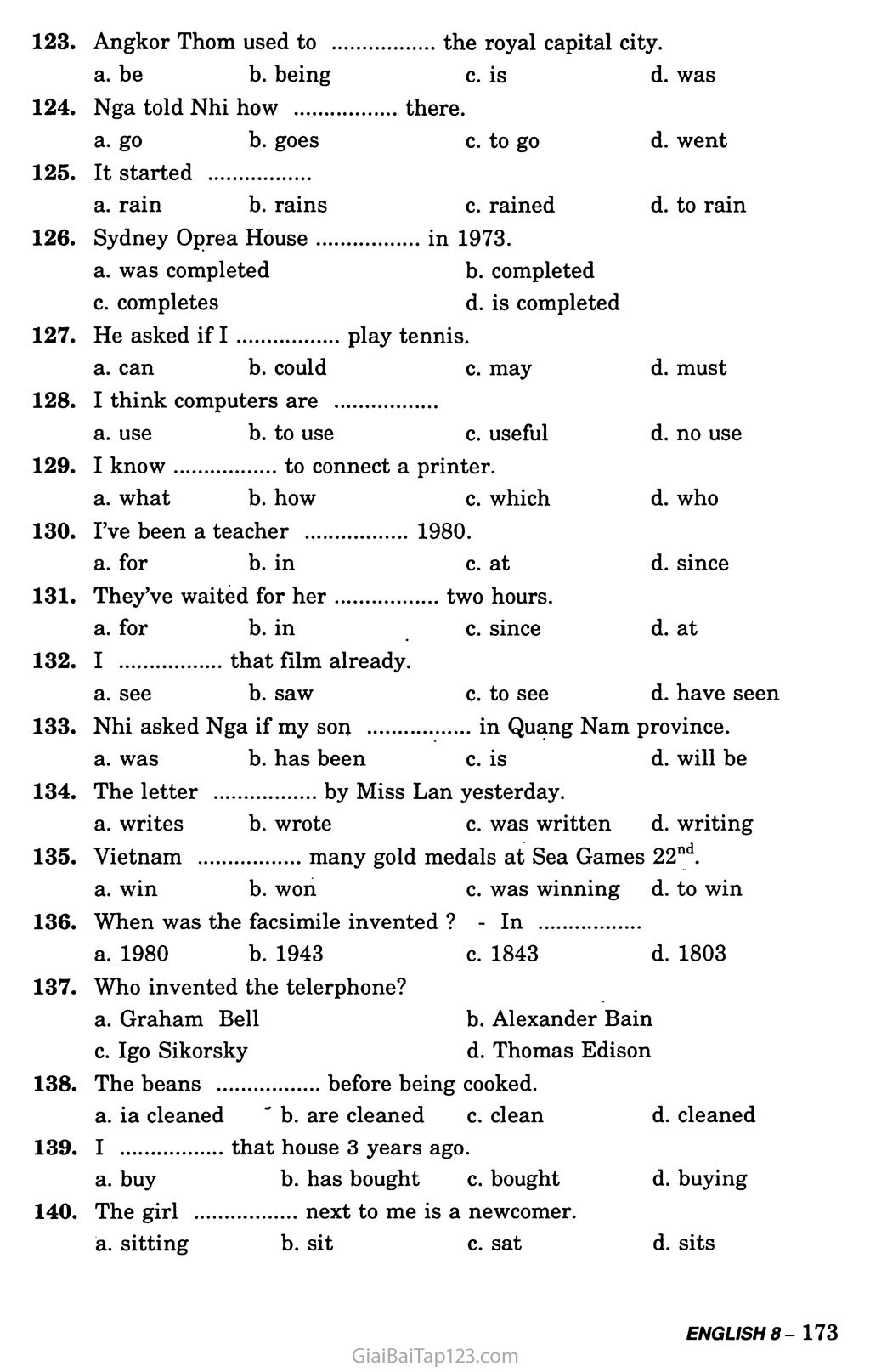
123.
Angkor Thom used to ..
	the royal capital city.
a. be	b. being
c. is
d. was
124.
Nga told Nhi how
	there.
a. go	b. goes
c. to go
d. went
125.
It started
a. rain	b. rains
c. rained
d. to rain
126.
Sydney Oprea House ....
	in 1973.
a. was completed
b. completed
c. completes
d. is completed
127.
He asked if I
play tennis.
a. can	b. could
c. may
d. must
128.
I think computers are .
a. use	b. to use
c. useful
d. no use
129. I know	to connect a printer.
a. what	b. how	c. which	d. who
130. I’ve been a teacher 	 1980.
a. for
b. in
c. at
d. since
131. They’ve waited for her	two hours.
a. for
b. in
c. since
d. at
132. I
.. that film already.
a. see
b. saw
c. to see
d. have seen
133. Nhi asked Nga if my son
.. in Quang Nam province.
a. was
b. has been
c. is
d. will be
134. The letter
	by Miss Lan yesterday.
a. writes
b. wrote
c. was written
d. writing
135. Vietnam ...
	many gold medals at Sea Games 22nd.
a. win
b. won
c. was winning
d. to win
136. When was the facsimile invented ?
- In
a. 1980
b. 1943
c. 1843
d. 1803
137. Who invented the telerphone?
a. Graham
Bell
b. Alexander Bain
c. Igo Sikorsky
d. Thomas Edison
138. The beans
a. ia cleaned	' b. are cleaned
c. clean
d. cleaned
139. I
.. that house 3 years ago.
a. buy
b. has bought
c. bought
d. buying
140. The girl ...
	next to me is a newcomer.
a. sitting
b. sit
c. sat
d. sits
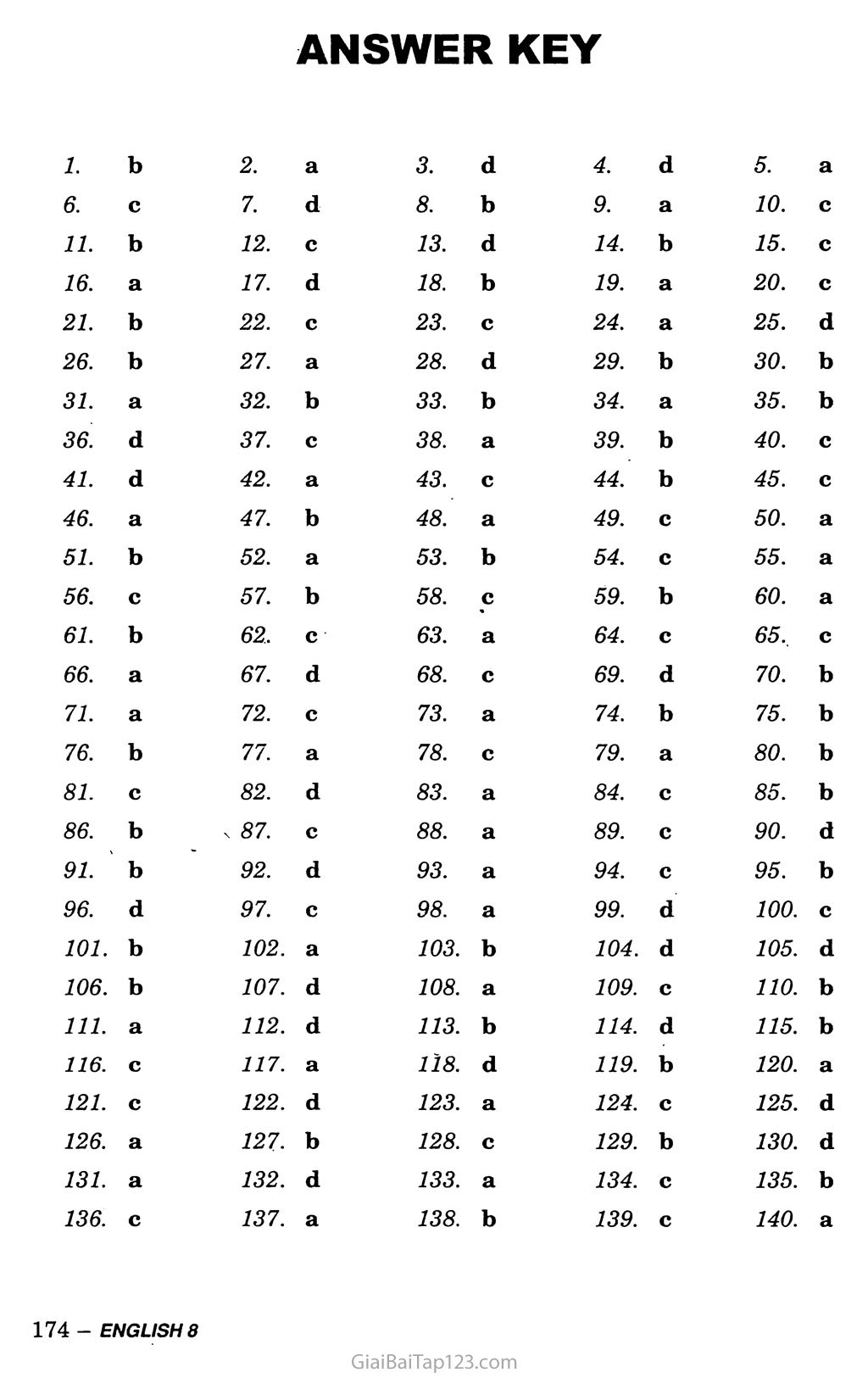
ANSWER KEY
1.
b
2.
a
3.
d
4.
d
5.
a
6.
c
7.
d
8.
b
9.
a
10.
c
11.
b
12.
c
13.
d
14.
b
15.
c
16.
a
17.
d
18.
b
19.
a
20.
c
21.
b
22.
c
23.
c
24.
a
25.
d
26.
b
27.
a
28.
d
29.
b
30.
b
31.
a
32.
b
33.
b
34.
a
35.
b
36.
d
37.
c
38.
a
39.
b
40.
c
41.
d
. 42.
a
43.
c
44.
b
45.
c
46.
a
47.
b
48.
a
49.
c
50.
a
51.
b
52.
a
53.
b
54.
c
55.
a
56.
c
57.
b
58.
c
59.
b
60.
a
61.
b
62.
c
63.
a
64.
c
65.
c
66.
a
67.
d
68.
c
69.
d
70.
b
71.
a
72.
c
73.
a
74.
b
75.
b
76.
b
77.
a
78.
c
79.
a
80.
b
81.
c
82.
d
83.
a
84.
c
85.
b
86.
b
, 87.
c
88.
a
89.
c
90.
d
91.
b
92.
d
93.
a
94.
c
95.
b
96.
d
97.
c
98.
a
99.
d
100.
c
101.
b
102.
a
103.
b
104.
d
105.
d
106.
b
107.
d
108.
a
109.
c
110.
b
111.
a
112.
d
113.
b
114.
d
115.
b
116.
c
117.
a
118.
d
119.
b
120.
a
121.
c
122.
d
123.
a
124.
c
125.
d
126.
a
127.
b
128.
c
129.
b
130.
d
131.
a
132.
d
133.
a
134.
c
135.
b
136.
c
137.
a
138.
b
139.
c
140.
a