
Giải tiếng Anh lớp 10 Unit 7: The Mass Media

57
THE MASS MEDIA
(Phương tiện truyền thông đại chúng)
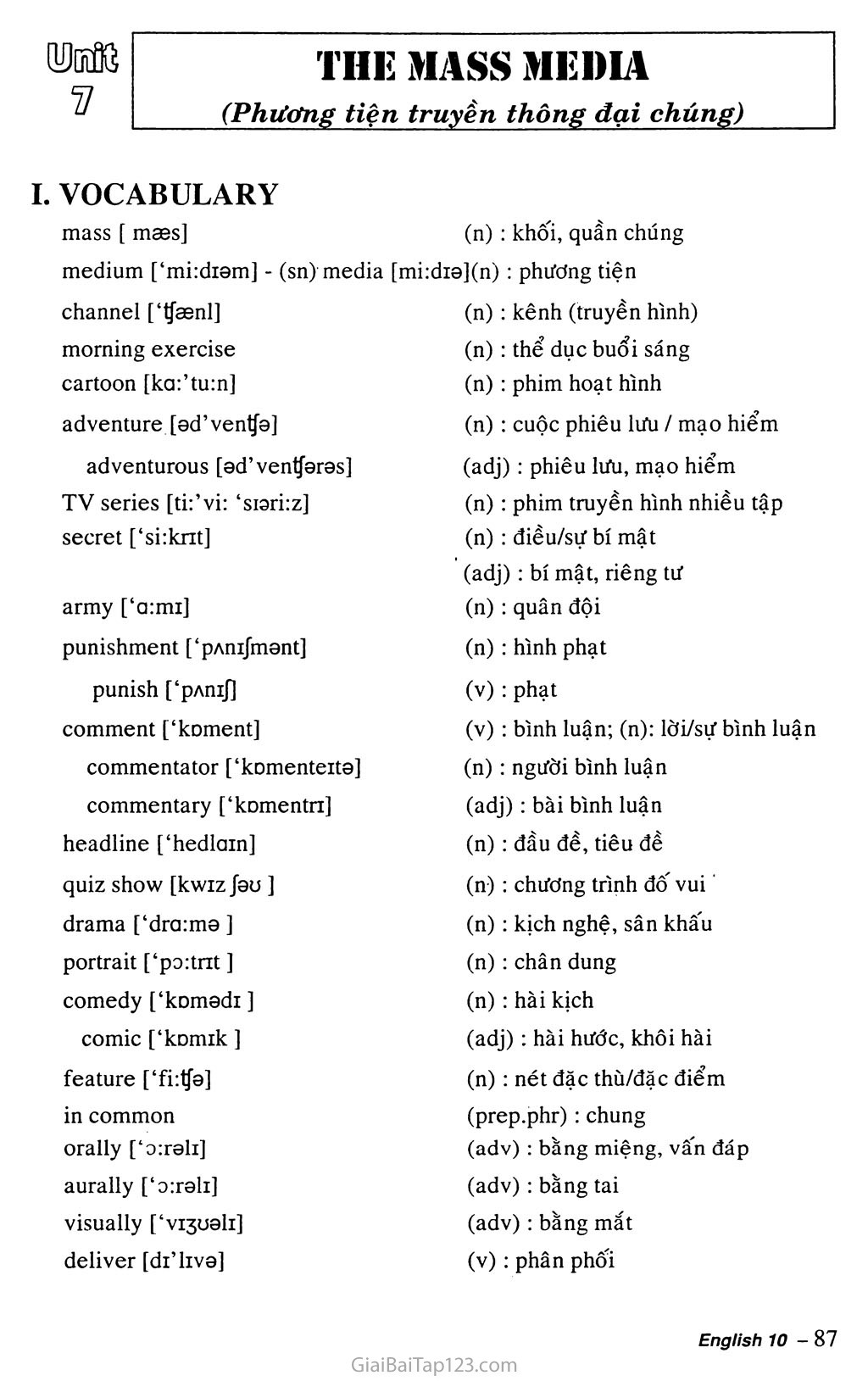
VOCABULARY
mass [ maes]	(n) : khôi, quần chúng
medium [lmi:diem] - (sn) media [mi:di9](n): phương tiện
channel [‘tfasnl] morning exercise cartoon [ka:’tu:n]
adventure [ed’ventfs]
adventurous [ed’ventferas]
TV series [ti:’vi: ‘sioriiz] secret [‘si:knt]
army [la:mi]
punishment [‘pAnifment] punish [‘pAnifl
comment [‘kDment]
commentator [‘komenteite] commentary [‘kDmentri]
headline [‘hedlain] quiz show [kwizjbu ] drama [‘dra:ma ] portrait [‘po:trit ] comedy [‘kDmsdi ]
comic [‘komik ] feature [‘fi:tfa] in common orally [‘o:rsli] aurally [lo:rali] visually [‘vi^uali] deliver [di’livo]
(n) : kênh (truyền hình)
(n) : thể dục buổi sáng
(n) : phim hoạt hình
(n) : cuộc phiêu lưu / mạo hiểm
(adj) : phiêu lưu, mạo hiểm
(n) : phim truyền hình nhiều tập
(n) : điều/sự bí mật
(adj) : bí mật, riêng tư
(n) : quân đội
(n) : hình phạt
(v) : phạt
(v) : bình luận; (n): lời/sự bình luận
(n) : người bình luận
(adj) : bài bình luận
(n) : đầu đề, tiêu đề
(n) : chương trình đố vui
(n) : kịch nghệ, sân khâu
(n) : chân dung
(n) : hài kịch
(adj) : hài hước, khôi hài
(n) : nét đặc thù/đặc điểm
(prep.phr) : chung
(adv) : bằng miệng, vấn đáp
(adv) : bằng tai
(adv) : bằng mắt
(v) : phân phôi
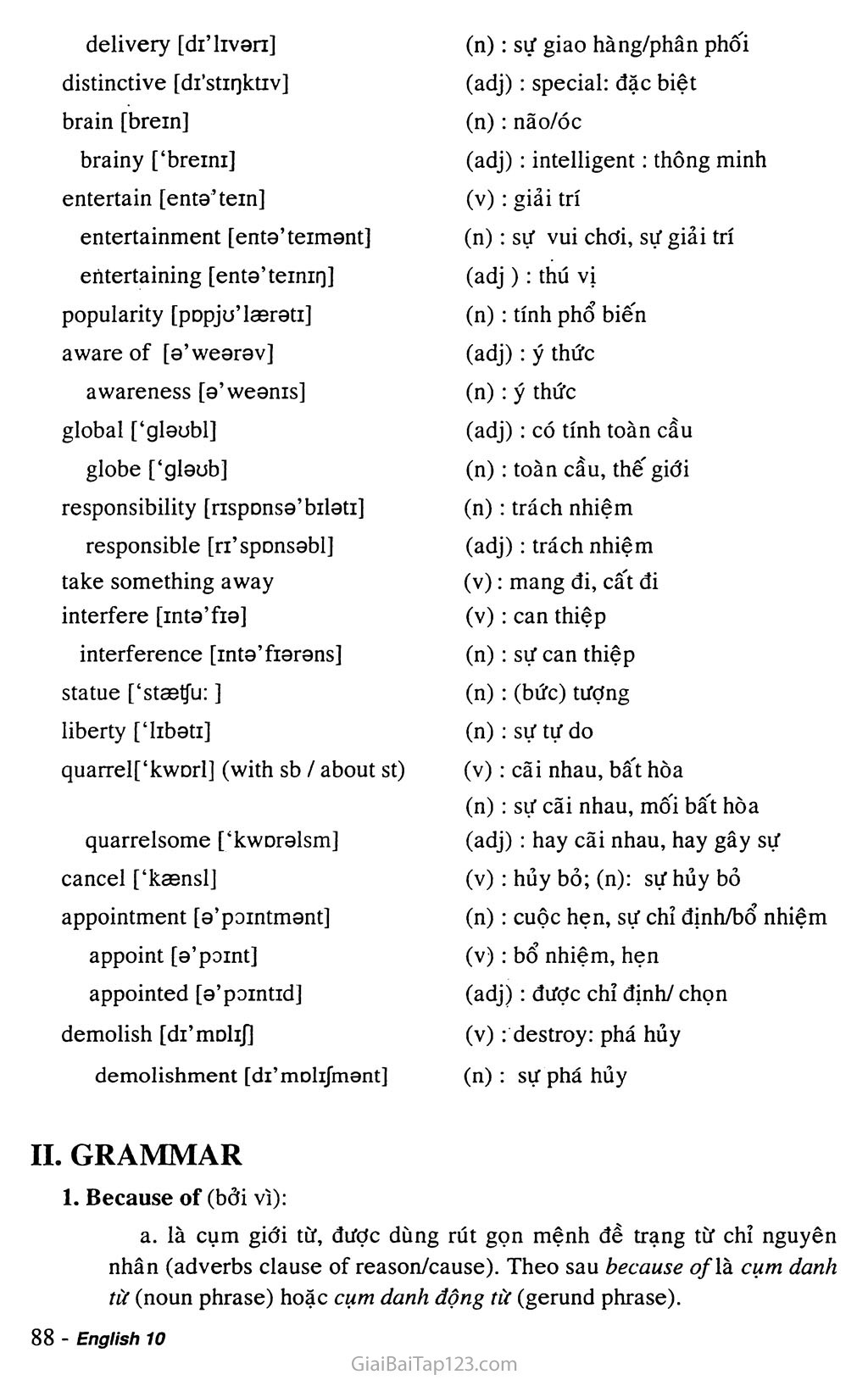
delivery [di’liven] distinctive [di’stiqktiv] brain [brein]
brainy [‘breini] entertain [enta’tein]
entertainment [ente’teimsnt] entertaining [ento’teiniq]
popularity [pDpju’lsersti] aware of [e’weersv]
awareness [a’weenis] global [‘glaobl]
globe [‘glaub]
responsibility [rispDnsa’ bilati] responsible [ri’sponsabl]
take something away
interfere [inta’fia] interference [inta’fiarans]
statue [‘stastfu: ]
liberty [‘libati]
quarrel[‘kwDrl] (with sb / about St)
quarrelsome pkwDralsm] cancel [‘kasnslj appointment [a’pointmant]
appoint [a’point] appointed [a’pointid]
demolish [di’mDliJ]
demolishment [di’mDhJmant]
(n): sự giao hàng/phân phôi (adj) : special: đặc biệt (n): não/óc
(adj) : intelligent: thông minh (v): giải trí
(n) : sự vui chơi, sự giải trí (adj) : thú vị (n) : tính phổ biến (adj) : ý thức (n) : ý thức
(adj) : có tính toàn cầu
(n) : toàn cầu, thế giới
(n) : trách nhiệm
(adj) : trách nhiệm
(v): mang đi, cất đi
(v) : can thiệp
(n): sự can thiệp
(n) : (bức) tượng
(n) : sự tự do
(v): cãi nhau, bất hòa
(n) : sự cãi nhau, môi bất hòa
(adj) : hay cãi nhau, hay gây sự
(v) : hủy bỏ; (n); sự hủy bỏ
(n) : cuộc hẹn, sự chỉ định/bổ nhiệm
(v) : bổ nhiệm, hẹn
(adj) : được chỉ định/ chọn
(v) : destroy: phá hủy
(n) : sự phá hủy
GRAMMAR
1. Because of (bỡi vì):
a. là cụm giới từ, được dùng rút gọn mệnh đề trạng từ chỉ nguyên nhân (adverbs clause of reason/cause). Theo sau because of\à cụm danh từ (noun phrase) hoặc cụm danh động từ (gerund phrase).
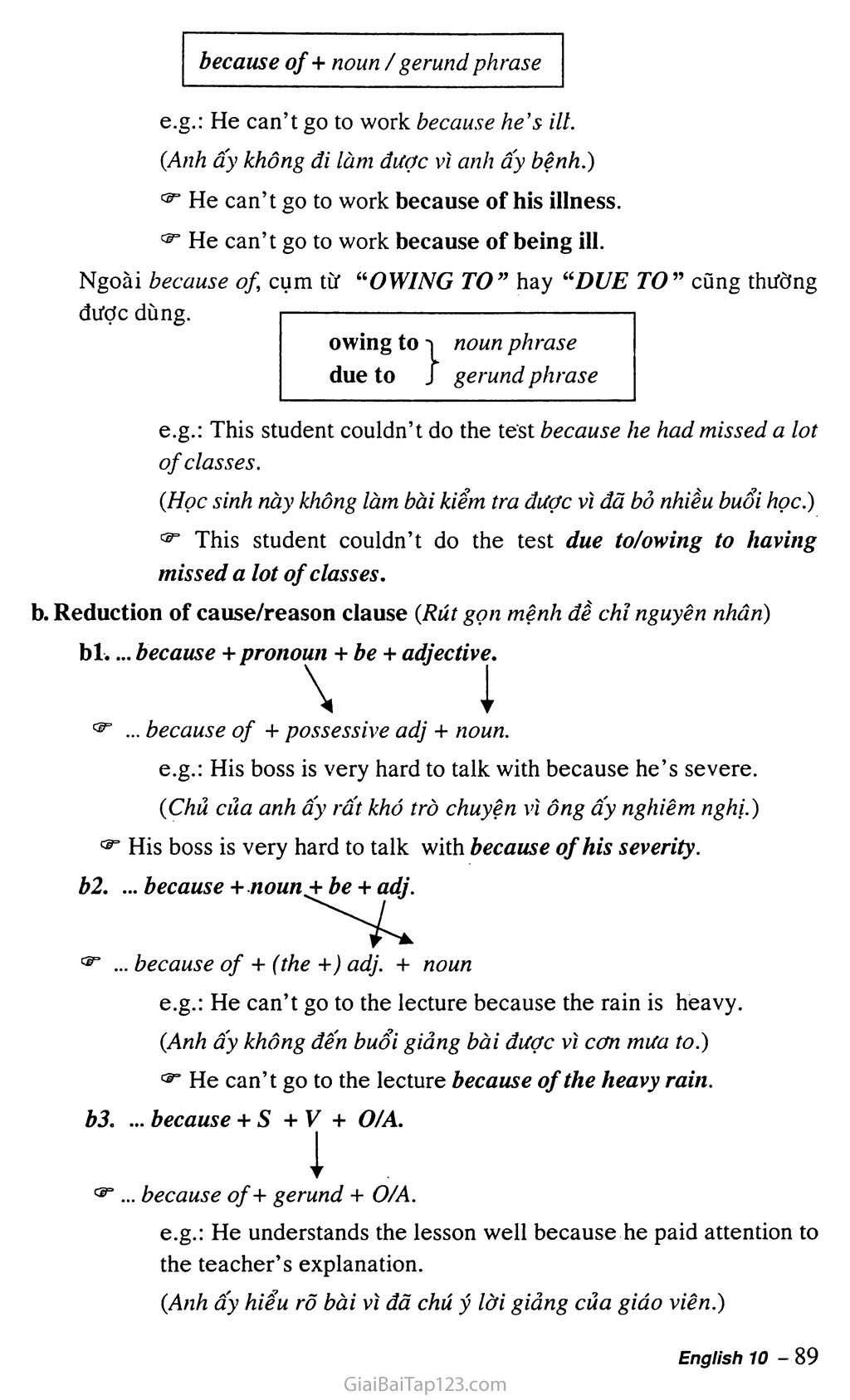
because of + noun / gerund phrase
e.g.: He can’t go to work because he’s ill.
(Anh ấy không đi làm được vì anh ấy bệnh.')
He can’t go to work because of his illness.
He can’t go to work because of being ill.
owing to 1
noun phrase
due to J
gerund phrase
Ngoài because of, cụm từ “OWING TO” hay “DUE TO” cũng thường được dùng.
e.g.: This student couldn’t do the test because he had missed a lot of classes.
{Học sinh này không làm bài kiểm tra được vì dã bỏ nhiều buổi học.) This student couldn’t do the test due to!owing to having
missed a lot of classes.
b. Reduction of cause/reason clause {Rút gọn mệnh đề chỉ nguyên nhân) bl.... because + pronoun + be + adjective.
... because of + possessive adj + noun.
e.g.: His boss is very hard to talk with because he’s severe. {Chủ của anh ấy rất khó trò chuyện vì ông ấy nghiêm nghị.)
His boss is very hard to talk with because of his severity. b2. ... because + noun + be + adj.
... because of + (the +,) adj. + noun
e.g.: He can’t go to the lecture because the rain is heavy.
(Anh ấy không đến buổi giảng bài được vì cơn mưa to.)
He can’t go to the lecture because of the heavy rain. b3. ... because + s + V + O/A.
\ I .
... because of+ gerund + O/A.
e.g.: He understands the lesson well because he paid attention to the teacher’s explanation.
(Anh ấy hiểu rõ bài vì đã chú ý lời giảng của giáo viên.)
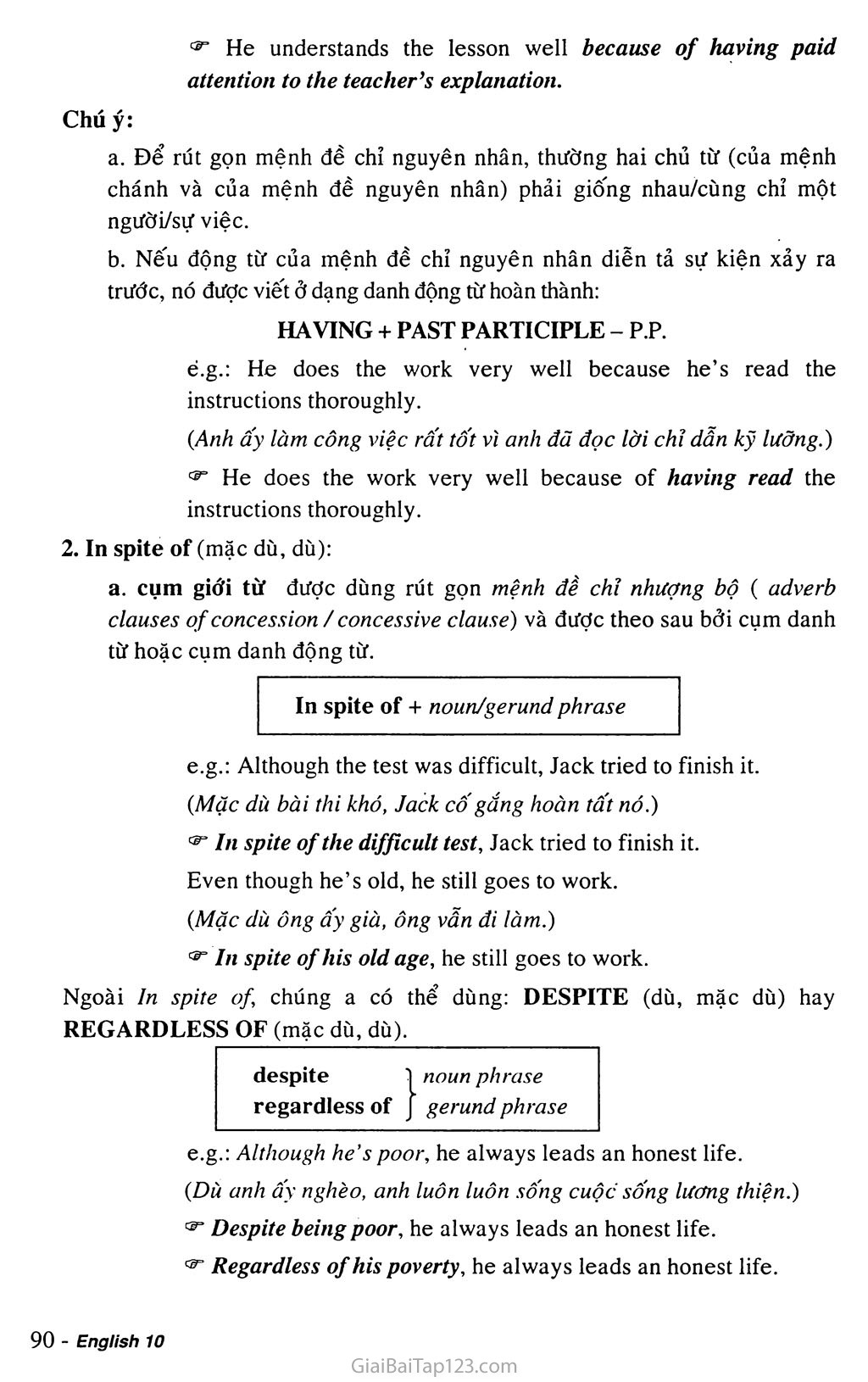
He understands the lesson well because of having paid attention to the teacher’s explanation.
Chú ý:
Để rút gọn mệnh đề chỉ nguyên nhân, thường hai chủ từ (của mệnh chánh và của mệnh đề nguyên nhân) phải giông nhau/cùng chỉ một người/sự việc.
Nếu động từ của mệnh đề chỉ nguyên nhân diễn tả sự kiện xảy ra trước, nó được viết ở dạng danh động từ hoàn thành:
HAVING + PAST PARTICIPLE - P.P.
é.g.: He does the work very well because he’s read the instructions thoroughly.
(Anh ấy làm công việc rất tốt vì anh đã đọc lời chỉ dẫn kỹ lưỡng.')
He does the work very well because of having read the instructions thoroughly.
2. In spite of (mặc dù, dù):
a. cụm giới từ được dùng rút gọn mệnh đề chỉ nhượng bộ ( adverb clauses of concession / concessive clause) và được theo sau bởi cụm danh từ hoặc cụm danh động từ.
In spite of + noun/gerund phrase
e.g.: Although the test was difficult, Jack tried to finish it.
(Mặc dù bài thi khó, Jack cố gắng hoàn tất nó.)
In spite of the difficult test, Jack tried to finish it.
Even though he’s old, he still goes to work.
(Mặc dù ông ấy già, ông vẫn đi làm.)
III spite of his old age, he still goes to work.
Ngoài In spite of, chúng a có thể dùng: DESPITE (dù, mặc dù) hay REGARDLESS OF (mặc dù, dù).
despite	1 noun phrase
regardless of j gerund phrase
e.g.: Although he’s poor, he always leads an honest life.
(Dù anh ấy nghèo, anh luôn luôn sống cuộc sống lương thiện.)
Despite being poor, he always leads an honest life.
Regardless of his poverty, he always leads an honest life.
b. Reduction of concessive clause (Rút gọn mệnh đề chỉ nhượng bộ): cách rút gọn mệnh đề chỉ nhượng bộ giống như mệnh đề chỉ nguyên nhân, nghĩa là chúng ta phải căn cứ vào câu trúc của mệnh đề chỉ nhượng bộ hay nguyên nhân.
III. SOLUTIONS and TRANSLATIONS (Lời giải và Bài dịch)
A. READING (Đọc)
BEFORE YOU READ (Trước khi em đọc)
Work with a partner. Ask and answer the following questions. (Làm việc với một bạn cùng học. Hỏi và trả lời các câu hỏi sau.)
often watch TV after dinner.
Besides the channels of national TV stations and HCM City TV channels, nearly every province has its own television station..
usually watch TV about four hours per week.
WHILE YOU READ (Trong khi em đọc)
Look at some popular programmes, and then do the tasks that follow. (Nhìn vào vài chương trình phổ biến, và sau đó làm bùi tập theo sau.)
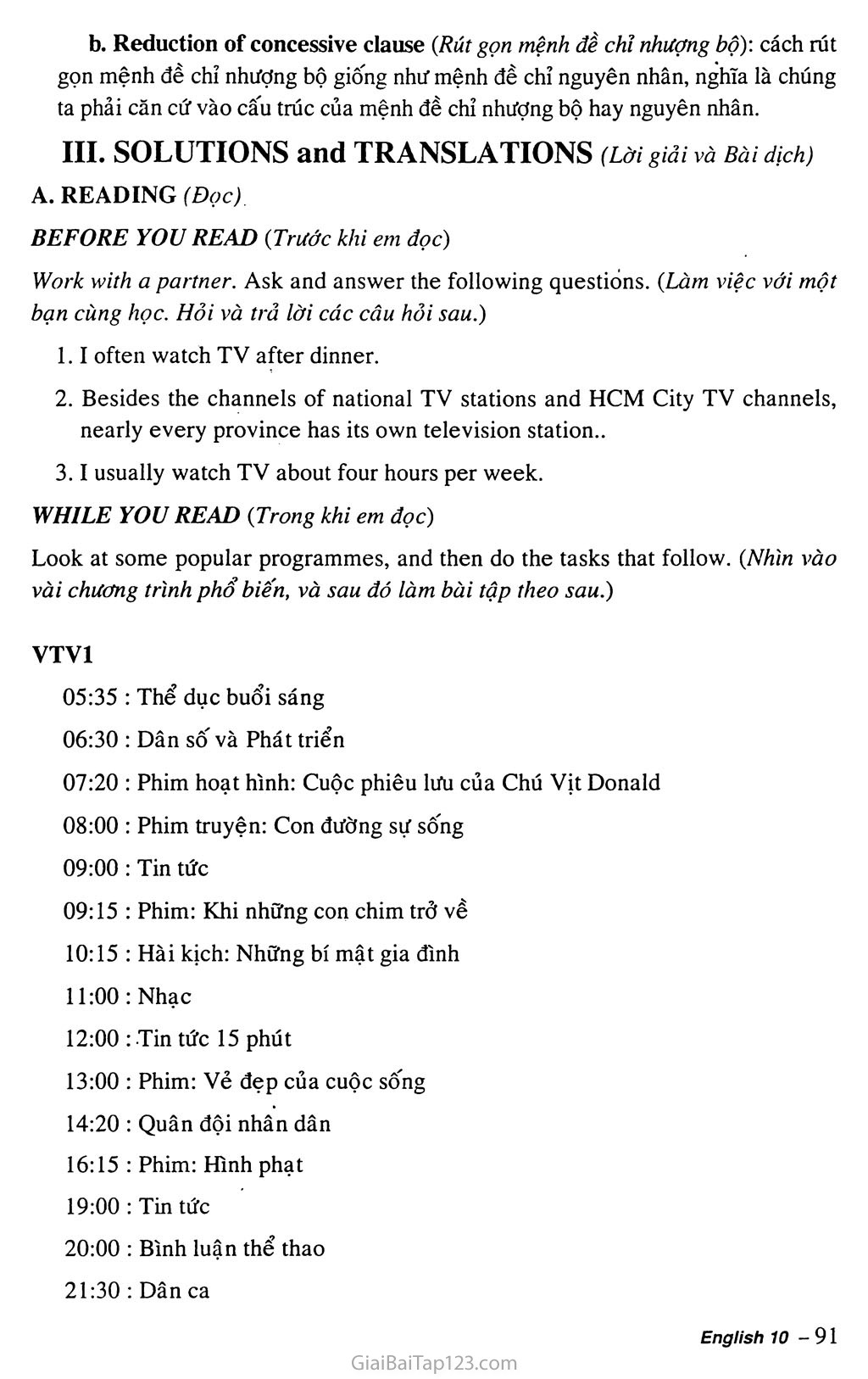
VTV1
05:35 : Thể dục buổi sáng
06:30 : Dân số và Phát triển
07:20 : Phim hoạt hình: Cuộc phiêu lưu của Chú Vịt Donald
08:00 : Phim truyện: Con đường sự sống
09:00 : Tin tức
09:15 : Phim: Khi những con chim trở về
10:15 : Hài kịch: Những bí mật gia đình
11:00 : Nhạc
12:00 : Tin tức 15 phút
13:00 : Phim: vẻ đẹp của cuộc sông
14:20 : Quân đội nhân dân
16:15 : Phim: Hình phạt
19:00 : Tin tức
20:00 : Bình luận thể thao
21:30 : Dân ca
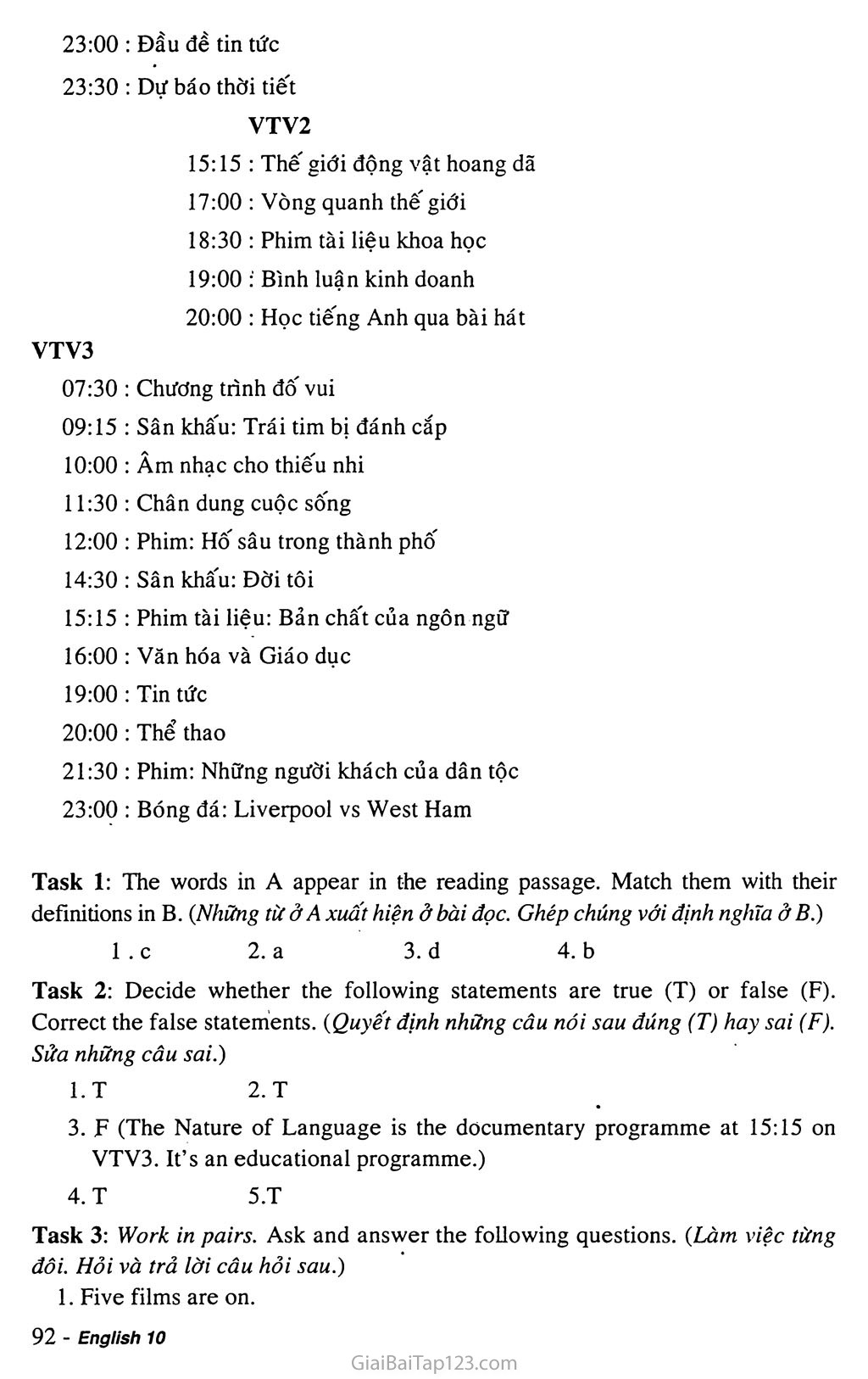
23:00 : Đầu đề tin tức 23:30 : Dự báo thời tiết
VTV2
15:15 : Thế giới động vật hoang dã 17:00 : Vòng quanh thế giới 18:30 : Phim tài liệu khoa học 19:00 : Bình luận kinh doanh 20:00 : Học tiếng Anh qua bài hát
VTV3
07:30 : Chương trình đố vui
09:15 : Sân khấu: Trái tim bị đánh cắp
10:00 : Âm nhạc cho thiếu nhi
11:30 : Chân dung cuộc sông
12:00 : Phim: Hô" sâu trong thành phố
14:30 : Sân khâu: Đời tôi
15:15 : Phim tài liệu: Bản chất của ngôn ngữ
16:00 : Văn hóa và Giáo dục
19:00 : Tin tức
20:00 : Thể thao
21:30 : Phim: Những người khách của dân tộc 23:00 : Bóng đá: Liverpool vs West Ham
Task 1: The words in A appear in the reading passage. Match them with their definitions in B. {Những từ Ở A xuất hiện ở bài đọc. Ghép chúng với định nghĩa ở B.)
Task 3: Work in pairs. Ask and answer the following questions. {Làm việc từng đôi. Hỏi và trả lời câu hỏi sau.)
Five films are on.
can watch the news at 9:00, 12:00 noon; 19:00 and 23:00 on VTV1 and at 19:00 on VTV3.
VTV2
The programme on VTV3 at 7:30 is the “Quiz Show”.
You should watch VTV1 at 21:30.
The last programme on VTV3 is the “Football”
AFTER YOU READ {Sau khi em đọc)
Work in pairs. Tell your partner about one of the TV programs you like watching best and explain why. {Làm việc từng đôi. Hãy kể cho bạn cùng học với em về một trong những chương trình truyền hình em thích xem nhất và giải thích tại sao.)
I like watching the programmes such as the “Wildlife World” and “Culture and Education” best, because these programmes provide me with the knowledge of the life of wild animals and of the matters of various cultures and of education in our country and around the world. Thanks to these, I can broaden the horizon of my'knowledge .
B. SPEAKING (Với)
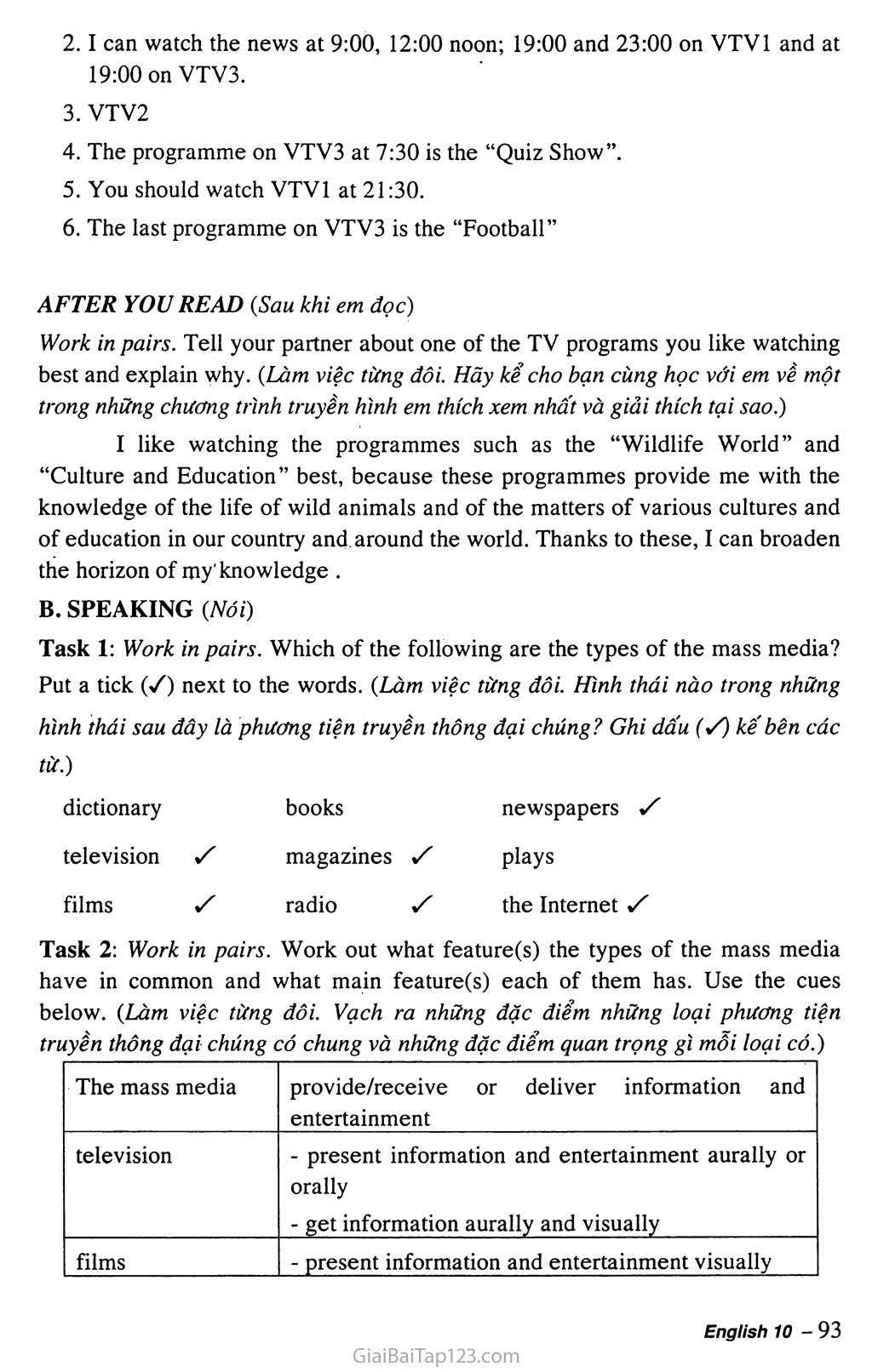
Task 1: Work in pairs. Which of the following are the types of the mass media? Put a tick (Z) next to the words. {Làm việc từng đôi. Hình thái nào trong những hình thái sau đây là phương tiện truyền thông đại chúng? Ghi dấu (z9 kế bên các từ.)
dictionary	books	newspapers s
television	z magazines z plays
films	■/ radio	■/ the Internet ■/
Task 2: Work in pairs. Work out what feature(s) the types of the mass media have in common and what main feature(s) each of them has. Use the cues below. {Làm việc từng đôi. Vạch ra những đặc điểm những loại phương tiện truyền thông đại chúng có chung và những đặc điểm quan trọng gì mỗi loại có.)
The mass media
provide/receive or deliver information and entertainment
television
present information and entertainment aurally or orally
get information aurally and visually
films
- present information and entertainment visually
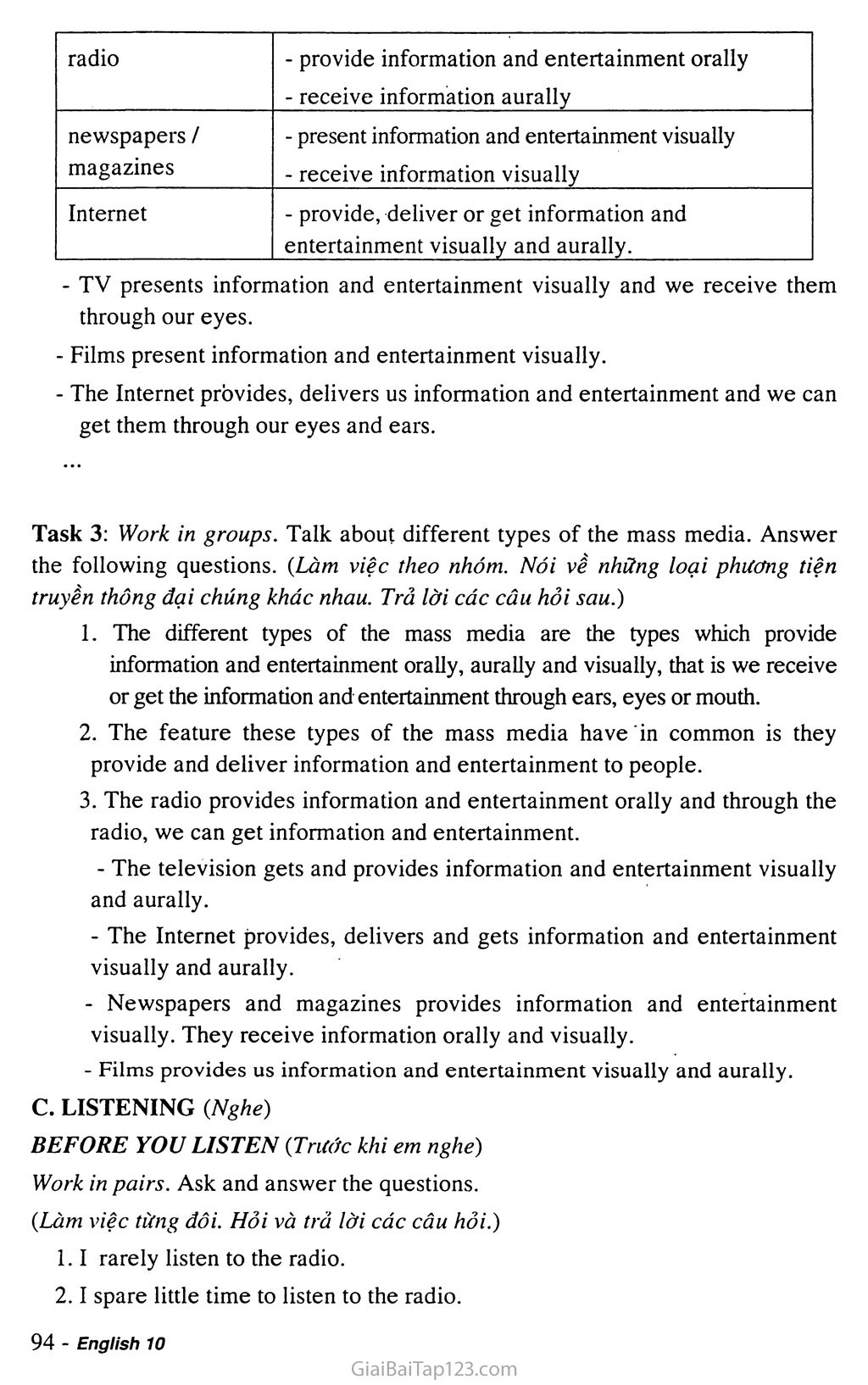
radio
provide information and entertainment orally
receive information aurally
newspapers / magazines
present information and entertainment visually
receive information visually
Internet
- provide, deliver or get information and entertainment visually and aurally.
- TV presents information and entertainment visually and we receive them through our eyes.
Films present information and entertainment visually.
The Internet provides, delivers US information and entertainment and we can
get them through our eyes and ears.
Task 3: Work in groups. Talk about different types of the mass media. Answer the following questions. (Làm việc theo nhóm. Nói về những loại phương tiện truyền thông đại chúng khác nhau. Trả lời các câu hỏi sau.)
The different types of the mass media are the types which provide information and entertainment orally, aurally and visually, that is we receive or get the information and entertainment through ears, eyes or mouth.
The feature these types of the mass media have in common is they provide and deliver information and entertainment to people.
The radio provides information and entertainment orally and through the radio, we can get information and entertainment.
The television gets and provides information and entertainment visually and aurally.
The Internet provides, delivers and gets information and entertainment visually and aurally.
Newspapers and magazines provides information and entertainment visually. They receive information orally and visually.
Films provides US information and entertainment visually and aurally, c. LISTENING (Nghe)
BEFORE YOU LISTEN (Trước khi em nghe)
Work in pairs. Ask and answer the questions.
(Làm việc từng đôi. Hỏi và trả lời các câu hởi.)
rarely listen to the radio.
spare little time to listen to the radio.
3. I rarely listen to the news and leaming-English programmes in foreign languages on the radio, because almost all pieces of news have already been broadcast on TV. Morever, the news on TV are the latest and more interesting because they are broadcast with pictures.
WHILE YOU LISTEN (Trong khi em nghe)
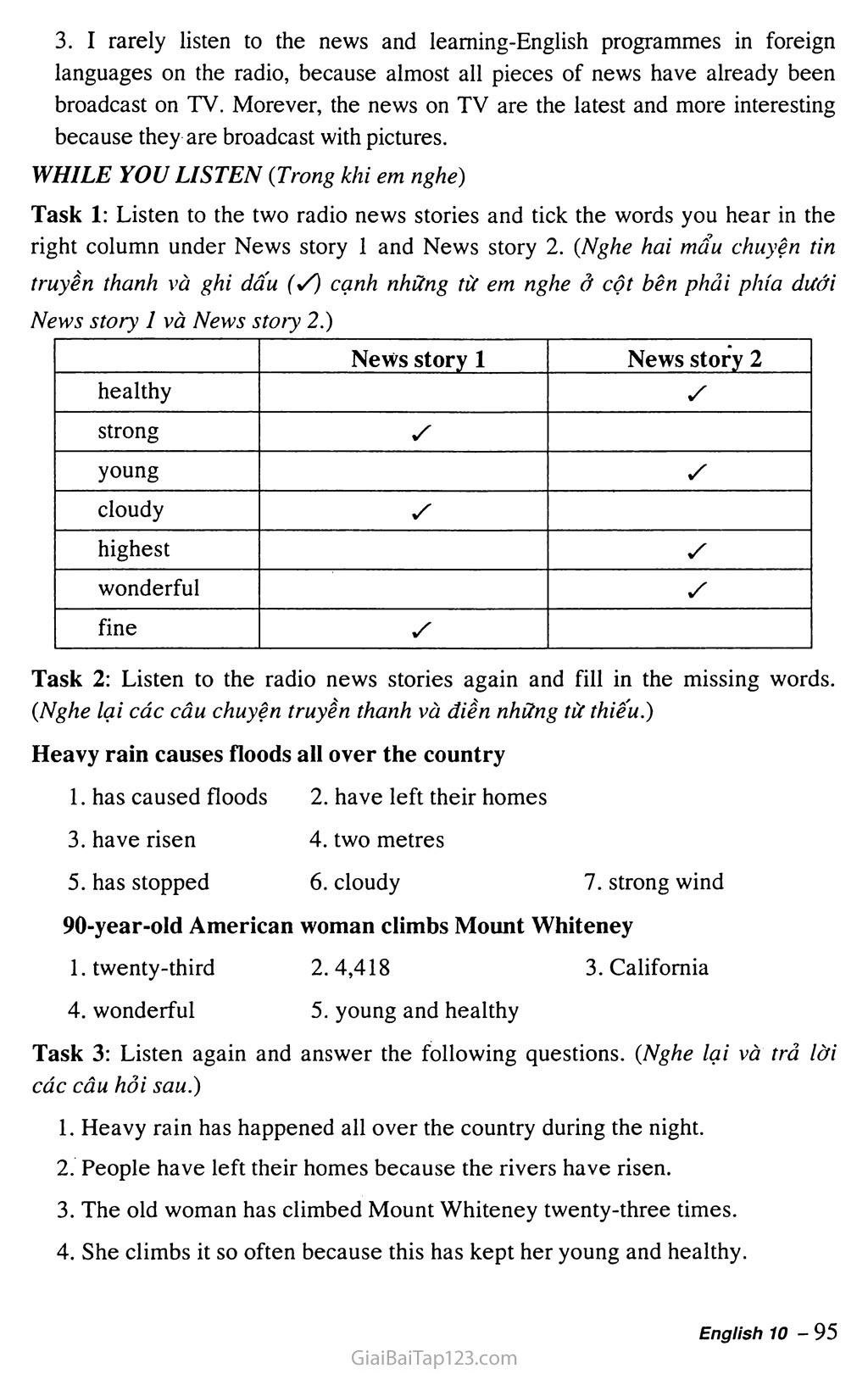
Task 1: Listen to the two radio news stories and tick the words you hear in the right column under News story 1 and News story 2. (Nghe hai mẩu chuyện tin truyền thanh và ghi dấu (■/) cạnh những từ em nghe ở cột bên phải phía dưới News story 1 và News story 2.)
News story 1
News story 2
healthy
z
strong
z
young
z
cloudy
z
highest
z
wonderful
z
fine
z
Task 2: Listen to the radio news stories again and fill in the missing words. (Nghe lại các câu chuyện truyền thanh và điền những từ thiếu.)
Heavy rain causes floods all over the country
1. has caused floods
2. have left their homes
3. have risen
4. two metres
5. has stopped
6. cloudy
7. strong wind
90-year-old American woman climbs Mount Whiteney
1. twenty-third
2.4,418
3. California
4. wonderful
5. young and healthy
Task 3: Listen again and answer the following questions. (Nghe lại và trả lời các câu hỏi sau.)
Heavy rain has happened all over the country during the night.
People have left their homes because the rivers have risen.
The old woman has climbed Mount Whiteney twenty-three times.
She climbs it so often because this has kept her young and healthy.
TAPESCRIPT
The time is 7 o’clock and here is the news summary.
Heavy rain during the night has caused floods all over the country today. Many people have left their homes because rivers have risen. Some roads in the north-west are under two metres of water. The rain has stopped at the moment, but it’s still cloudy and there’s a strong wind. Because of the bad weather, people can't go out to work.
A ninety-year-old woman has climbed Mount Whitney in California for the twenty-third times. At 4,418 metres, Mount Whitney is the highest mountain in California, The woman says the view from the top is wonderful. She also says that the mountain has kept her young and healthy. In spite of her old age, the woman tries to climb the mountain very often.
Í
AFTER YOU LISTEN (Sau khi em nghe)
Work in groups. Choose one of the news stories and tell your classmates about it. {Làm việc từng nhóm. Chọn một trong những câu chuyện tin tức và kể cho các bạn cùng lớp.)
A ninety-year-old woman has climbed the highest mountain in California, Mount Whitney, for the twenty-thừd times. She says that the view from the top is wonderful and that she tries to climb it very often despite her old age because the mountain has kept her young and healthy.
D. WRITING (Viết)
Writing about advantages ans disadvantages of television. (Viết về những lợi ích và bất lợi của trứyền hình).
Task 1: Read about the advantages and disadvantages of television below. (Đọc những lợi ích và bất lợi của truyền hình dưới dây.)
Lợi ích của truyền hình
Bất lợi của truyền hình
Truyền hình giúp chúng ta học biết nhiều hơn về thế giới và thấy nhiều điều mới.
Truyền hình có thể làm cho các sự việc có thể nhớ được vì nó trình bày thông tin với phương cách hữu hiệu.
Nó giúp chúng ta giải trí. Xem truyền hình là cách thư giãn thú vị.
Truyền hình có thể làm chúng ta thụ động. Chúng ta không phải suy nghĩ, do đó não chúng ta trở nên lười biếng.
Nó khích lệ chúng ta mua những vật chúng ta không cần.
Nó cướp đi thời gian của những hoạt động khác như đọc sách và trò chơi.
Nó phát triển tính phổ biến của thể thao và trò chơi.
Nó làm cho chúng ta ý thức được trách nhiệm toàn cầu của chúng ta.
Một số chương trình truyền hình có thể làm cho người ta trở nên bạo lực.
Truyền hình can thiệp vào đời sông gia đình và giao tiếp.
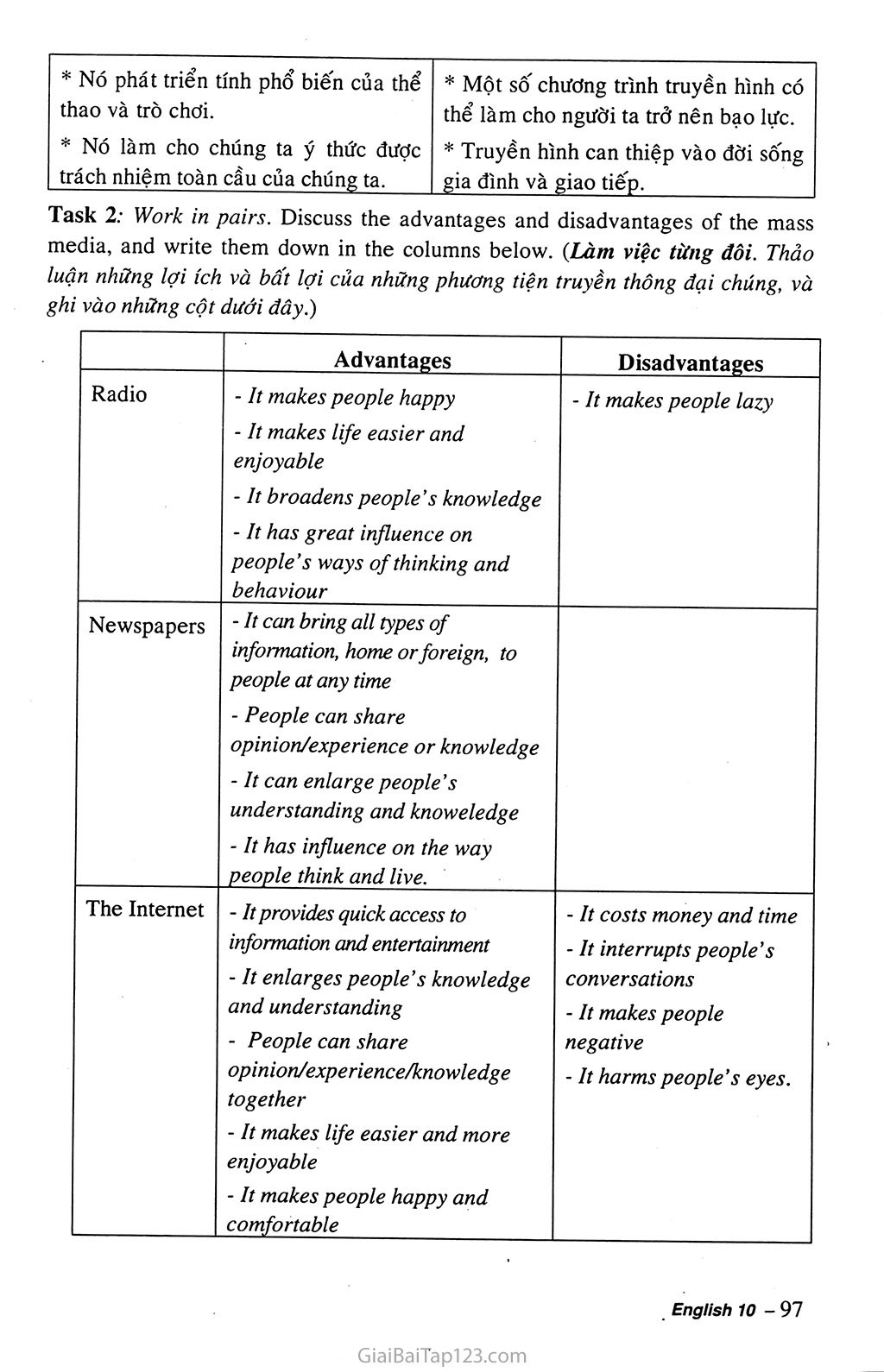
Task 2: Work in pairs. Discuss the advantages and disadvantages of the mass media, and write them down in the columns below. {Làm việc từng đôi. Thảo luận những lợi ích và bất lợi của những phương tiện truyền thông đại chúng, và ghi vào những cột dưới đây.)
Advantages
Disadvantages
Radio
It makes people happy
It makes life easier and enjoyable
It broadens people’s knowledge
It has great influence on people’s ways of thinking and behaviour
- It makes people lazy
Newspapers
It can bring all types of information, home or foreign, to people at any time
People can share opinion/experience or knowledge
It can enlarge people’s understanding and knoweledge
It has influence on the way people think and live.
The Internet
It provides quick access to information and entertainment
It enlarges people’s knowledge and understanding
People can share opinion/experience/knowledge together
It makes life easier and more enjoyable
It makes people happy and comfortable
It costs money and time
It interrupts people’s conversations
It makes people negative
It harms people’s eyes.
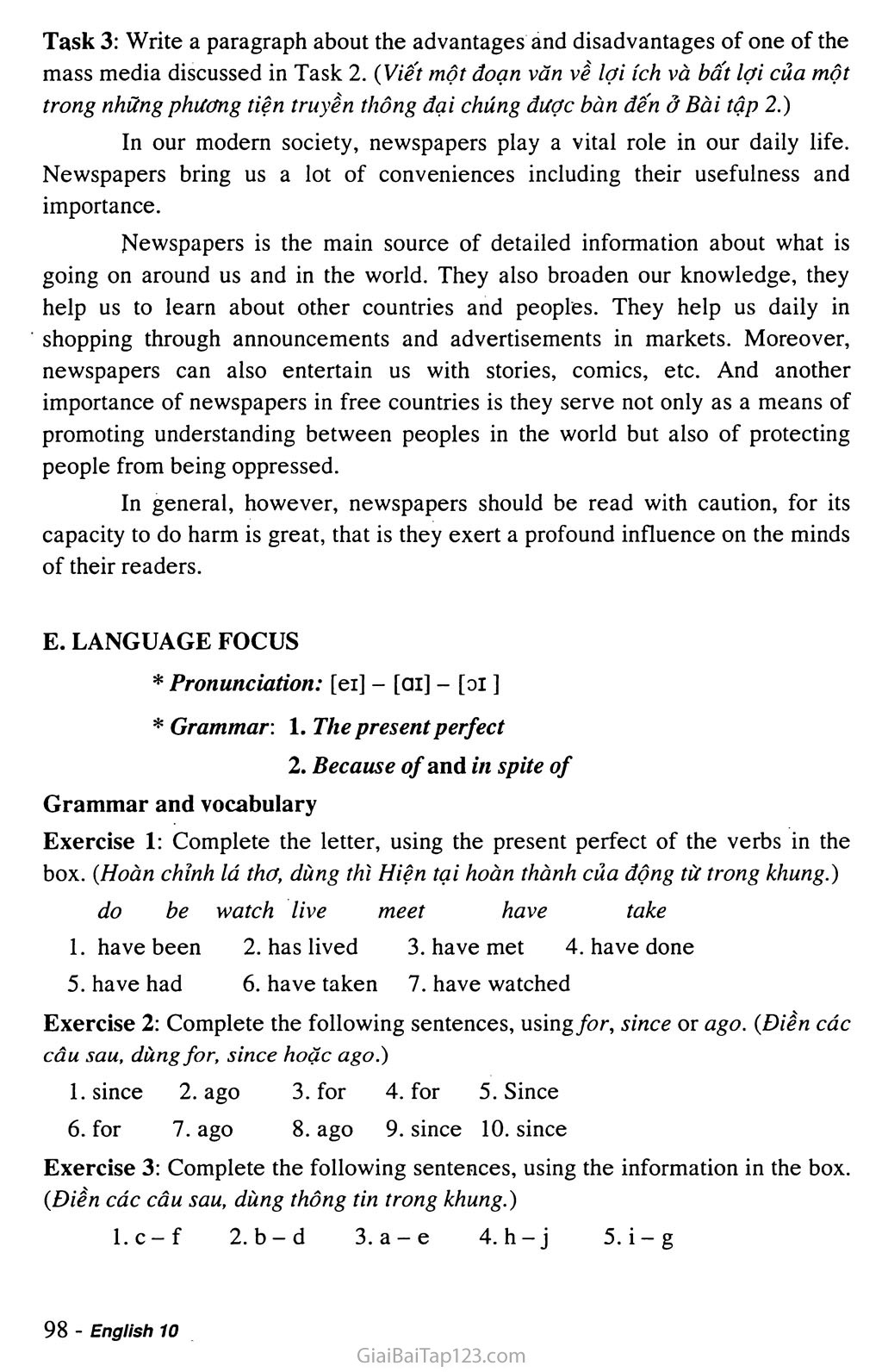
Task 3: Write a paragraph about the advantages and disadvantages of one of the mass media discussed in Task 2. (Viết một đoạn văn về lợi ích và bất lợi của một trong những phương tiện truyền thông đại chúng được bàn đến ở Bài tập 2.)
In our modern society, newspapers play a vital role in our daily life. Newspapers bring US a lot of conveniences including their usefulness and importance.
Newspapers is the main source of detailed information about what is going on around US and in the world. They also broaden our knowledge, they help us to learn about other countries and peoples. They help US daily in shopping through announcements and advertisements in markets. Moreover, newspapers can also entertain us with stories, comics, etc. And another importance of newspapers in free countries is they serve not only as a means of promoting understanding between peoples in the world but also of protecting people from being oppressed.
In general, however, newspapers should be read with caution, for its capacity to do harm is great, that is they exert a profound influence on the minds of their readers.
E. LANGUAGE FOCUS
Pronunciation: [ei] - [ai] - [oi ]
Grammar-. 1, The present perfect
Because of and in spite of Grammar and vocabulary
Exercise 1: Complete the letter, using the present perfect of the verbs in the box. (Hoàn chỉnh lá thơ, dùng thì Hiện tại hoàn thành của động từ trong khung.)
do be -watch live meet	have	take
1. have been	2. has lived	3. have met 4. have done
have had	6. have taken 7. have watched
Exercise 2: Complete the following sentences, using/ơr, since or ago. (Điền các câu sau, dùng for, since hoặc ago.)
1. since 2. ago 3. for 4. for 5. Since
for 7. ago 8. ago 9. since 10. since
Exercise 3: Complete the following sentences, using the information in the box. (Điền các câu sau, dùng thông tin trong khung.)
l.c—f 2. b - d 3.a-e	4.h-j	5.i-g